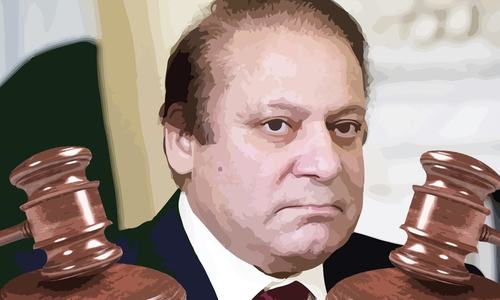
The historic Panama Papers verdict may have been short on immediate impact and pounced on by both sides to claim vindication, but it is relatively clear that Prime Minister Nawaz Sharif will still have to contend with an elevated degree of scrutiny.
That is only right. Through the agonising series of explanations offered by the Sharif family in court, it often appeared that more questions were being raised about the first family’s financial history than were being answered. Three out of five Supreme Court judges did not have enough evidence before them to oust Mr Sharif, but all the justices appear to have been troubled by the evasiveness or lack of clarity by a serving prime minister and his family. That creates a very real problem at the intersection of law and politics: Mr Sharif is legally entitled to continue in office, but arguably his mandate and political legitimacy have been significantly dented. The prime minister ought to give serious consideration to at least two options.
The first option: step aside temporarily while the investigation ordered by the SC is conducted. The PML-N automatically resists most demands of the PTI, but Imran Khan’s umpteenth demand for Mr Sharif to step aside has been buttressed by an SC judgement this time. When the Panama Papers first shook the political landscape in Pakistan last April, it was clear that a high-powered investigation was needed and that the first family would have to submit itself to scrutiny ahead of all others implicated in the leaked documents. The very credibility of the democratic project was on the line. Now, a year later, two things have been established: neither has a credible investigation been conducted nor has the SC been able to penetrate the murkiness of the Sharif business empire. The former appears to have been stymied by political interference and the latter by the inherent limitations of a court as a financial investigatory body. If the prime minister temporarily steps aside, the likelihood of a fair and impartial investigation will surely increase significantly.
In the brutal world of politics, a damaged Prime Minister Sharif may be loath to give his arch rival, Imran Khan, anything resembling a victory, especially now that the SC itself has declined to act immediately against Mr Sharif. In that case, the prime minister has a second option: dissolve parliament, hand over power to a caretaker government and have the ECP hold a general election at the earliest. A fresh mandate from the people may be the only way for Mr Sharif to claim that he still has both political and legal legitimacy — a dual legitimacy that all elected representatives must seek. And if the PML-N loses, the people will have spoken, withdrawing the mandate they gave Mr Sharif and his party four years ago. The time for courageous decision-making is now.
Published in Dawn, April 22nd, 2017