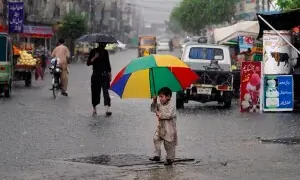
THE irregular pattern of snowfall in Murree and the wider Galiyat area is yet another sign that, slowly and perhaps irreversibly, our climate is changing. This is the first time in 39 years that snow has fallen in this area in the month of April; March also saw unusually warm temperatures followed by heavy snowfall. Add to this the fact that the region saw its hottest summer on record in 2016, and we have a picture of very odd climate patterns battering the hills. Pakistan is one of the countries most vulnerable to climate change as it depends heavily on river flows that originate from mountain snowfall. Each monsoon season has been bringing with it unusual rainfall, and now winters and spring are also beginning to see bizarre weather patterns emerge. As an agrarian country, there are grounds to be extremely concerned about the impact this situation will have on cropping cycles and patterns.
That concern needs to be felt at the highest levels of government. At the moment, the climate change ministry is mostly involved in public relations work. It should take the challenge more seriously; it needs to lead the effort to improve weather monitoring and the forecasting capabilities of the Met department, as well as coordinate with the provincial governments to develop and disseminate adaptive strategies for farmers. Hardly any research has been done in the country to look at what adaptive strategies might be available — such as new seed varieties that are more resistant to changing weather patterns. Far more also needs to be done to generate flood alerts and response plans, for which coordination with the local authorities is crucial. Pakistan is flying blind into a possible storm without making efforts along these lines. All manner of help is available from the international community, but thus far, nobody from the government, not even the climate change ministry, seems particularly interested beyond attending a few regional seminars. The ministry’s website shows only two books and two monographs published over a decade ago as its research output. Of the nine projects listed there, more than half were also from a decade ago. Signs of climate change are all around us now, sometimes coming in benign forms like a spring snowfall, and at other times as massive cloudbursts that cause floods and glacial lake outbursts. But each time our response is to muddle through and revert to business as usual once the skies clear.
Published in Dawn, April 9th, 2017