172
172

Amid increasing tensions on the western border between Afghanistan and Pakistan, former Afghan president Hamid Karzai in a tweet on Sunday said Pakistan has "no legal authority to dictate terms on the Durand Line".
Karzai's comment followed Pakistan's decision to close the border between the two states for an indefinite period on February 16 after a recent surge in terrorist attacks across the country.
The border closure has strained Pak-Afghan relations.
Read more: Durand Line status
"While we wish freedom for the people of [the Federally Administered Tribal Areas [Fata] from Frontier Crime Regulation [FCR] and other repressive measures, we remind the Government of Pakistan that Afghanistan hasn't and will not recognize the Durand line," Karzai added in his tweet.
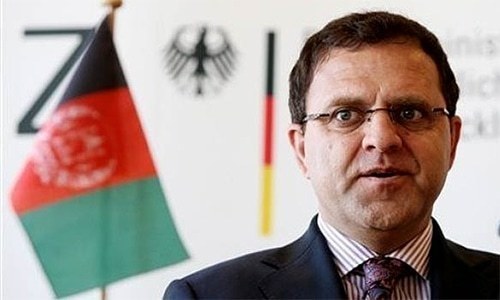
Karzai seemed to echo the sentiment of many of his country's officials, such as Ambassador Omar Zakhilwalal, who in a Facebook post on Saturday said Pakistan does not have a valid reason for the continued closure of crossing points on the Pak-Afghan border.
Zakhilwal said the argument presented by Pakistan — that the border closure is intended to stop terrorists from crossing over — does not carry any weight, as “these points such as Torkham and Spin Boldak have been manned by hundreds of military and other security personnel” and have all the necessary equipment and infrastructure in place to prevent such a possibility.
Also read: Durand Line is recognised border: US
"Continuous unreasonable closure of legal Pak-Afghan trade and transit routes cannot have any other explanation except to be aimed at hurting the common Afghan people," the envoy said in his social media post, apparently in breach of diplomatic protocol.
The Durand Line is the a 2640-kilometre-long border between Afghanistan and Pakistan, established in 1893 following an agreement between Sir Mortimer Durand, a representative of British India, and Abdur Rahman Khan, the Amir of Afghanistan.
Afghan national security advisor to meet Indian counterpart
Afghanistan's national security adviser, Mohammad Haneef Atmar, left for India on Sunday for a three-day-long trip to attend the 19th Asian Security Conference.
The conference, titled 'Combating Terrorism: Evolving an Asian Response', is being held in New Delhi, a press released issued by the Afghanistan Office of National Security Council stated.
Apart from being the keynote speaker at the event, he will also have bilateral meetings with several Indian security and political officials, such as his Indian counterpart, Ajit Kumar Doval, the national security adviser to the prime minister of India.
Atmar will "discuss counter-terrorism measures" as well as strategies to expand "political and security ties between two countries", the statement added.
The conference, organised by India's Institute of Defense Studies and Analyses (IDSA), begins on March 6 and concludes March 8.