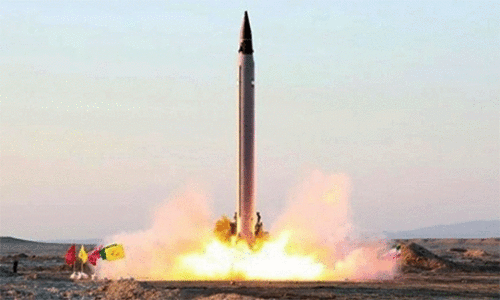
TEHRAN: Iran confirmed on Wednesday that it had tested a ballistic missile, but denied that was a breach of its 2015 nuclear deal with world powers.
The comments from Defence Minister Hossein Dehghan came after the UN Security Council met on Tuesday to discuss the weekend test, which Washington described as “absolutely unacceptable”.
“The action was in line with boosting Iran’s defence power and is not in contradiction with the JCPOA [the nuclear deal] or Resolution 2231,” Dehghan said.
He was referring to a UN Security Council resolution that bans Iran from developing missiles that can carry nuclear warheads.
“This test was in line with our ongoing programmes,” Iranian media quoted him as saying. “We have previously announced that we will execute the programmes we have planned in production of defence equipment meant for our national interests and objectives ... We will not allow foreigners to interfere in our defence affairs.”
Iran’s ballistic missile programme has been a bone of contention with the West since the nuclear deal took effect in January last year, triggering the lifting of international sanctions.
Iran says its missiles do not breach United Nations resolutions because they are for defence purposes only and are not designed to carry nuclear warheads.
It has missiles with a range of up to 2,000 kilometres, sufficient to reach Israel as well as US bases in the region.
US ambassador Nikki Haley told Tuesday’s Security Council meeting that Washington would not stand idly by while Tehran pursued its missile programme. “The United States is not naive. We are not going to stand by. You will see us call them out,” she said.
Tehran warned Washington against using the issue to fuel tensions. “We hope that Iran’s defence programme is not used by the new US administration ... as a pretext to create new tensions,” Foreign Minister Mohammad Javad Zarif said ahead of the meeting.
The row comes against a backdrop of already strained relations between Washington and Tehran over US President Donald Trump’s travel ban on citizens from Iran and six other Muslim-majority countries.
Some 220 Iranian lawmakers signed a motion on Wednesday endorsing the boosting of Iran’s defence capabilities, the Fars news agency reported.
“The Islamic Republic of Iran’s only way to deter the enemy’s aggression is its missile power,” the motion said, calling the programme “an unavoidable necessity” for protecting national security.
The European Union, which helped broker the nuclear deal, had appealed to Tehran to refrain from activities such as the missile tests, “which deepen mistrust”.
But Moscow, which is fighting alongside Tehran’s forces in Syria, leapt to its ally’s defence. Deputy Foreign Minister Sergei Ryabkov said Iran’s missile test did not breach Resolution 2231 and accused Washington of “heating up the situation”.
Published in Dawn February 2nd, 2017