Unusual jellyfish blooms affecting fishing
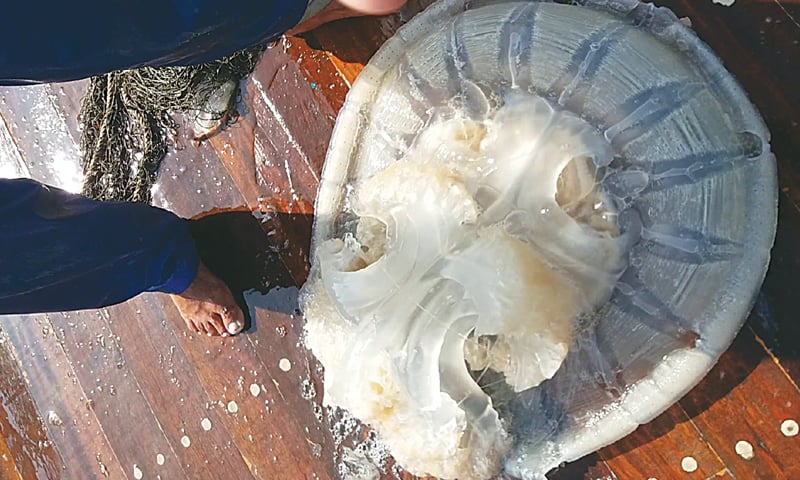


KARACHI: Unprecedented jellyfish blooms in the offshore waters of Pakistan are affecting fishing activities, the World Wide Fund for Nature-Pakistan (WWF-P) said on Monday.
According to its officials, over the last two weeks, blooms caused by mauve stinger, scientifically known as Pelagia noctiluca, have been observed by fishermen in the continental shelf along the Sindh and Balochistan coasts.
“Large aggregations of this stinging jellyfish have been reported in the offshore waters of Karachi to Swatch Area at the mouth of the River Indus (around 140km south of Karachi) and Ormara along Sindh and Balochistan coast,” said adviser on marine fisheries at the WWF-P Mohammad Moazzam Khan.
Information gathered by his organisation has revealed a population of more than 150 individuals per cubic meter which is clogging fishermen’s nets.
“Its eight tentacles are loaded with stinging cells. Within these cells are harpoon-like structures full of venom, which shoot out when triggered by touch and can penetrate human skin,” he explained.
According to him, Pelagia noctiluca is well-known for beautiful luminescence and glitters at night when disturbed or moved by wave action.
“Luminescence in sea has been reported by fishermen over the last two weeks. Due to the high density of this jellyfish, fishing activities are being affected resulting in clogging of the nets,” he said, adding that handling or removing of jellyfish from nets could inflict severe pain due to its sting.
“Once affected, the pain lasts for more than 24 hours and results in skin inflammation. Fishermen involved in gillnetting and other fishing operations have decided to move to areas like Sonmiani Bay and adjacent waters. Sudden decrease in the catch of some prime fish has been attributed to the jellyfish bloom,” he said.
There was a need for research to assess whether jellyfish blooms were a function of natural cycles, or the result of human impact on environment, he noted.
Published in Dawn, December 27th, 2016