1
1

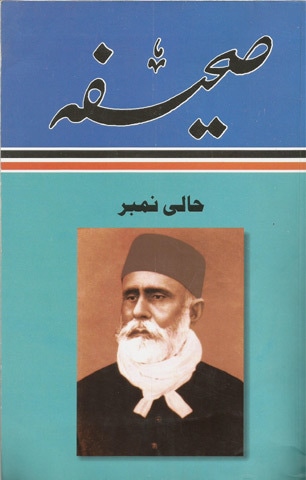
ALTAF Hussain Hali, dubbed as one of the ‘anaasir-i-khamsa’ or ‘the five elements of Urdu literature’ by Mehdi Ifadi (1870-1921), was among the five most significant authors who influenced Urdu literature in the latter half of the 19th century — the other four being Sir Syed Ahmed Khan, Nazeer Ahmed, Muhammad Hussain Azad and Shibli Nomani.
Hali’s legacy includes a number of things: his Muqaddama-i-shaer-o-shaeri (1896) is Urdu’s first modern treatise on criticism, showing the way to the modern critics of Urdu. Hali was one of the pioneers of modern Urdu ‘nazm’ (poem) along with Muhammad Hussain Azad, who, under the aegis of Anjuman-i-Punjab, began Urdu mushaeras where only nazms (and no ghazals) were recited. Hali’s approach to contemporary issues was modernistic and he was much inspired and influenced by Sir Syed Ahmed Khan and his views.
In 2014, to commemorate Shibli and Hali’s centenary, a number of programmes were organised in India and Pakistan. Literary magazines published special issues. But some trailed behind. So the special issues on Hali are still coming up. For example Saheefa, the literary journal published by Lahore’s Majlis-i-Tarqqi-i-Adab, first launched a thick special issue on Shibli. They naturally had to go for another special issue to pay homage to Hali. But publishing bulky special issues that meet a certain standard is not easy. So they took a little time but finally came up with a voluminous issue on Hali a few months ago. And the articles included prove that the wait was worth it.
Saheefa’s Hali Number (as special issues of Urdu literary journals are usually named) offers some rare articles retrieved from old publications. Among them, is one by Hali himself, giving a brief account of his own life, first published in the May 1927 issue of Maarif, Azamgarh. Hali died in 1914 and the piece was discovered among Nawab Imad-ul-Mulk Bilgirami’s papers, notes and documents found after his death. Perhaps Hali had written and sent his brief autobiography on Nawab Sahib’s request but it remained unpublished for unknown reasons. In this piece Hali confirmed that he was born in 1837 in Panipat.
Other important and rare pieces on Hali reproduced in the issue include the ones by Shibli Nomani, Sir Ross Masood, Hamid Hasan Qadri, Abul Kalam Azad, Moulvi Abdul Haq, Abdur Rahman Bijnori, Faiz Ahmed Faiz, Syed Abduallh, Hafiz Mahmood Sherani, Shiekh Abdul Qadir, Abdul Majid Daryabadi, Shiekh Muhammad Ikram, Mumtaz Hasan and many others. One wishes that Tehseen Firaqi and Afzal Haq Qarshi, the editors, would have included Muhammad Hasan Asakri’s views on Hali and especially Hali’s naat. Askari was much critical of Hali and his naat for Hali stressed, among other things, the “worldly” qualities of Prophet Muhammad (PBUH) and tried to avoid talking about the “spiritual” aspects of Islam and the Prophet of Islam, emphasising the general moral qualities instead. Askari thought it was influence of the West that prompted Hali to do so as the modernistic point of view and not the religious one fitted into his scheme of things.
Bazyaft, the research journal published by Punjab University’s Oriental College, has come up with a special issue on Hali, though it has taken a little longer than it usually takes, the valuable contents justify the belatedness. Punjab University Oriental College had organised a Shibli and Hali seminar and the papers read out on the occasion as well as some other papers especially written are included in the special issue, informs Dr Muhammad Kamran, the chief editor and the head of Urdu department, in his editorial. An important paper is by Dr Tabassum Kashmiri, giving the details of Hali’ stay in Lahore. Hali stayed in Lahore from 1870 to 1875. He had joined Aitchison College and Punjab Government Book Depot. At the depot, his job was correcting the texts translated from English into Urdu. According to Hali’s own account, it was during this period in Lahore that he realised the importance of the English language and its literature and it was there that the value of eastern and especially Persian literature in his eyes began to wane. According to Dr Kashmiri it was Halis’ stay in Lahore that played a vital role in transforming his views on literature and that ultimately changed Urdu literature’s general thinking about certain aspects as Hali’s stay in Lahore had culminated in writing of Muqaddama, which is often denounced by some for criticising our traditional ghazal and qaseeda poetry. Other articles included in the journal highlight Halis’ life, his thought, his works and his revolutionary approach towards Urdu literature.
Altaf Hussain Hali died in Panipat on Dec 31, 1914.
Published in Dawn, December 26th, 2016