1
1


Once home to Kashmiri wood carvers, the trend for such wood art is declining in the city. Kashmiri wood art was loved by Rajas and Maharajas, and later on, by the British. After the partition, Kashmiri wood artists came to Rawalpindi city where they established their workshops.
These artists were popular for their walnut wood carved items including coffee tables, chairs, settees, sideboards, mirror frames, tables, lamp shades, bed sets, jewellery boxes and other items.
Kashmiri wood art can be recognised by its neat and simple designs, and the old patterns are still popular with some people. Most Kashmiri furniture have roses, leaves of the chinaar tree, sumbal or lotus carved on them.
There were four walnut wood carving and handicraft workshops in Chittian Hattian and only one of them is open now. The lack of walnut wood is the main reason why so many of these artisans have stopped making furniture.
The only workshop in the area is owned by 65-year-old Hamid Ali and Mohammad Javed.
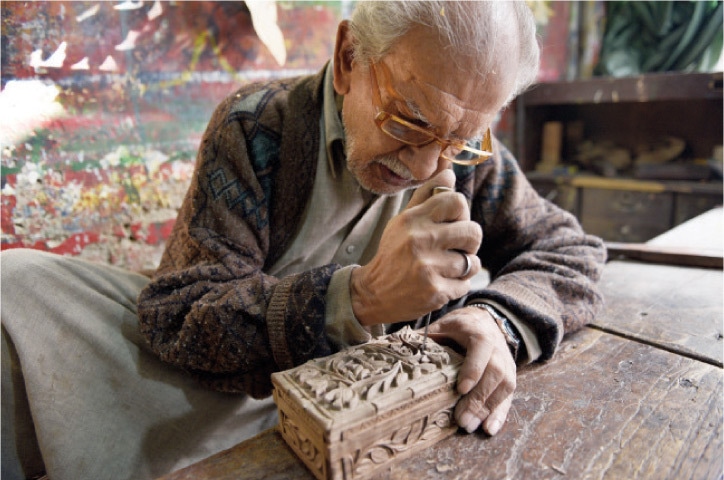
Hamid Ali came from Budgam, Kashmir in 1963, where he had learnt to make simple art pieces from wood.
“I learnt my trade from Ghulam Ahmed Shah of Srinagar and he was against Dogra Raj and the Indian occupation of Kashmir so he moved to Pakistan and settled in Rawalpindi. He opened a workshop in Chittian Hattian, where I learnt the art of making Kashmiri wood art and furniture along with Javed and other Kashmiris. He gave us a skill to make money with,” he said.

Walnut wood is very expensive and costs Rs3,000 per square wood, he said, adding the art pieces turn out finer if they are carved out of Walnut wood. Also, he said, Walnut wood does not get infested with insects and the furniture is good to use for centuries.
Asked about the dying trend for the art, he said that the younger generation did not want to pursue a career is wood carving as it takes a lot of time to finish a piece and earns little money.

“I finished making a coffee table in a week and I will not be able to sell it for a lot,” he said, adding that even his two sons had chosen other professions.
“But I am still running this workshop because I want this art to live,” he said. His colleague, 55-year-old Mohammad Javed who also learnt the art from Ghulam Ali Shah, said the process of carving Walnut wood is lengthy.
“The trunk of a Walnut tree is first cut into small pieces and carved into various shapes such as floral motifs, birds, animals and geometric patterns which are then fixed onto furniture made from the same wood,” he explained.
Taking out a piece of wood to carve a rose out of, Hamid Ali said wood carving required special equipment as well.

“A special iron, which is also used in car manufacturing, is also used in wood carving,” he said.
He said dry wood is used for carving wood and that a log of wood is first let to dry in the open for a couple of years before it is carved.
He said the government should help artists and give people an incentive to not leave the profession of making furniture.
Published in Dawn, December 18th, 2016