0
0

Based on the findings from a comparative review of the region and in-depth studies of countries covering Bangladesh, Cambodia, China, India, Indonesia and Sri Lanka, this volume highlights both diverse trends and commonalities in the challenges women face in gaining access to more and better jobs. The approach taken goes beyond the framework provided by the U-shaped hypothesis, which has dominated comparative analysis of female labour force participation across the world. Rather, the selection and the analysis of countries in this volume is built on a typology that consists of three sets of countries: low to middle-income and high female labour force participation (e.g. Cambodia); low to middle-income and low participation (South Asia apart from Nepal); and middle to high-income and middle participation (China and Indonesia). Drawing on these typologies, the book identifies the complex factors affecting women’s participation in the process of economic transformation, which include drivers and barriers impacting both demand and supply sides.
The three different groups of countries highlighted above not only indicate different paths for women’s labour force participation, but also indicate some common challenges. As evident in the labour markets of South Asia, social norms and lack of alternative job opportunities continue to constrain women from accessing jobs. One of the biggest puzzles of recent years is the decline in the labour force participation of women in India, especially in rural areas. Empirical analysis presented in this volume, which draws on both primary and secondary data, shows that this phenomenon is driven by various factors. Some dimensions, such as increased attendance in education and higher household income levels in India, are no doubt a positive reflection of rapid economic development. Additionally, changes in measurement methodology across survey rounds potentially contributed to the estimated decline in female participation due to the difficulty of differentiating between domestic duties and contributing family work. However, the key long run issue is the lack of employment opportunities for India’s women, owing to factors such as inadequate job creation in the vicinity where women live, and occupational segregation. Insights from the primary survey underscore the impact of reproductive roles, household and care responsibilities, cultural sanctions and patriarchal hierarchies on the degree to which women can work outside the home.
A number of factors make up the obstacles keeping women out of South Asian workplaces
In contrast to the predictions of the U-shaped relationship, there has been an increase in the female labour force participation in Bangladesh — a low-income country — alongside the acceleration in economic growth since the 1990s. In line with the experience of countries achieving export-oriented industrialisation, Bangladesh has witnessed a substantial increase in female employment in labour-intensive export-oriented industries in urban areas. The rapid expansion of microfinance in rural areas has supported women’s employment in poultry and livestock. However, Bangladesh’s economy and labour market are overly concentrated in a single industry (garments) and consequently, other sectors have not emerged as significant employers of women. Moreover, other labour market deficits for women remain. Further progress is needed in women’s access to education and skill training, productive assets like land and credit beyond microcredit, and services of various government institutions, along with further progression in social norms and environment that often act as barriers to women’s employment.
Another puzzle emerging from South Asia is that despite progress in human development over many decades and the more recent positive economic trends, female labour force participation in Sri Lanka has remained stagnant. In this context, there is evidence of important differences in the factors that enable or constrain women from participating in the labour market, notably education. The critical stage in the education cycle for participation is secondary education, beyond which the likelihood of participation rises. The findings suggest that investment in education beyond secondary school and vocational education and training is critical, while highlighting the importance of cultural and household-based constraints, particularly to married women’s participation in the workforce. A key factor is household work and the care burden deriving, on one hand, from the lack of institutional support for the care of young children and elderly people and, on the other hand, social norms that impose on women the responsibility for the care and household work. Better implementation of policies and revising laws is needed to promote opportunities for Sri Lankan women in paid work.
The second set of countries in Asia are those with low to middle-income status but high female labour force participation rates, as found in Cambodia. The female labour force participation rate in Cambodia increased to 84.8 per cent in 2011 from 77.5 per cent in 2004, which is one of the highest rates witnessed anywhere in the world. Women in rural areas have a higher labour force participation rate (89 per cent) than those in urban areas (62.5 per cent) in 2011. The gender gap in participation rates is, therefore, one of the smallest in Asia. However, Cambodian women face greater barriers to accessing better jobs, which is reflected in their higher representation in informal jobs, lower pay and worse working conditions even though their labour force participation rates remain high. While most women still work in the agriculture sector, the emergence and growth of the garment sector has been critical to increasing wage employment opportunities for women, as also found in Bangladesh. That has certainly had its positive impact as well, since much of the garment sector in Cambodia is formal and is the only sector that has a stipulated minimum wage. Overall, women’s work in Cambodia is still characterised as low-skill, though the shift to garments indicates some sort of structural change for women’s employment. However, the almost complete reliance on external markets also exposes Cambodia’s young women workers to much vulnerability — during the recent economic crisis, women lost their jobs and faced hardships.
Bangladesh has witnessed a substantial increase in female employment in labour-intensive export‑oriented industries in urban areas. The rapid expansion of microfinance in rural areas has supported women’s employment in poultry and livestock. However, Bangladesh’s economy and labour market are overly concentrated in a single industry (garments) and consequently, other sectors have not emerged as significant employers of women.
Thirdly, turning to the last set of countries consisting of middle-to-high income levels and medium female labour force participation reveals that even when economies advance, barriers, nonetheless, remain for women, constraining their participation in the labour market. This is evident in middle-income countries such as China and Indonesia, and in high-income economies including Japan and Korea.
In the case of Indonesia, there have been notable structural changes in the female employment situation, particularly since the late 2000s, away from agricultural and vulnerable forms of employment, toward wage and salaried employment in non-agricultural sectors. It highlights the existence of diversity in participation and employment of women across provinces, and this diversity is much greater than among men. This suggests that women are both responsive to the opportunities available in the labour market and yet have remained secondary actors compared to men. Thus, as long as non-agricultural employment opportunities are growing, measures to promote women’s greater participation in the labour market would help accelerate structural changes of the economy and the labour market. At the same time, gender gaps in participation and employment remain large, and gaps in terms of earnings and sectors of work persist. On an average, women continue to earn less than men, with little signs of narrowing in the gap over the last two decades. Sectors in which a large portion of women work, including manufacturing and trade, are generally characterised by low skill requirements. Policy action to improve the quality of women’s work and to improve access to better-paying employment opportunities is needed.
The above excerpt is taken from the chapter ‘Mapping Out a Way Forward: Can Policies Make a Difference?’
Excerpted with permission from
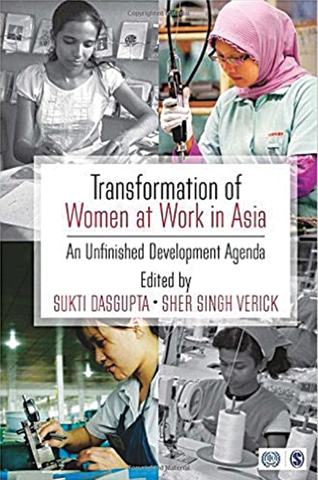
Transformation of Women at Work in Asia: An Unfinished Development Agenda
Edited by Sukti Dasgupta and Sher Singh Verick
Sage Publishing, India
ISBN: 978-9385985058
312pp.
Published in Dawn, Books & Authors, December 4th, 2016