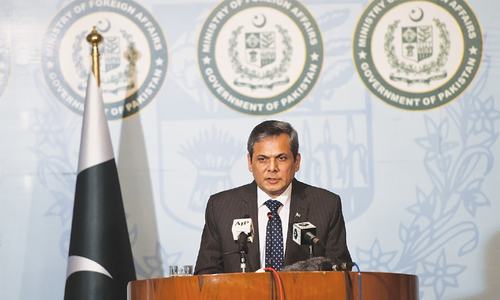
Once India had gone down the path of targeting Pakistani officials in the high commission in New Delhi, there was a weary certainty of a similar response by Pakistan.
Eight Indian diplomats in Islamabad have now been identified via leaks to the media as belonging to Indian intelligence agencies. It can be assumed that the individuals were in fact sent to Pakistan as undercover operatives; it is an established tradition, with carefully observed though secretive rules, that diplomatic missions the world over are partly staffed with intelligence personnel.
The same may be true for the Pakistani individual earlier named in India and it will remain true going forward — neither India nor Pakistan are going to be able to rewrite the rules of diplomacy as practised globally. The Indian action and Pakistani reaction, however, indicate a deeper problem at present: diplomacy has been overtaken by ‘spy wars’.
When the security establishments on either side of the border begin to take aim at diplomatic missions, the old rules of diplomacy can go out of the window, making it difficult to normalise the situation relatively quickly. In this case, deep anger and a sense of grievance appear to be animating both sides.
The Pakistani security establishment is enraged by the perception, manifestly encouraged by no less a person than Indian Prime Minister Narendra Modi, of Indian interference in Balochistan. Meanwhile, the Indian security establishment, perhaps to help deflect attention from its own failings and excesses in India-held Kashmir, has increasingly railed against alleged Pakistani sponsorship of militancy in IHK.
The suspicions on either side are not new. However, what makes them troubling is the renewed intensity with which they are being peddled and the willingness to take diplomatically disruptive actions based on those suspicions.
Compounding the problem is the civil-military dynamic in the two countries. In India, Prime Minister Modi and his national security team have explicitly played up the importance of the Indian military and intelligence apparatus and appear to have encouraged the trend of growing militarisation of Indian policy towards Pakistan.
In Pakistan, the overt tensions between the political and military leadership, especially over how to approach policy on India, have for now reduced the space for sensible, peace-enhancing decisions. Yet, whatever the new realities that shadowy forces may be trying to impose, the oldest of realities remains unchanged. India and Pakistan must eventually return to trying to resolve mutual disputes diplomatically and peacefully.
Published in Dawn, November 4th, 2016