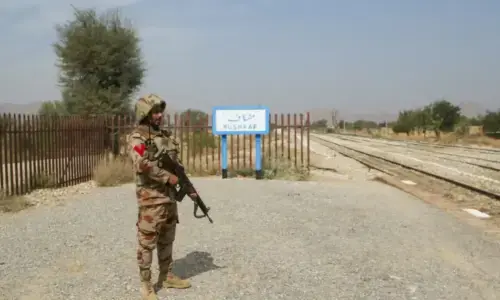
TWO separate acts of violence in Balochistan on Friday clearly show that the province’s militancy problem remains unresolved. In one attack, separatist militants bombed the Rawalpindi-bound Jaffar Express train; at least seven people were killed in the Aab-i-Gum area in the bombing claimed by the proscribed Baloch Liberation Army. In the second incident, another banned separatist group — the Baloch Liberation Front — claimed the murder of Syed Mullah Akhtar Mullai, spiritual leader of the Zikri community, in Kech. Both incidents are condemnable and reflect the fact that the state has failed to protect targets that are known to be vulnerable.
The religious leader was shot only days after the All Pakistan Muslim Zikri Anjuman had issued a statement condemning acts of violence targeting the community on Sept 20 in Panjgur. According to the statement, the group’s places of worship and houses of community members were set on fire. Over the past few years, there have been a growing number of incidents in which minority sects and communities have been targeted in Balochistan. There have been frequent attacks on the Hazara Shia community that have left hundreds dead. However, the Zikris have also been facing various types of violence. The Zikris are a small Muslim sect found mostly in Balochistan, though community members also reside in Karachi and other areas. There have been periods in history where the Zikris have had to face the wrath of the ruler of the day, but in modern times, their persecution became particularly acute during the Ziaul Haq dictatorship. Over the decades, as religious extremists established themselves in Balochistan, the persecution has only increased. In 2014, at least six Zikris were massacred in Awaran, while slogans have appeared in the province, warning the Zikris to ‘convert’ or die, signed off by an outfit calling itself Lashkar-i-Khorasan. While religious extremists have long been active against the Zikris — observers say the recent Panjgur violence was of a sectarian nature — it is now apparent that elements within the separatists have also turned their guns on the vulnerable community. For example, the BLF said Syed Mullai was killed because he was ‘working against’ the outfit; those familiar with Baloch politics say this means the religious leader was targeted for his pro-state sympathies. Squeezed between religious extremists on one end and separatist militants on the other, the Zikris need the state’s protection, while those responsible for acts of violence against the community must be brought to justice.
Published in Dawn, October 9th, 2016