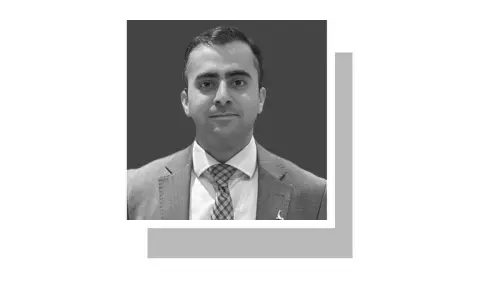
Humble and humane Safdar Dogar is a seasoned Punjabi poet, living a low-profile life in a small village near Sucha Sauda in Sheikhupura district.
With three books to his credit he has been composing poetry for at least three decades.
His parents migrated from Amritsar in 1947. His grandfather and great grandfather were killed during the riots. Grown up with the stories of Partition, the tragedy faced by his family still haunts him and have a deep impact on his writings.
“I was in grade six; all my playmates would go to bed early. But I couldn’t sleep and stay awake for late hours. I felt it deeply; there is no one to keep company and talk to me. I would talk to myself until I found books as an interesting companion to be with me for late hours.
“In the meantime, I found Russian literature; Dostoyevsky became my favourite. I would read his novels again and again.
“The first book of Punjabi classics I read was Bulleh Shah. It left a lasting impression on my mind. I didn’t understand the concepts of poetry at that age but enjoyed the magical rhythm of Bulleh Shah.
“In my childhood, there was a tradition of playing Punjabi songs, late in the night, on loudspeakers at weddings and at other celebrations. That was my first exposure to the Punjabi music.
“The tradition of reading and singing Heer Waris Shah was alive. The word used for Heer Waris Shah was Kitab,” he vividly recalls.
As a keen reader of literature, he believes that the religious extremism has been taught in schools since Partition.
“What kind of nation we have raised by teaching ‘Tobah Tun Nasuh’ in high schools. The novel by Deputy Nazeer Ahmad glorifies the hero who burnt all musical instruments and the books of his son except for religious books after he decided to shun all sins,” he narrates.
“Partition is not a lesser tragedy than holocaust, but unfortunately not much is written about it. It affected generations of the Punjabi folks and will have its impact on the generations to come. In few stories by Manto, he looked at this like an outsider,” he believes.
“To remain silent on the roots of religious extremism is a criminal act for the writers,” he claims.
Inspired by the works of Najam Hosain Syed, Surjit Patar, Ashu Lal Faqeer and Riffat Abbas, he firmly believes in writing in the language of folks.
“When the Russian elite was influenced by the French, those who felt the agony of the people created in Russian language; Buddha left the Sanskrit and opted for Pali, the language of the poor folks. Meeran Bai also composed her poetry in the language of masses,” he adds.
A Punjabi translation of the works of Meeran Bai and a couple of his collection of poetry are in the final stages of compilation.
Living a major part of life in a small village helped him keep his diction pure and safe from getting influenced from other languages.
Most of his poetry is rooted in classic traditions of Punjabi literature.
He expresses himself in various traditional and modern genres.
Dealing with a wide range of subjects, he remains uncompromising on the aesthetics and melody of the poems. On the one hand, he makes colourful imagery while narrating the existentialist experiences and on the other, he bluntly addresses the class conflicts and condemns the false narratives being promoted to justify the cruelties of market economy, resulting in exploitation of masses.
The multi-layered metaphors and indigenous diction reflect on his serious studies, depth of vision, and poetic skills. He dissects the glorification of invaders and the distorted historical narratives like a son of the soil.
Published in Dawn, August 15th, 2016