“If this play doesn’t get shut down, it will do phenomenally well,” predicts Dawar Mehmood, the brains behind Kopykats Productions.
These words alone are enough to make one curious about the troupe’s upcoming Bananistan.
In quintessential Kopykats’ style, the play is being touted as a satire that packs in political punch lines and provides audiences with a rollicking good time. This is standard fare for Dawar, of course. His production group has carved a reputation for staging laugh-out-loud political innuendo.
Kopykats can, in fact, be credited, to a large extent, with having lifted theatre from the backwater it had drifted into, bringing it back in vogue. The group’s previous productions penned by acclaimed playwright Anwar Maqsood and acted out by young, talented thespians include hits like Pawnay 14 August, Sawa 14 August and Siachen. This time, though, Kopykats has departed from Anwar Maqsood’s well-honed wit to work on a script of their own.
Kopykats Productions’ latest play looks beyond Anwar Maqsood’s wit.
Enter Bananistan, circa 2030, when Pakistan has become a superpower under military rule but is saddled with intolerant policies. The media has been blacked out; there is no radio, television or film viewership; the only mode of entertainment allowed is non-political, inhibited theatre. “The government feels that staging a play to a limited audience is hardly likely to cause a revolution,” explains Dawar.
In this dystopian landscape, a play expansively titled Meray Sultan ka Fatima Gul say Ishq-e-Mamnoon is set to be staged in Karachi with the producer and director flying in from Islamabad. The caste is due to arrive in a second plane but when the plane crashes and the cast is killed, there is a mad flurry to audition new actors.
Eventually, the play’s new caste is selected. Among them, Asif Ali Zardari, Nawaz Sharif, Shahbaz Sharif, Imran Khan, Qaim Ali Shah, Sheikh Rasheed, Hina Rabbani Khar and Kashmala Tariq. Rendered jobless under the new regime, the politicians have chosen to aspire for careers on the stage.
It’s a melting pot set to brew slapdash squabbles, comic political speeches and delicious tongue-in-cheek one-liners. A certain politician can’t stop singing, another is inclined towards flirting and getting married and there is a ‘chota don’ (small don) and a ‘bara don’ (big don). A certain ‘maulana’ has a penchant for parading as a ‘dai’ (nurse) but he can also substitute as a ‘nikah-khwan’ when the need arises. He is not to be trusted though – he might just read out his own nikah and replace the groom!
“It’s a play within a play and it reveals the theatrical exercises, the backstage politics and the tussles between the director and producer.” – Dawar Mehmood
From one act to the other, our politicos audition, rehearse and create mayhem in their final rendition of the play. “It’s a play within a play and it reveals the world of theatre, the theatrical exercises, the backstage politics, the food breaks, the spot boys roaming around and the tussles between the director and producer,” reveals Dawar. “And in the midst of it all, there is a perpetual comic diatribe going on between the characters.”
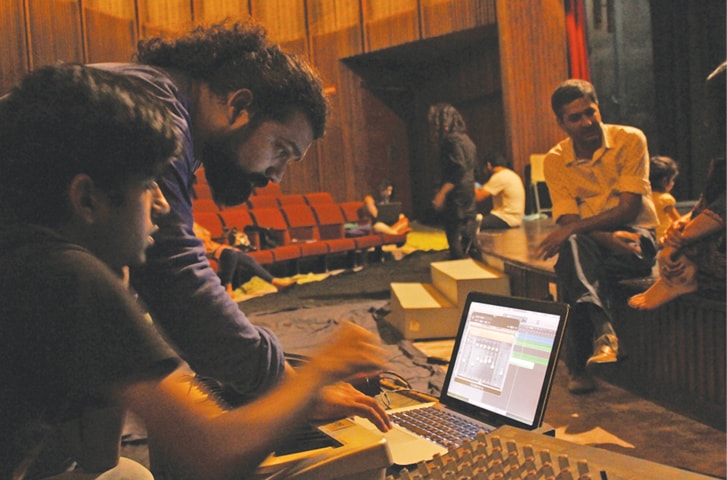
Occasionally, the actors will also break into conversational song. “I like songs that tell a story,” says Dawar. “The politicians sing tunelessly and the lyrics are hilarious. Our auditoriums aren’t constructed for live music and so we have pre-recorded the music while the singing will all be live.”
Unlike his earlier productions, where Maqsood’s script mingled humour with bittersweet poignance, Dawar promises that Bananistan is an all-out comedy with never a sad moment. “It’s riveting, the audience will be eager to know what happens next,” he predicts.
Given that this is his production, Dawar is bound to be biased. But the few sneak-peeks one has had of the show look promising. There’s plenty of situational comedy, many of the politicians have taken up jobs as pizza deliverers, event planners and property dealers. The hero chosen for the play learns his dialogues in his sleep and begins mumbling about gutter covers. There are some very pointed jibes at work and Bananistan is very likely to raise controversy even as it raises profits.
“I am hoping that the show will be allowed to run its course,” says Dawar. “It’s scheduled to be shown in Karachi for two-and-a-half months, then a month in Lahore, another in Islamabad and a week each in Peshawar, Faisalabad, Multan and Sialkot. After this, we’ll be staging it in Dubai and we also have a US tour planned out.”
Part of his entourage are a motley crew of new actors as well as some regulars. Dawar himself is going to be enacting Imran Khan, a character that he played remarkably well in earlier plays. Tulin Khalid Azim is on board as director.
Theatre-lovers have seen Kopykats Productions grow from strength to strength. One hopes that the group still delivers even as they move away from having Anwar Maqsood’s profile advertised on their billboards and posters. While Dawar is indubitably talented, there’s no denying that Maqsood’s name has played a significant role in drawing audiences to Dawar’s plays so far.
In fact, one remembers Kopykats Productions and the National Academy of Performing Arts collaborating to present Mein Adakara Banungi starring Sania Saaed – an exemplary play that failed to generate the kind of enthusiasm that Mr Maqsood easily evokes.
There are chances that Bananistan’s script may not have the finesse that Maqsood wields so well. Furthermore, a large chunk of Kopykats’ audience has often constituted middle-aged and older aficionados who grew up watching the writer’s satirical skits. This time round, they may not be interested in buying the Rs1,500 apiece tickets. Does this make Dawar nervous?
“We’ve worked very hard and we’ve learnt a lot from Anwar Maqsood,” he says. “I conceptualised the story while six extremely funny script writers have written the dialogue: Saqib Sumair, Mustafa Chaudry, Faisal Chaudry, Salman Khan and Fawad Baig. So far, our sponsors have loved the play and we’re booked solid for the first month with corporate shows. The poster that we have uploaded on Facebook is also generating a great response on social media. Over the years, we’ve maintained a standard for our productions and have built a following of our own. I have high hopes.”
Will Bananistan have audiences eating out of its hands or will it cause reputations to slip? We will find out next week.
Published in Dawn, Sunday Magazine, August 14th, 2016