SARAJEVO: Nearly 23 years have passed since Momcilo Salipur lost his only child, Predrag, in war-torn Sarajevo. But he recalls his son’s death with brutal clarity.
In October 1993, Predrag, a 28-year-old ethnic Serb, was killed by Musan ‘Caco’ Topalovic, who commanded a Muslim paramilitary unit.
“He stabbed him seven times before cutting off his head and throwing him into a ravine,” Salipur, 76, recalls bluntly.
Predrag is one of the forgotten Serbian victims of the siege of Sarajevo — a 44-month conflict mainly recalled around the world for the suffering and misery of the city’s Muslim population.
At the time, Sarajevo was besieged by Belgrade-backed Serbian forces who rained sniper fire and shells onto the city from their positions on the surrounding mountains.
Predrag was also a Serb — but as a Sarajevan, took up arms to defend his city.
He chose to join Caco’s Muslim unit, the rogue 10th Mountain Brigade of the Army of Bosnia and Herzegovina.
He was one of several dozen slain Serbs whose bodies were thrown into the Kazani ravine on the outskirts of the city.
Some 10,000 mostly Muslim residents, including 1,500 children, died in the siege.
While many Serbs fled the city, those who remained were also among the city’s dead, victims not only of the mountainside snipers, but also of Sarajevo’s Muslim defenders, such as Topalovic’s brigade.
“It was his city,” Salipur said of his son. He lives with his wife in a village outside Sarajevo.
Predrag had a daughter, Ivana, who was six at the time of his murder, and who now lives in the United States. But she rarely visits her grandparents and “barely remembers” her father, according to Salipur.
Historic visit
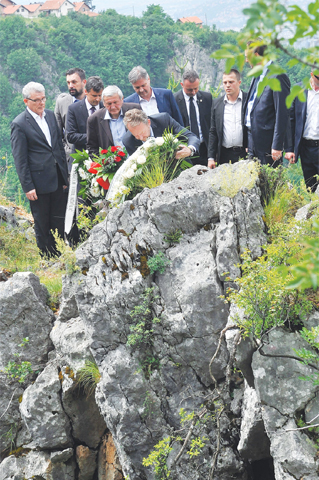
Last month, for the first time since the war, a senior Bosnian Muslim official visited Kazani.
“It’s a personal gesture. I’ve felt I had to do this for a while. I hope it will inspire others to do something similar,” said Bakir Izetbegovic, the political leader of Bosnia’s Muslims, as he laid a wreath at the site.
Miladin Vidakovic, who heads an association of Sarajevo Serbs, described the visit as a “major contribution to reconciliation, peace and tolerance”.
But Izetbegovic’s gesture may not be enough to heal divisions in the small Balkan country, which remains deeply divided along ethnic lines.
Senad Pecanin, founder of the Dani magazine, which exposed the Kazani crimes in 1997, said it had taken “unforgivably too long” for Izetbegovic to visit the site.
Wartime crimes against Sarajevo’s Serbs, at Kazani and elsewhere, are widely known, but there are no monuments to commemorate the victims.
And there are no reliable estimates of their numbers, with figures ranging from several dozen to several hundred.
Twenty-three bodies were eventually exhumed at Kazani, but the process was never completed.
Last year, a memorial plaque was put up by citizens in a Sarajevo park — but within two days it was vandalised.
Only one person has been convicted of war crimes related to the killings at Kazani: brigade member Samir Bejtic was sentenced to 14-and-a-half years on one count and acquitted on three others. All of these verdicts were overturned by the supreme court.
Bejtic is now on trial again for the murder of three Serbs and complicity to murder six others, including Predrag.
During the war, a military court found 14 of Caco’s brigade guilty of murder, complicity to murder and abduction, but these were not tried as war crimes.
The failure to treat most of the killings of Sarajevo’s Serbs as war crimes has fuelled sentiments that their deaths are seen as less egregious than those of Muslims in the city.
German-French historian Nicolas Moll, who wrote a book about Kazani, said that even admitting such crimes took place “contradicts the image we usually have of Sarajevo” as the “victim of the aggression”.
“It’s always easier for a society to look at the heroic rather than the dark sides of its history,” Moll said.
Gang leader glorified
Topalovic’s death in 1993 remains shrouded in mystery. The official story is that he was killed while trying to escape from a police van after his arrest.
His place of burial was kept secret until 1997 when an elaborate funeral was held at a cemetery for defenders of the city. Some 15,000 people attended to pay their respects.
Jovan Divjak, an ethnic Serb who had served as a general in the Muslim-led Bosnian army, was so angered by the ceremony that he returned his epaulettes to the then Muslim political leader, Alija Izetbegovic, father of the current leader Bakir.
After years without closure, Salipur remains unmoved by the recent graveside gesture.
“God sees it all. Everyone will pay for what they’ve done, here or elsewhere,” he said.
Published in Dawn, July 9th, 2016