In 326 BC, Raja Porus – whose original name was Parvateshwar – fought Alexander the Great in the great battle of Hydaspes, now known as Jhelum. Porus fought bravely, but lost, and legend has it that Porus’ troops were killed by their own elephants, which ran amok due to lightning and thunder. It was here that Alexander’s horses introduced the world to salt when they were seen licking stones in the Salt Range, near present day Khewra.
According to information from the Pakistan Mineral Development Corporation (PMDC), ASP Khan, a local chief brought the existence of salt at Khewra to the notice of Akbar the Great in 1500 AD. The mines were then taken over by the army of Ranjit Singh in 1809. However, it was the British colonialists who launched various projects 142 years ago to develop the mines.
In 1872 Dr H. Warth, a British engineer, surveyed the mines and introduced a more scientific mining method. He also laid out the main tunnel at the ground level, and the British established a railway station, a rest house and hospital for miners at the site. In 1890, salt production crossed over 50,000 tons.
Today, the discovery by Alexander’s horses and the ingenuity of Dr Warth, has made Pakistan one of the major producers of salt in the world.
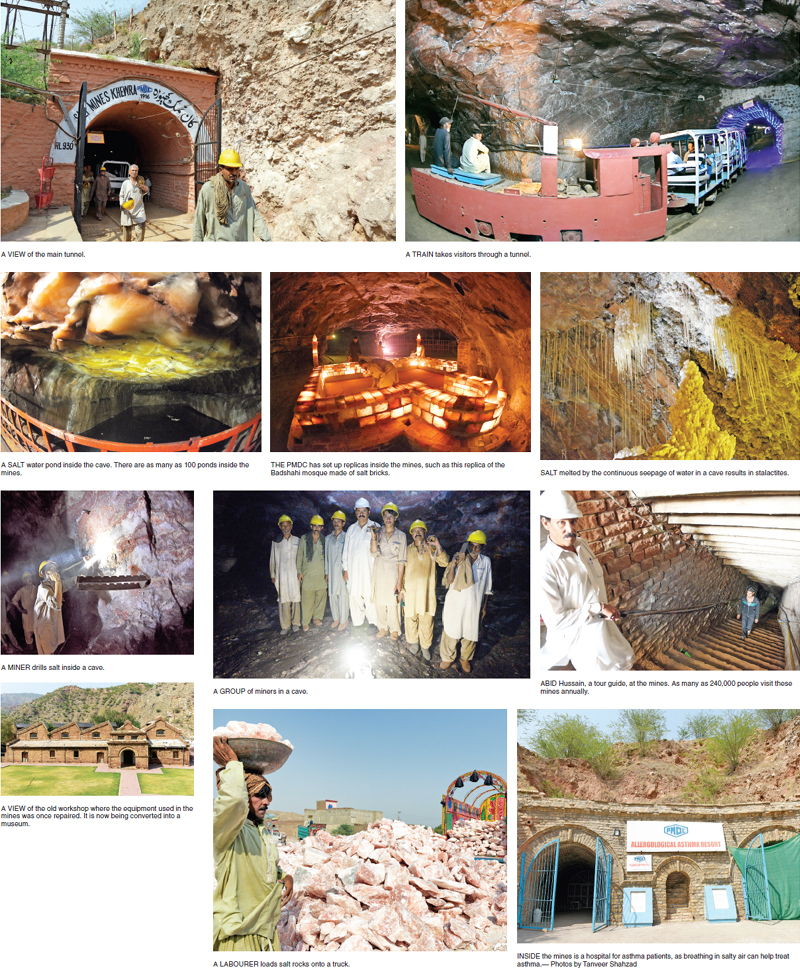
Tucked away in the foothills of the Salt Range, in the hilly town of Khewra around 160km south of Islamabad, Khewra Salt Mines are one of Pakistan’s most popular heritage sites, packed with tourists throughout the year.
The temperature in the main tunnel is always 18 degrees Celsius, no matter the weather outside. According to the PMDC, the mines are divided into 17 levels – the cumulative length being more than 40km, while the tourist area is about 3km. There are seven thick salt seams, with a cumulative thickness of around 150 metres.
There are around 100 ponds built in the mines to store water that seeps in from the mountains. Once filled, the water is pumped out from the ponds and supplied to nearby industries.
According to PMDC assistant general manager Bakhtiar Ali: “The salt produced in Khewra is listed as the best in the world because it contains 99pc sodium chloride.”
PMDC general manager Mohammad Yaqub told Dawn that the net reserves of salt in the mines are over 376 tons. He said 33pc of the salt produced is used for edible purposes, while 67pc is used for industrial purposes.
“At the current production level, the salt is enough for 762 years, but we are trying our best to increase production by 4 to 5pc, and if production is increased the salt could be drilled for the next 151 years,” he added.
Published in Dawn, May 29th, 2016