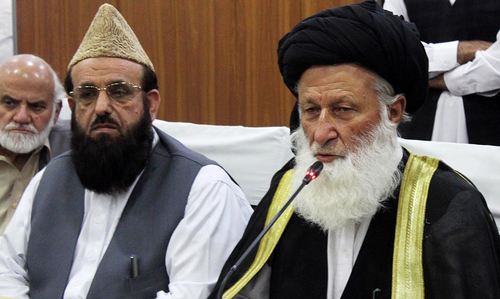
ISLAMABAD: Senior members of the Council of Islamic Ideology (CII) categorically denied on Thursday that there was any violence or physical oppression of women at the hands of their husbands or in-laws, at least inside Pakistan.
Two of the council’s senior-most members told Dawn that Pakistanis were God-fearing and religious-minded folk who did not beat their wives.
The CII had been considering its own draft of a ‘Women Protection Bill’, written by CII member Imdadullah. But the draft does not outline any punishments for those who do beat their wives.
A major divergence between the CII’s proposed legislation and the law it seeks to replace – the Punjab Protection of Women Against Violence bill – is that the council has highlighted women as “culprit party”, while the Punjab bill focuses on women victims of domestic violence.
The council’s 75 page draft, instead, describes the modes of punishments husbands are permitted to impose on their wives, if they do not comply with their responsibilities under Sharia.
Much of the CII’s opposition to existing domestic violence legislation has been the assertion that domestic violence does not exist in Pakistan, and therefore does not need to be legislated against.
Taking a very simplistic approach when asked about this issue, Allama Iftikhar Naqvi posited that, “That women are facing injustice and ill-treatment here is only Western propaganda.”
He then asked the reporter: “Tell me, do you beat your wife? No. Does your wife beat you? No. So who is spreading this propaganda?”
Instead, Allama Naqvi argued, the real issue facing women was the lack of understanding of their own rights, as granted by Islam.
Where the Punjab bill aims to address the grievances of women who face violence at the hands of their husbands or relatives, the CII’s law has no provisions to award punishments to men who resort to violence against women, and clerics continue to deny that this is a problem.
At a press conference earlier in the day, CII chairman Maulana Sherani described some of the punishments that are permitted against women who do not comply with their responsibilities under Sharia.
“No man can beat or humiliate his wife, and if there is a need to discipline her, then he should distance himself from her until she mends her ways,” Mr Sheerani said.
He said Islam gives women extensive rights and allows women to play an active role in society.
“Whenever there is a need, the government can force men to conscript, but women cannot be forced to do so. Similarly, if a woman denounces Islam, she cannot be awarded the death sentence as it is prescribed for men. Women can own property and even do jobs, while conforming to religious norms,” he added.
When asked about cases where husbands beat their wives, he claimed that there was no one in Pakistan disgraced enough to beat a woman.
“In our tribal culture, we stop firing during gunfights if a woman appears in the range,” he said. “If there is any such case, the government has to create awareness first, instead of making stringent laws.”
Published in Dawn, May 27th, 2016