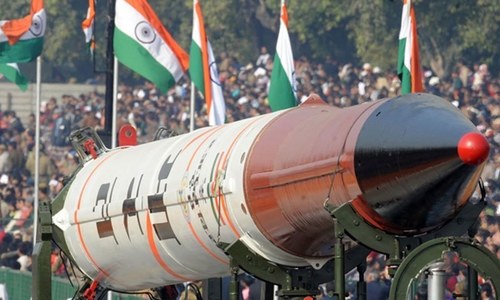
ISLAMABAD: India’s nuclear-armed missiles deployed on nuclear-powered submarines pose a threat to the maritime security of the Indian Ocean Region’s (IOR) 32 littoral states, besides upsetting the strategic balance in South Asia, the Senate was told on Thursday.
Making a policy statement on the deployment of nuclear-armed missiles on submarines in the Indian Ocean, Adviser to the Prime Minister on Foreign Affairs Sartaj Aziz said Pakistan was considering a proposal for tabling a resolution at the UN General Assembly session later this year, which would call for making the Indian Ocean a nuclear-free zone.
He said Pakistan might ask the 32 littoral states to co-sponsor the move. Some of the key littoral states include the Maldives, Sri Lanka, Bahrain, Iran, Iraq, Kuwait, Oman, Qatar, Saudi Arabia, the UAE, Egypt, South Africa, Australia, Indonesia, Malaysia, Myanmar, Singapore and Thailand.
Additionally, he said, the matter would be raised with all major world powers, both at bilateral and multilateral fora.
“We are planning to highlight the dangerous implications of India’s plans to nuclearise the Indian Ocean at all relevant international fora,” Mr Aziz said.
India had last month tested nuclear-capable K-4 Submarine-Launched Ballistic Missiles (SLBMs) from its nuclear-powered submarine INS Arihant as part of its efforts to develop second-strike capability.
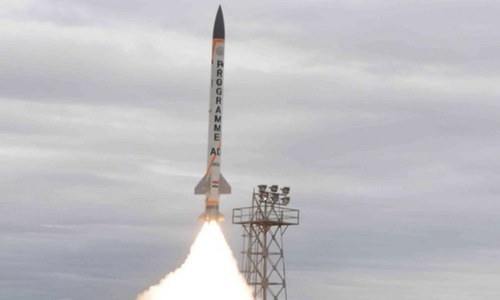
Also on Sunday, India tested its Advanced Air Defence Missile Ashwin for its upcoming multi-layered Ballistic Missile Defence system.
“These two developments are part of the massive conventional, nuclear and missile development programmes being pursued by India and are contributing to nuclearisation of the Indian Ocean,” Mr Aziz said.
Noting that nuclear and advanced conventional weapon technologies required responsibility and maturity, he said, Indian actions did not reflect that.
He assured the Senate that Pakistani armed forces and defence scientists were fully vigilant and taking remedial measures by “evaluating the strategic threats” and developing “strategic responses”.
“Pakistan is fully prepared to defend its people and its borders,” Mr Aziz said, adding that the country would take all necessary measures to augment and upgrade its defence capabilities through suitable technologies.
“Despite limitation of resources, Pakistan has developed a robust nuclear deterrence, which is constantly updated. At the same time, Pakistan’s successful efforts to ensure the safety and security of its nuclear and missile assets have been widely acknowledged,” he underscored.
The adviser recalled that Pakistan had in the past offered India discussions on an anti-ballistic missile-free zone in South Asia under nuclear confidence-building measures. But India did not respond positively, he regretted.
Mr Aziz said there were doubts about the effectiveness of India’s ballistic missile defence system, but it might give India a false sense of security leading to unexpected complications.
“Such actions are also contrary to the policy of a peaceful and friendly neighbourhood,” he added.
Published in Dawn, May 20th, 2016