8
8
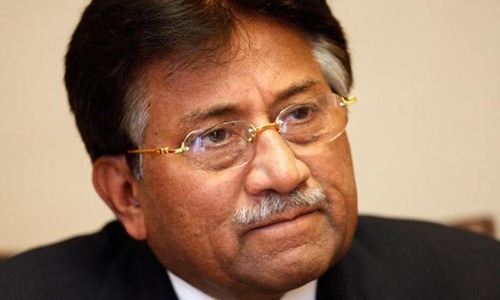
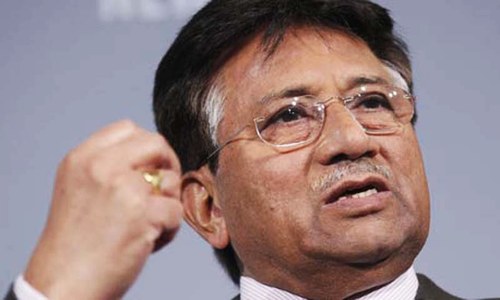
ISLAMABAD: The head of the joint investigation team (JIT), which probed the Benazir Bhutto murder case, on Thursday stated that the investigation team could not trace the threatening call allegedly made by former president retired General Pervez Musharraf to Bhutto.
Mohammad Khalid Qureshi, the JIT head, who is a former additional director general of the Federal Investigation Agency (FIA), was the last prosecution witness in the high-profile murder case.
During the cross-examination by Barrister Farogh Nasim, the counsel for Mr Musharraf, in the Anti-Terrorism Court (ATC) Rawalpindi, Qureshi admitted that JIT could not trace the call either from the two mobile phones of Bhutto or Mr Musharraf’s cellphone.
However, he expressed the possibility that Gen Musharraf might have made the call from any of his official phones.
Last prosecution witness cross-examined in Benazir murder case at ATC Rawalpindi
The prosecution case was based on the threatening call which Mr Musharraf allegedly made to Bhutto while she was at the office of US Congressman Tom Lantos.
According to the prosecution, US lobbyist Mark Siegel claimed that on September 25, 2007, in his presence at the office of Congressman Lantos in Washington, Bhutto received a telephone call which she later described as “a very bad call” from Mr Musharraf.
The statement said the former military ruler had warned Bhutto that “her safety depends on the state of their [Musharraf and Benazir’s] relationship.”
According to Mr Siegel, Bhutto sent him an email on Oct 26, 2007, in which she expressed her sense of insecurity. She also said if something happened to her, she would hold the military ruler responsible, apart from the individuals mentioned in her letter to Mr Musharraf on Oct 16, 2007.
The individuals Bhutto had mentioned in the letter were: retired Brigadier Ejaz Shah, retired Lt-Gen Hameed Gul and former Punjab chief minister Chaudhry Pervaiz Elahi.
During the cross-examination, Barrister Nasim asked Mr Qureshi whether he submitted any forensic report of the email to the ATC.
In response, Mr Qureshi admitted that no forensic report was submitted to the court, adding the email was sent from two official accounts of Bhutto and did not need any forensic audit.
Mr Qureshi also denied of having any direct evidence of the conversation between Gen Musharraf and the then city police officer Rawalpindi, Saud Aziz, as the prosecution had alleged that Aziz washed the crime scene to destroy the evidence on the direction of Mr Musharraf.
In the written statement recorded with the ATC, Mr Qureshi said, “during the investigation of this [Benazir murder] case, I also personally recorded statements of …retired General Hameed Gul, retired Brigadier Ejaz Shah, Zamurd Khan (former MD Baitul Maal), Farhatullah Babar, retired General Tauqeer Zia, Senator Rehman Malik, Khusro Pervez, retired Brigadier Javed Iqbal Cheema and issued questionnaires to a number of people, including former secretary interior Syed Kamal Shah.”
He also said he included Mr Musharraf, DIG Aziz and SSP Khurram Shahzad in the high-profile murder case.
When Barrister Nasim told him that he had some personal grudge with Mr Musharraf due to which he implicated him in the murder case, Qureshi replied that he was the head of the counterterrorism wing of the FIA and had probed several high-profile cases.
He denied of having any personal grudge with Mr Musharraf, adding he was also the investigating officer in a terrorist attack on Mr Musharraf in 2003 in which the court awarded life imprisonment to six persons.
On the request of senior lawyer Malik Rafique, the counsel for the two police officers, ATC Judge Rai Ayub Khan Marth adjourned the proceedings to May 11 when he (Mr Rafique) would cross examine the JIT head.
Published in Dawn, May 6th, 2016