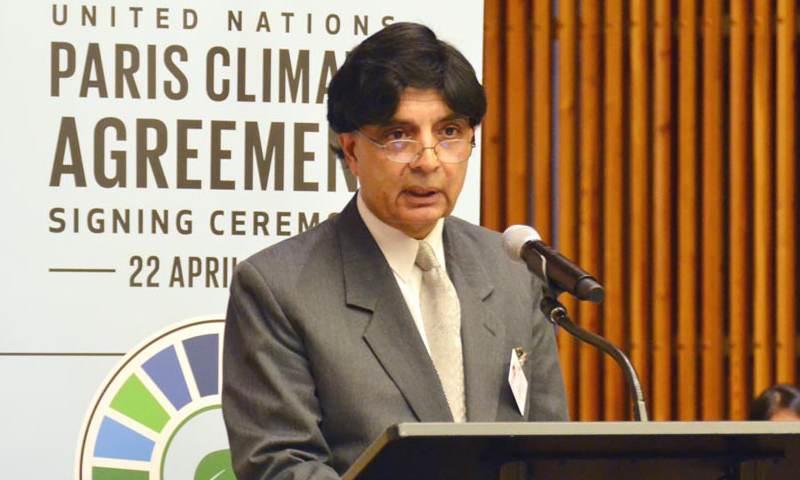

UNITED NATIONS: Pakistan is strengthening its institutional structures to step up action to stave off the most drastic effects of climate change, Interior Minister Chaudhry Nisar Ali Khan told the international community here.
Speaking after the signing of the Paris climate agreement at the UN General Assembly, he said Pakistan would establish a climate change council and climate change authority, adding that more than five per cent of its annual budget was allocated to climate change activities.
At the same time, the minister said that adequate resources were critical for climate actions in developing countries.
Noting that trillions of dollars were needed globally to effectively respond to climate change impacts, he said the bulk of this amount should be spent in developing countries, because their challenges and needs were enormous.
“Fulfilment of financial obligations, particularly meeting the target of $100 billion fixed by the developed countries is extremely important,” the minister told the 193-member assembly.
Leaders from at least 175 countries signed the Paris agreement on climate change as the landmark deal took a key step forward, potentially entering into force years ahead of schedule.
The impressive ceremony set a record for international diplomacy: never have so many countries signed an agreement on the first available day. States that didn’t sign on Friday have a year to do so.
“We are in a race against time,” United Nations Secretary-General Ban Ki-moon told the gathering. “The era of consumption without consequences is over”.
Many at the UN now expect the climate agreement to enter into force long before the original deadline of 2020.Some say it could happen this year.
After signing, countries must formally approve the Paris agreement through their domestic procedures. The United Nations says 15 countries, several of them small island states under threat from rising seas, had done that on Friday by depositing their instruments of ratification.
Calling it a “defining moment,” Chaudhry Nisar said: “We have now an action plan to deal with the greatest development emergency of our times. We must implement it fully and faithfully.”
He said Pakistan had joined the consensus in Paris because its objectives aligned with those of the Climate Change Convention. The temperature in Pakistan had risen and its 5,000 glaciers were receding faster than those in any other part of the world, he said, adding that the country was already water-stressed.
“The frequency of large floods has also increased in recent years causing huge losses to the lives and livelihoods of our people,” he told world leaders. “Besides tragic human and material cost, these threats also constrain our ability to promote sustainable growth and development, and ensure economic prosperity for our people.”
Pakistan’s national priority was to ensure economic growth, while avoiding the “business-as-usual” attitude of increasing emissions. It would present its intended nationally determined contributions, promote the imperative of development and address environmental concerns.
To that end, the minister said, Pakistan’s ratification process would hinge on the updated Intended Nationally Determined Contributions (INDC), a process that has commenced. “We will be presenting an ambitious INDC that would both promote the imperative of development and address environmental concerns.” He was confident that a comprehensive approach would enable Pakistan to contribute to the global mitigation efforts against climate change.
“We must all live up to these commitments to realise the Paris agreement”, he said. “This will test all of us but we owe this to our common humanity and future generations”.
Published in Dawn, April 24th, 2016