10
10

WASHINGTON: Foreign Secretary Aizaz Chaudhary said on Thursday that Pakistan had never had a nuclear accident or breach of security and, therefore, there was no cause of concern about its nuclear programme.
At a news briefing at the Pakistan Embassy, the foreign secretary said the impression that Pakistan’s nuclear installations were insecure was baseless.
“Pakistan’s nuclear installations are not only secure but the world also acknowledges that they are,” he said. “Pakistan has worked very hard to ensure their security.”
Mr Chaudhary said that the International Atomic Energy Agency has recorded 2,734 nuclear incidents worldwide, including five in India, but “not a single accident or breach happened in Pakistan, although our programme is 40-year old”.
He recalled that earlier this month, Pakistan signed the amended Convention on Physical Protection of Nuclear Materials, “which shows our confidence”.
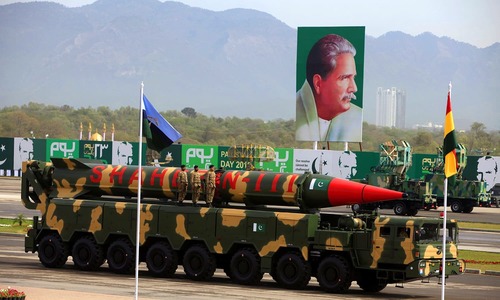
The foreign secretary said it was wrong to describe Pakistan’s short-range missiles or small nukes as battlefield or tactical weapons.
“Pakistan has short-range and long-range missiles, and the purpose behind both is to deter aggression,” he said. “We want to prevent war, to prevent the space Indians created for war” by building military installations close to the Pakistani border as part of their cold start doctrine, he added.
“Calling them battlefield weapons creates a wrong perception. These are for deterrence, only and only for defence,” Mr Chaudhary said. “There is no cause of concern.”
He explained that Pakistan has a principled stance, “maintaining a credible, minimum deterrence”.
Asked how Pakistan determines what’s credible minimum deterrence, the foreign secretary said the National Command Authority “continues to assess the threat perception and the threat level determines the level of deterrence”.
He said Pakistan’s preparedness was tied to the threat posed by India and the deterrence varied accordingly. “If the threat level increases we have to meet that and their conventional and nuclear levels are increasing too,” he said.
“All nuclear weapons are centrally controlled by the National Command Authority,” said Mr Chaudhary while rejecting media speculations that the present arrangement in Pakistan gave the decision power to a field commander.
Responding to a question about the summit, the foreign secretary said each of the 50 plus participating nations would present their case, and then all would sit together to consider how to increase global security.
The summit, he said, would issue a joint communiqué and four action plans, on the roles the IAEA, United Nations and Interpol in the monitoring process and on global partnership and combating nuclear terrorism and Pakistan was actively participating in preparing these documents.
The foreign secretary said Pakistan had installed radiation monitors at all sensitive facilities and planned to install more monitors at all 72 exit and entry points in the country.
He said that Pakistan had participated in all preparatory talks for the summit and its participation would reflect in all the documents that would be issued after the summit.
He said that Pakistan had a modest nuclear programme with “full ownership of its people, essentially for its defence and not to threaten anyone”.
“India, on the other hand, has an ambitious nuclear programme, and an equally ambitious conventional weapons programme,” he added. “We have a modest programme because we feel we have the right to defend ourselves.”
Mr Chaudhary also rejected the suggestion that the Nuclear Security Summit was focusing on Pakistan. “This summit is based on certain principles, stating clearly that nuclear security is essentially a national responsibility and all measures are voluntary,” he said.
He said Pakistan was working with the international community to ensure the security of its nuclear installations, which were always in safe hands. “The National Command Authority, headed by the PM, is fully in charge.”
He said the perception created in the media that Pakistan had the fastest growing nuclear programme was wrong and pointed that several studies showed that India had a bigger nuclear programme.
Published in Dawn, April 1st, 2016