0
0

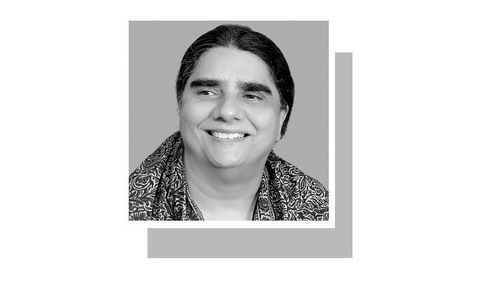
Samina Quraeshi (1944-2013) was a graphic designer, artist and educator; she was also the author of four books on the visual, material and spiritual culture of Pakistan. Mind Maps is a retrospective exhibition of the multidisciplinary artist’s printmaking work spanning 35 years. In the ’70s her work, especially for the Pakistan Tourism Development Corporation, took her all over the country to its heritage treasures and natural magnificence. Later, when she moved out of the country, it was her search for the identity and diversity of Pakistan that compelled her to return to her roots — to travel, study, document and create.
In earlier works made between 1971-81 ‘Bactrian Camel’, ‘Caravan Camel’ and ‘Falcon Series’, she portrayed the landscapes of Sindh and Punjab and icons of the East — camel representing endurance, and falcon as a symbol of freedom and strength. Quraeshi used a number of printmaking techniques such as silkscreen, solar plate etching and lithography, combining it with drawing and digital technologies. The mark making is evident in the black and white litho-printed camel as well as the multi coloured silk-screened falcon series, both of which developed from the artist’s drawings made during her travels. On the other hand, the ‘Caravan Camel’ series has been created in bold solid colours as graphic iterations of the photographs.
Dr Annemarie Schimmel’s scholarly work on Sufism also had a profound influence on her oeuvre. In later works one can see a shift towards researching and documenting Sufi traditions in the subcontinent. The book Lahore: The City Within, published in 1989, was followed by a series of nine handbound folios that she developed, each with a mystical poem, photographs and archival imagery.
Mind Maps is a retrospective exhibition of the multidisciplinary artist Samina Quraeshi’s printmaking work spanning 35 years
‘The Sacred Spaces’ is another visual project accompanying her book Sacred Spaces: A Journey with the Sufis of the Indus published in 2009. The artist has layered archival maps, photographs and drawings with text, architectural plans and geometric grids. This series resembles old preserved documents or parchments; some of the compositions also incorporated calligraphy or hashia. The work was put up in a red room creating a shrine like feel to this part of the gallery. The installation includes a 12-minute film that was created in collaboration with daughter Sadia Shepard and son-in-law Andreas Burgess, both filmmakers, at the Nizamuddin Auliya’s dargah in Delhi.
The last and the most complex series in the show is ‘Mind Maps’, created after the artist suffered a stroke that paralysed the left side of her body. Quraeshi studied the scans of her damaged brain and juxtaposed it with red and geometry of the Islamic patterns. Starting from a simple square and a circle, the geometry becomes increasingly complex. Perhaps the artist was trying to map the brain, creating a geometric analysis towards comprehending brain function. It can be further read as a study to find a connection between the brain and its structure with the universal symbol — correlating the most vital and unique organ of a human being with the outside or the universal.

During this time, and as the work suggests, the artist continually searched for inner peace and closeness to the Almighty for direction. For this series, Quraeshi digitally manipulated and layered images, handwritten notes, brain scans and drawings. She collaborated with Shepard and Burgess to construct the imagery. And after her death Shepard produced the prints further collaborating with master printmakers in a studio in Brooklyn, New York. This exhibition, curated by Noorjehan Bilgrami and Samina Quraeshi’s children Sadia Shepard and Cassim Shepard at the Koel Gallery, is a peek into the creative life of a multi-faceted artist.
Published in Dawn, Sunday Magazine, March 13th, 2016