Artist Lubna Agha was young, talented and prolific in the ’70s. Holding her own among the early modernists she garnered considerable acclaim as an abstractionist, yet today remains relatively unknown to the present generation of artists and art students. A diaspora artist since the ’80s she passed away in Brookline, Massachusetts, US in May 2012, leaving behind a large collection of works which is now managed by the Lubna Agha Estate.
Mounting as many as seven solo exhibitions in Karachi, Lahore and Rawalpindi, as well as winning laurels and critical reviews during 1969-1980, Agha in contrast had just three exhibitions in Pakistan (1987 at Indus Gallery, and in 1996 and 2001 at Chawkandi Art Gallery) after her departure. Her growth as an artist came on record with these exhibitions but her work did not receive the extensive showcasing and media coverage related to book launches, group showings, talks, residencies and art forums that nowadays contribute much to create a lasting impact on art audiences.
A current retrospective, A Path All My Own, at the VM Art Gallery, Karachi, attempts to recapture the artist in her entirety by displaying artworks from all the phases of her artistic practice. The voluminous gallery halls accommodate capacious shows and Agha’s retrospective has substantial visual and textual material to inform the uninitiated about the intricacies of her art.
The artist proficiently combined the modern-abstract style of the West with the motifs of Islamic art and architecture to create a niche for herself
Lubna Agha was the first student to enrol at the Zuberi sisters’ Mina School of Art, presently Karachi School of Art (KSA), and her initial education centred on the basics of academic drawing and painting. Taught by Hajra Zuberi she became adept in the Chughtai technique of overlaid washes and her street scenes, en plein air, of Bohri Bazaar and under the Golimar Bridge bear the influence of Mansur Rahi.
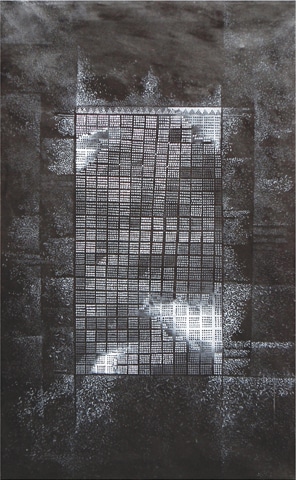
A collective look at Agha’s art reveals that her practise is marked by distinct stylistic shifts and this attitude had its beginnings in her move from the literal and the realistic, imbibed at the KSA, to a wholly abstract idiom after her return from London in 1970. Taken in by Jasper John and Nicholas de Stael, she opted to paint colour fields whose stillness was ruptured with splinters, shards and cubes of multiple hues. This abstract stage peaked in the ‘white paintings phase’ when she concentrated on punctuating her space with subtle gradations of white dramatically interrupted by ambiguous organic forms mainly in red and black. The nature of these shapes variously interpreted as broken egg shells, bleeding nipples, thorns and suggestive nude forms, was fodder to the mill of review writers prompting several oblique as well as philosophical explanations.
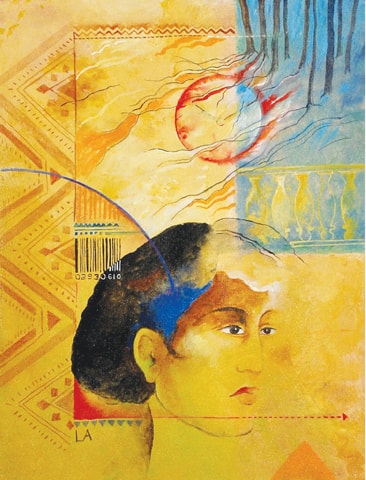
If a trip to London pushed her towards abstraction then her migration to the US with her family in 1981 brought her back to figuration. Enrolling at the Sacramento State University, California she took extensive classes in printmaking. Leaving home where she was settled with her family, had friends, relatives and a successful career as a practising artist, for a strange new environment where the family had to make ends meet on a limited budget in cramped housing amongst strangers , was a crushing experience.
Her life became fragmented, and overwhelmed by the displacement she poured her heart out into her canvases. Upside down, floating and jostling for space her figures translated her uneasiness. Marcella Nesom (in her monograph on the artist) narrates an incident where well-known California artist Wayne Theibauld on viewing her figurative painting asked, “Why are none of your figures grounded?” To which Agha responded, “I recently came from Pakistan and don’t have my bearings here yet. It’s a metaphor.” Some of her strongest works belong to this phase. Other than paintings like ‘Doli’, ‘Roots’ and ‘Falling’ the most telling was ‘Three Days’, centralising on three phases of life, birth, struggle for existence and death. Here the foetus and umbilical cord were the connection to her cultural heritage, the continuation of life and thread between generations.
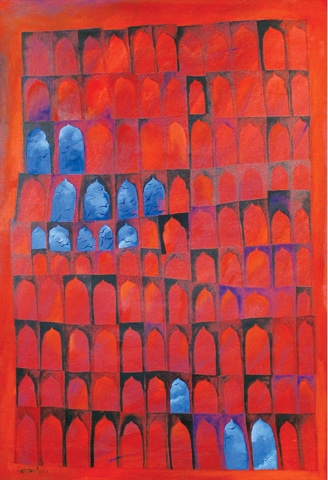
Moving to Boston after several years in California again prompted another series of migratory paintings but soon her concerns shifted to herself as a Muslim in the Western environment. Her reaction to career opportunities, technological developments in art and interventionist global politics was directly addressed in paintings like ‘Janamaz and the White House,’ McDonald’s Golden Arches and the IMF logo.
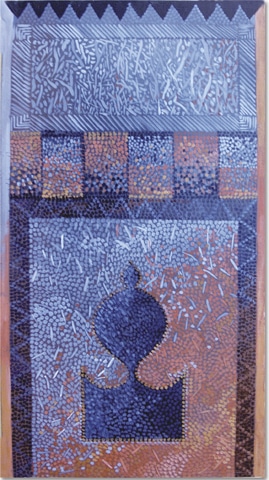
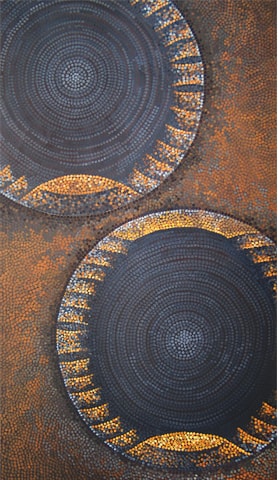
If notions of ‘home’ and looking inwards were a constant in her oeuvre, a visit to Morocco and Turkey literally opened windows into a world beyond. She began stippling dots (nuktas and primordial marks) to form arabesques and Islamic geometric patterns on canvas and ‘rehel’ (Quran bookstands). Reverting to her Islamic roots in the final phase her personal worldly narrative began to give way to infinity patterns and a preoccupation with abstraction related to perpetuity.
Published in Dawn, Sunday Magazine, February 21st, 2016