In its eighth-month report published in Sept 2015, the Human Rights Commission of Pakistan (HRCP) counts 391 cases of ‘encounters’ in and around the city. Of them, 116 are said to have been conducted by paramilitary forces. An HRCP spokesperson says that the majority of the ‘encounters’ took place in Baldia Town and Malir.
One police officer whose name keeps cropping up in this regard is that of SSP Rao Anwar. He is known as the ‘encounter specialist’ and comes across as someone who doesn’t want to hide this fact, irrespective of the controversy surrounding a case.
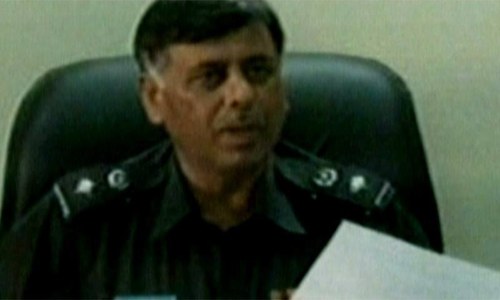
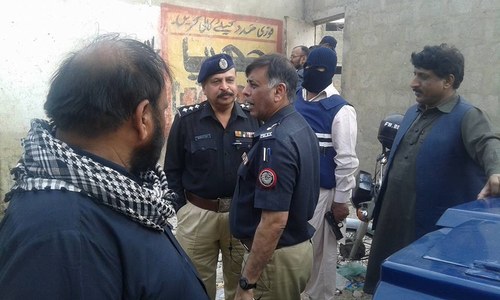
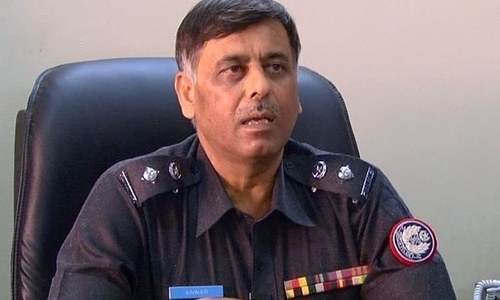
Malir SSP Anwar Ahmad, better known as Rao Anwar, has two other people sitting in his office as we meet him at the Gadap City police station, near the Superhighway toll plaza, to interview him. Anwar seated behind a big brown desk, and the others, are all looking towards the television. Two military men have been shot dead on Karachi’s M.A. Jinnah Road. The SSP begins the interview speaking about this.
“They should go after the big guys this time around,” he says, eyes glued to the screen. “The problem is that when you let the big guys go and shoot the workers or supporters of any organisation, you give them a chance to recruit more people and gain sympathy,” he explains. In the same breath, he speaks about the number of men he arrested or shot belonging to the Tehreek-i-Taliban Pakistan (TTP), the Harkat-ul-Mujahideen, and Al Qaeda, among others. “There’s no other remedy in dealing with them since most of their chain of command is based in Afghanistan,” he adds.
It has been 32 years since Anwar joined the police force as an assistant sub-inspector at the Airport police station. Anwar and Sarwar Commando are the only two surviving officers of the high-profile police officers who took part in the security operations of the 1990s against the then Mohajir Qaumi Movement.
Owning up to having arrested and shot down in police encounters Mohajir Qaumi Movement activists from the areas where he was posted, including Gulshan-i-Iqbal and North Nazimabad, he remains nonchalant about the controversies. The majority of the cases remained unquestioned, apart from the few where the families of those shot dead moved the court.
Shifting in his seat a bit, he says: “That’s my duty as a police officer — to maintain law and order whether it is in my area or in the city in general. I have a clear record and I have not been challenged in the court for killing criminals. If I know that a criminal is involved in anti-state activities, my duty is to go after them.”
Being involved in anti-state activities is what he blamed the Muttahida Qaumi Movement (MQM) for during a press conference in April this year. This ended with him being suspended for a while, after which he was reinstated as SSP Malir.
Did the altercation with the MQM also strain his relations with the Pakistan Peoples Party? “I don’t think so,” he says. “I have never taken pressure when it comes to arresting workers of a political party. I think it was necessary to speak about it. Earlier, a similar confession made by hitman Ajmal Pahari about the MQM’s links with the Indian spy agency RAW was ignored. Also, I was not giving my opinion at the press conference; it was based on the confessions of two suspects I had arrested a day before,” he explains.
“It can’t be that all of us are lying,” Anwar says. “The Counter- Terrorism Department arrested four MQM men after my press conference and so did the Rangers. I’m a Pakistani and a Muslim and felt it was my duty towards the state to speak the truth at the presser,” he continues.
Did he face any political pressure to retract his words or reach a compromise with the party like the late SSP CID Aslam Khan reportedly did? “I have not faced political pressure. And I don’t compromise with terrorists. It is as simple as that,” he curtly states.
There have been attacks on his life, including one in 2012 when his convoy was attacked while going to the Malir court after the murder of former Malir Bar Association president Salahuddin and his son, Ali. He survived two attacks in May and June respectively. But before I can put a question to him, he says: “The attacks were launched by the Tehreek-i-Taliban Pakistan.”
The conversation moves to the Rangers-led operation in the city. “In my years of service, I have seen Karachi deteriorating. The current peace which we are witnessing is unsustainable. It’d be sustainable if the operation continues and targets the big guys,” he repeats yet again, adding that: “That’s because political and administrative mistakes made in the past were ignored.”
Leaning forward, he gives the example of former inspector general of Sindh Dr Shoaib Suddle. “He instilled the fear of an IG among the police cadre and terrorists and knew how to get the job done,” he explains.
I ask if he is trying to emulate the former IG; Anwar smiles.
Published in Dawn, December 29th, 2015