0
0

ISLAMABAD, Oct 29: Pakistan on Wednesday made a wholesome response to Indian confidence-building measures and hoped that discussions on the CBMs would lead New Delhi to resume a sustained and composite dialogue with Islamabad on all contentious issues, notably the Kashmir dispute.
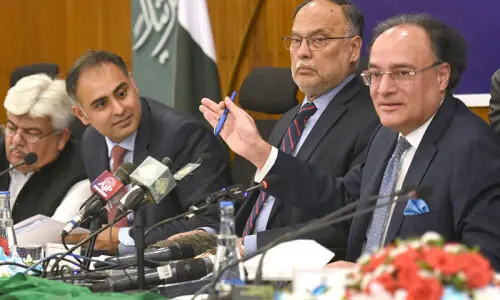
Foreign Secretary Riaz Khokhar told a press conference that Pakistan had decided to respond positively to the Indian proposals along with some of its own steps.
However, he pointed out, Pakistan felt disappointed that New Delhi had rejected Islamabad’s suggestion for resuming a comprehensive, sustained dialogue.
He said Pakistan still hoped that the proposed reciprocal steps would lead to the resumption of dialogue and help de-escalate the situation in occupied Kashmir.
Referring to the Indian proposal of introducing a bus service between Srinagar and Muzaffarabad, the foreign secretary said that could be welcome provided there were checkpoints manned by the United Nations and Kashmiri passengers carried UN travel papers.
Besides, Pakistan offered medical aid and assistance to Kashmiri victims of violence and rape, and to widows from the Valley. The secretary said international humanitarian bodies could be associated with the implementation of this proposal.
Pakistan, he said, was offering scholarships for 100 Kashmiri students for studies in graduate and post-graduate courses in professional institutions.
Pakistan, the secretary said, accepted the proposals pertaining to the resumption of the Samjhota Express between Lahore and Delhi, sports ties, visa camps with provision of necessary infrastructure and staff, land border crossing by people in the age group of 65 and above, and setting up of a hotline between Pakistan’s maritime agency and Indian coast guards to ensure humanitarian and expeditious assistance to arrested fishermen of either country.
About the Indian suggestions for Mumbai-Karachi ferry service and opening a land route between Munabao and Khokhrapar, the secretary said these issues should better be left for consideration at negotiations whenever the two sides decided to resume dialogue.
Answering questions, he said the talks on the CBMs had a long history. He said progress and development in both countries had suffered a great deal because of confrontation for the last 55 years, mainly owing to the Kashmir dispute.
Hence, he maintained, Pakistan had been insisting on negotiations on the Kashmir dispute along with other substantive issues.
Mr Khokhar said India might have floated the CBMs as a public relationing activity or a “tactical move”, but Pakistan had responded to them seriously and sincerely.
He emphasized that the Kashmir issue could never be set aside because it was the heart of the problem between the two countries and the only way to resolve it was by holding negotiations.
Asked for comments on statements of war by some Indian ministers, the foreign secretary said talking about war was most irresponsible.
Though Pakistan was ready to face any eventuality, it did not want to talk in terms of war. Rather it wanted dialogue to find a solution to the problems, he stressed.
In reply to a question about involving the United Nations in the proposed Srinagar-Muzaffarabad bus service, he said the suggestion was perfectly in order while considering travel facilities between the divided parts of a disputed territory which was on the UN agenda.
He said India was possibly amenable to a third party’s role in facilitating talks between the two countries as, he pointed out, the US had been talking to both Islamabad and New Delhi on contentious issues. He hoped that well-wishers of the two sides would continue to extend their support for a peaceful settlement of disputes.
In reply to a question about India’s stand that dialogue cannot be resumed because Pakistan had not done enough to prevent infiltration from across the Line of Control, the secretary said Islamabad had done its utmost and now the ball was in India’s court. Let India seal its borders to prevent any unwanted incursions, he added.