0
0
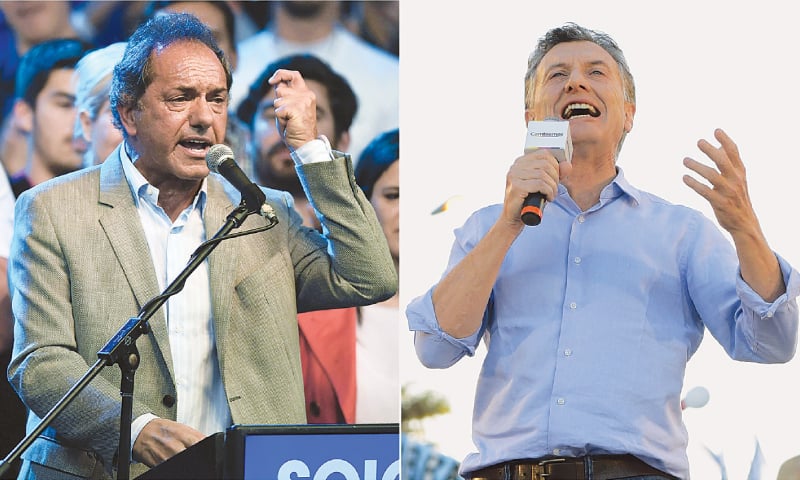

BUENOS AIRES: Argentines decide on Sunday whether to end years of leftist government in a run-off vote that could see the pro-business opposition seize command of Latin America’s third-biggest economy.
Polls show that the mayor of Buenos Aires, former football executive Mauricio Macri, could force a sharp realignment by beating his left-wing rival Daniel Scioli, an ex-powerboating champion.
If Macri breaks the grip of Peronism, the broad movement that has dominated Argentine politics for decades, he could liberalise the economy and lift the current limits on buying of US dollars.
Observers have complained that the two candidates lack charisma, but the stakes of their contest are potentially dramatic.
The tone sharpened as campaigning wound up on Thursday with Scioli branding Macri a “stuck-up” elitist.
“I want to save you from savage capitalism,” Scioli told supporters at a rally in the seaside town of Mar del Plata. “Macri wants to leave you at the mercy of the markets.” Macri in turn branded Scioli a liar.
“It’s very bad what he is doing, based on lies. He has deceived everyone,” said Macri, after attending an indigenous earth ritual in Jujuy, a poor northwestern province.
“The idea that only a Peronist can govern Argentina is just a myth.”
Argentine politics changing
The increasingly tense campaign has been fought on shifting political ground in the vast South American nation of 42 million people.
If he wins, Macri will be the first leader to be elected who is neither a Peronist nor from the radical liberal movement.
Macri’s Republican Proposal party, known as PRO, “draws mostly non-Peronists, but it is not virulently anti-Peronist. There are even Peronists within PRO,” said Sergio Morresi, a political scientist at state research institute CONICET.
Macri could become Argentina’s most economically liberal leader since the 1990s.
That has raised hopes among financiers, but fears among domestic businesses and poorer Argentines who have benefited from the social and trade policies of the combative outgoing president, Cristina Fernandez de Kirchner.
Scioli, 58, a milder ally of Kirchner, won 37.8 per cent of the vote in the first round on Oct 25.
Macri, 56, was close behind, gaining 34.15 per cent — a much closer result than polls had forecast.
Unusual election
The election has been unlike any other in Argentina’s history, with the first ever national run-off vote and the first televised candidate debate.
The debate drew huge audiences but provided little entertainment. Media observed that the candidates dodged the questions and failed to land a knockout blow.
Observers have complained the two lack charisma, but the stakes of their contest are potentially dramatic. The winner will have to tackle soaring inflation, currently estimated at more than 20 per cent.
He will also face a dispute with so-called “holdout” creditors who have sued Argentina in the US courts for unpaid debts.
Kirchner calls the creditors “vultures”. She and her late husband Nestor Kirchner tried to restructure tens of billions of dollars of debt that Argentina defaulted on in 2001, when it was bailed out by the International Monetary Fund. That was then the biggest sovereign default in history.
The Kirchners presided over a spectacular economic turnaround that is now flagging. As well as political change, Macri has promised an easing of restrictions on imports.
“I promise to do the opposite of kirchnerism” on the economy and state control of institutions, Macri said in a television interview this week.
Scioli has vowed to keep defending Argentine workers and businesses, accusing Macri of wanting to cut welfare subsidies.
“It is clear that Macri represents the market,” Scioli said. “I defend national industry.”
Published in Dawn, November 21st, 2015