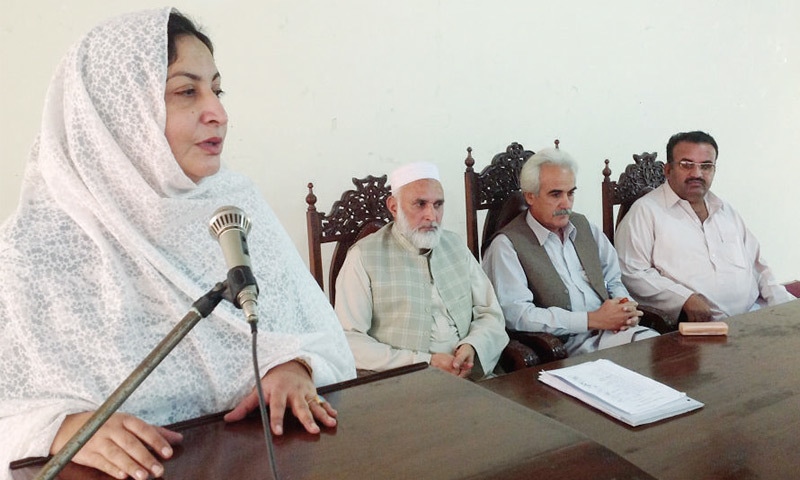
PESHAWAR: Speakers at a literary seminar held at the Pashto Academy, University of Peshawar, said that literary gatherings and exchange of views would boost cultural, social and political relations between the people of Pakistan and Afghanistan.
The daylong seminar on ‘comparative study of Khushhal Khan Khattak’s book on medicine’ and ‘creative imagery in Pashto poetry’ was held under the auspices of Pashto Academy at Maulana Abdul Qadir Hall here on Friday.
The speakers said that literary events would have positive impact on people across the Durand Line. They said that poets and writers should play due role in bringing peace in the restive region.
Prof Farkhanda, a senior teacher at the Pashto Academy, told the participants that the Afghan scholar-students would be facilitated in every possible way to conduct substantive research on various aspects of Pashto language and literature. She said that young scholars had great potential to influence their people and guide them towards achieving the goals of brotherhood, mutual respect and peace. She said that seminars would have a far-reaching impact on the Pak-Afghan relations in future.
According to officials, the academy had recently launched a series of literary seminars which had covered credit hours as part of doctorate thesis of students. Dr Nasarullah Jan Wazir, director of the Pashto Academy, told Dawn that currently around 15 Afghan students had been enrolled in the PhD programme.
Dr Javed Iqbal, senior research officer at the academy, said that conducting seminars proved a milestone in the field of literary research and critical evaluation. He said that it was the responsibility of the literati to promote literary and cultural values.
“The University of Peshawar, under a Memorandum of Understanding signed with the universities of Nangarhar and Kabul encourages research scholars to exchange their views on different topics. It covers three credit hours of the incumbent scholars and also imparts confidence and instills spirit of exquisiteness. Earlier, PhD scholars were supposed to sit a written test and submit a term paper,” Mr Wazir added.
Baitur Rehman Roodwal, an Afghan scholar, said that literary seminars and events could greatly help improve relations between the people of both the neighbouring countries. He said that exchange of views by literati could open up new avenues for the research students and could pave the way for permanent peace in the region. He said that Khushhal Khan Khattak wanted unification of Pakhtuns for struggle against the Mughal rulers.
Sadiq Zarrak, a Quetta-based scholar, said that Afghan scholars had positive views on Pak-Afghan political relations. He said that poets, writers and research scholars could help mend strained political ties between the people of Pakistan and Afghanistan. “Exchange of views on literary issues could also help us better understand each other, as people of both the countries had been facing same situation over the past several decades,” he said.
Abdul Ahad Mangal, another Afghan scholar from Kabul University, pointed out that Pakhtuns of both the countries wanted to have good working relations as it would further strengthen their century’s old literary and cultural ties. “We have never felt ourselves as strangers in Khyber Pakhtunkhwa, especially in Peshawar. We wish Islamabad and Kabul come closer to perpetuate everlasting peace and political stability in the region,” he said.
Abdul Jabbar, a scholar-student from Nangarhar University, delivered his paper on ‘importance of questionnaire in research’ and said that it should be prepared carefully keeping in view the ground realities and mental level of the participants. He said that research scholars were benefitting from each other’s scholarship, adding that it would have a positive impact on people-to-people contacts in different spheres of knowledge.
The seminar was attended by students, teachers and young research scholars.
Published in Dawn, October 31st, 2015
On a mobile phone? Get the Dawn Mobile App: Apple Store | Google Play