11
11


KABUL: Zakia Mohammadi, a woman in Afghanistan's first national paragliding team, waited on a hilltop on the outskirts of Kabul for a wind to lift her craft into the sky, as dozens of watching teenagers clapped and cheered.
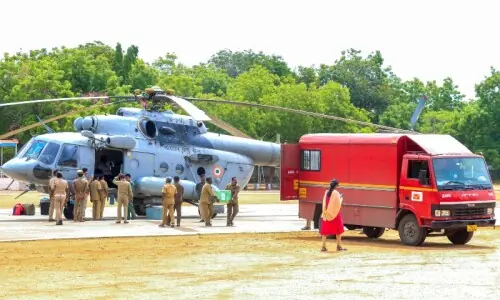
She is one of a group of young Afghans taking to the skies of a capital where military helicopters and surveillance balloons are a far more familiar sight.
“When I went up to the sky, I thought I was a bird which had just been freed from a cage,” said Mohammadi, one of two women in the newly established team of 15 that includes two trainers.
“I really enjoyed it.” Women in Afghanistan's conservative Muslim society are increasingly entering areas such as education, sports and the workplace, but most still wear the head-to-toe garment, the burqa.
“When women see me they don't believe that an Afghan woman can do this,” said Leeda Ozori, the other woman in the team. “The situation is not good, there is no security, but I am brave and I can do it.”
During the rule of the militant Taliban in the 1990s, Afghan women were kept out of schools, universities and public life. They could not leave their homes unless accompanied by a male family member.
“When we first came here, children were pelting us with stones,” paragliding trainer Mehran Rahbari told Reuters at the top of the hill in Kabul.
“But later, when they found out that we were coming here for sports, they stopped throwing stones at us. Now they love us.” Paragliding is an expensive pastime, however, in a city where the average wage is about $200 a month.
Even a middle-class Afghan will find it tough to afford the $500 cost of two weeks of training, while paragliding equipment costs $5,000.
Getting to the tops of hills takes hours of climbing in a four-wheel drive vehicle, in the absence of proper roads. An army vehicle carries the team's equipment, with a police escort to fend off possible attacks.
But the team's biggest concern is their vulnerability when aloft. “We fly for around 20 minutes in the sky and sometimes we fly over people's houses,” said Naweed Popal, who pooled his cash to set up the group just over three years ago.
“We are concerned if something happens and we find ourselves with no means of defence.” Each craft has a steering mechanism to avoid collisions, and every team member is given a radio to maintain contact.
Although the team hopes to expand operations to other Afghan provinces, security worries now restrict it to Kabul.
“We cannot go anywhere outside Kabul,” said Iranian trainer Rahbari. “We are afraid if we go out and get attacked, one bullet can end all our efforts.” But the women on the team are undeterred.
“Our idea is to show to the world that Afghan women, although living in war and insecurity, have the ability to improve and become developed,” said Mohammadi.