20
20
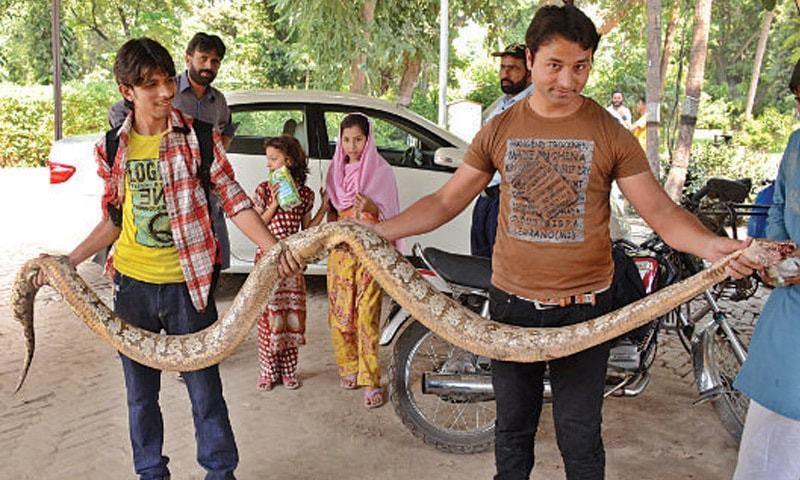

LAHORE: After killing of a huge female python in Bagh-i-Jinnah, The Mall, at the hands of its staff late on Friday, the Punjab Wildlife Department has decided to comb the public park to ascertain that no other such reptile was lurking there.
The move follows reports that some garden staffers saw another python on Friday night when the 10-foot long female was killed there.
Sources in the department told Dawn quoting garden staff that the other python ran away and hid somewhere in the park.
According to some department experts, the presence of python in a heavily populated urban area, and that too in a public park, was unusual.
They said pythons were found in rocky and riverine areas. How this female (or the pair) got access to an urban area was baffling, they added.
Wildlife Director General Khalid Ayaz said the department, in collaboration with Bagh-i-Jinnah staff, would conduct a survey of the garden to look for “more pythons” if they were there.
“We don’t have any expert on snakes in our department. Therefore, we shall ask our snake zoo keepers to conduct a survey of the garden, since they are expert on such searches,” said the DG.
Shahid Iqbal, Director of Bagh-i-Jinnah, however, denied another python was sighted in the garden.
“We welcome the wildlife survey, but there was no other python in the garden,” he said.
To the question why his staff killed a specimen of a protected snake species, Iqbal said the python was seen after 12 midnight and the workers got scared. He claimed the python had attacked the staff and could harm the garden employees living in nearby quarters.
On the other hand, World Wide Fund for Nature (WWF-Pakistan) Species Conservation Director Dr Uzma Khan condemned the python killing in a statement.
“The Indian Rock Python is a protected species which has declined because of poaching for skin and habitat loss. It is highly irresponsible attitude to kill a specimen without reporting it to the concerned authorities. It is a non-poisonous species and incidences of their occurring in urban areas are not uncommon in other countries.
The species is closely associated with riverine areas and can spread to more urbanised areas in the rainy season. Generally, there is a need to improve (public) awareness level about these species that are non-poisonous. Wildlife department, Rescue 1122 and WWF have rescued snakes in the past upon receiving similar reports,”the statement said.
Published in Dawn, September 15th, 2015
On a mobile phone? Get the Dawn Mobile App: Apple Store | Google Play