0
0

PESHAWAR, Oct 9: Duplication of work due to lack of coordination among authorities of various foreign-funded projects is resulting in financial and human resource losses, according to officials.
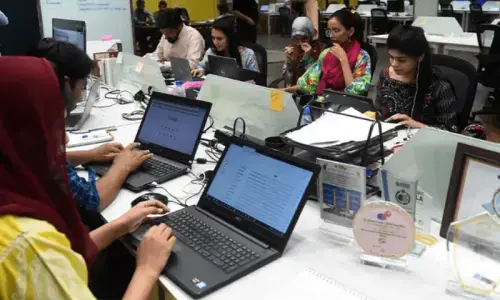
The topic was discussed at a workshop titled “Streamlining Capacity Building Interventions & Developing a Mechanism for Avoiding Duplication” held here on Thursday.
Majority of the participants belonging to different departments and non-governmental organizations stressed the need for a coordinated effort on the part of the stakeholders to rectify the situation.
The workshop was organized by the capacity building advisory board which has been recently established in the planning and development department aimed at sharing information about certain development initiatives and devising a mechanism to avoid duplication of efforts. The recommendations formulated at the workshop would be forwarded to the board.
The workshop was informed that over 10 donor-funded projects were assisting the provincial government in the capacity building of local governments in areas of human resources, systems development, identification of untapped resources, etc.
Apart from the Essential Institutional Reforms Operationalization Programme funded by UNDP and SDC, other programmes carrying out capacity building initiatives include Sarhad Provincial Conservation Strategy funded by SDC, Governance Programme assisted by DFID, and CIDA-financed CESSD.
Officials from the planning and development department informed the workshop that the activities conducted under most of these projects overlapped the work being done by other organizations.
Masoom Shah, Nazim of the Tehsil Municipal Administration, Charsadda, said four training courses for union councillors were conducted simultaneously on a single day with no coordination among the organizers.
“Each one of them simply wanted to hold the training sessions without caring for the fact that majority of the trainees did not understand their lectures and material written in English,” noted Mr Shah, adding “we have never been consulted on our requirements”.
Rehmat Ghazi, deputy secretary of the local government and rural development department, was critical of the fact that CBAB had been set up in the P&D department instead of its parent agency, that is local government and rural development department.
Mohammad Qasim Jan, executive director of the Institute of Research and Development Studies, during the question-answer session, observed that duplication of work might well be beneficial in broader perspective. Ms Irma Mail, representative of the Decentralization Support Programme, and Dr Reinhard Sauer, chief technical adviser to German Technical Cooperation, also spoke.