Contemporary art practices are slowly and steadily continuing to make their mark in Pakistan. For example in Lahore, art galleries have emerged that particularly promote new ideas and experimental discourse which in turn has raised the bar especially for young practitioners of art in terms of unique ideas in addition to technical skill.
Galleries like Rohtas, Grey Noise, 39K, and The Taseer Gallery are prominent examples of spaces for art that come in the aforementioned category. Another welcome addition is Avant Garde & Kitsch, which was opened recently. The brainchild of Hana and Hasan Altaf Saleem, a young couple who describe themselves as being ‘avid collectors of contemporary Pakistani art’, its very name indicates the kind of art it hopes to show case.
Avant Garde & Kitsch (with the acronym A & K), was launched with an exhibition titled “The Hatchery”, a name inspired by the idea of serving as “a springboard for emerging Pakistani artists”, in addition to providing selected young artists the opportunity to work together and also interact with established art practitioners and academics. This concept of a ‘residency’, whereby artists are provided with a space to live in and work with other artists, is the main thrust of A&K and is likely to continue in the future as well.
The exhibition proves once again that collaborative creative endeavours can be a rewarding experience for artists
“The Hatchery” was the result of group of five young artists working together in a studio space far away from the main city and included Anas Ghauri, Ayesha Akbar, Syed Haider Ali Naqvi, Sidra Asim and Numair Abbasi. Abbasi is a recent graduate of the Indus Valley School of Art in Karachi, and all the other artists graduated recently from the National College of Art (NCA) Lahore. While the show was curated by well-known art practitioner Waseem Ahmed, the young practitioners were also given the opportunity to benefit from the professional expertise of R.M. Naeem and Dr Adnan Zahid.
This particular residency brought forth an interesting mix of personal and socio-political discourse expressed in a variety of mediums and styles. Ghauri, who seems to have mastered the art of life-sized graphite-based drawings, vented his angst through a visually tantalising series of works in which the human body was seen posed upside down while the shirt would be seen fitted on the lower torso with the trousers on the head! At the heart of his expression was the trauma of witnessing a bomb blast in a restaurant he had frequented. The work appeared as a sensitive, well thought out catharsis that commented on the predicaments of living in an often painfully difficult environment.
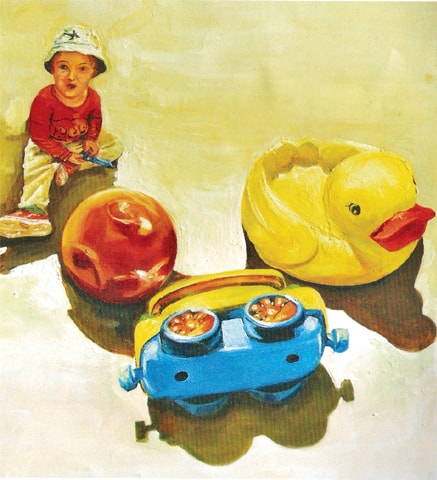 |
| Untitled, Sidra Asim |
Akbar’s work was based on her own photography, and explored the contrasts between reality and memory. The miniscule format and the experimentation with negative and positive spaces that emerged in the way selected paintings were displayed and framed, made the work both enigmatic and enchanting.
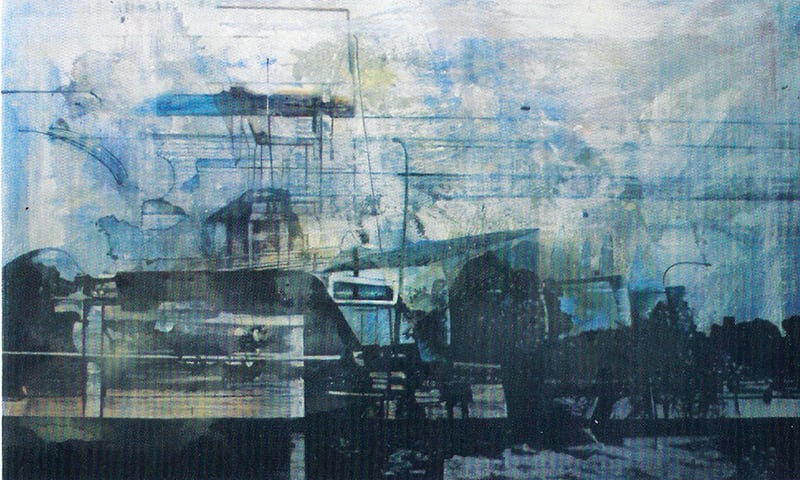
Ali’s large canvases displayed a fascination with architecture and construction, with images juxtaposed to create a surreal environment. He even used cement as a medium alongside paint in some of the paintings, imbuing them with a unique texture. Asim’s colourful painterly discourse was relatively straightforward, as she realistically rendered human figures and objects to convey the “overwhelming relationship objects and people have developed”, emphasising this point in the simple symbolism of small scaled people amidst abnormally large objects.
Abbassi’s huge canvases were also figurative, and though he had rendered the male body in a highly sensitive and realistic way, he nonetheless enmeshed these figures in swathes of colour, deft line work and mixed media elements to create a surreal ambiance. His rather voyeuristic discourse was unabashedly bold and uninhibited.
‘The Hatchery’ came across as a good beginning for a fledgling art space and reiterated the idea that artists need not work in isolation. Collaborative creative endeavours where one can share ideas and yet maintain one’s individual expression can indeed be a fruitful experience. In fact, it is a concept that can be emulated even in our socio-political context, promoting the much needed ethos of tolerance, and unity within diversity.
Published in Dawn, Sunday Magazine, July 5th, 2015
On a mobile phone? Get the Dawn Mobile App: Apple Store | Google Play