0
0

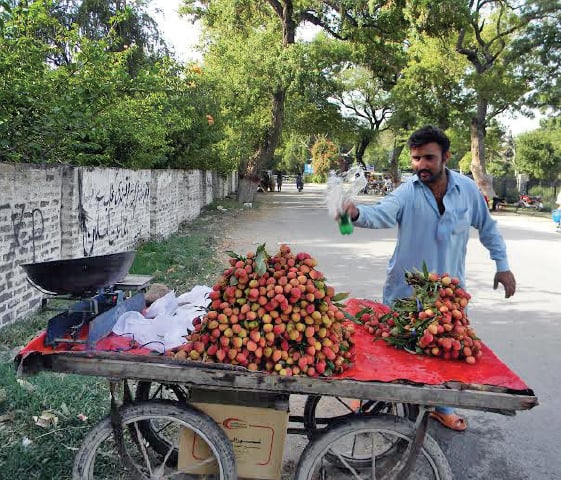 |
| A vendor sells Khanpuri lychee on Museum Road. |
TAXILA: As the juicy lychee from the Panj Khattha area of Khanpur has ripened, scores of makeshift kiosks have been set up along the Taxila-Khanpur Road for those wanting to buy the fruit fresh from the farm.
The Punj Khatta locality near Taxila is known as the food basket of the area and fruit is grown over some 280 hectares. This area is famous for producing world class oranges as well but lychee is only available in the market for a few weeks each year.
Imran Rasheed, one of the customers visiting the orchards, told Dawn that lychee grown in this area has a unique flavour and is not available elsewhere.
Another visitor, Mohammad Asim, had come with his family, who enjoyed a nice outing picking fresh lychee from trees in the farm.
“There is nothing like eating fresh fruit in the summer and children especially enjoy picking fruit,” he said.
According to officials in the local crop reporting centre, the lychee produced in the Punj Khatta area is of Chinese origin. There are four varieties in the lychee grown in Khanpur namely Gola, Surahi, Bedana and China. Each variety has a unique flavour and is larger in size than the varieties grown in Punjab, which is why it is generally more expensive. The officials said that lychee orchards spread over 2,500 to 3,000 kanals.
A farmer, Raja Kamran, told Dawn that timely rains this year coupled with uninterrupted water supply from the Khanpur Dam led to a good yield. He said that under an agreement with the Khanpur Dam authorities, farmers of Punj Khatta are entitled to receive 56 cusecs of water from the dam each day.
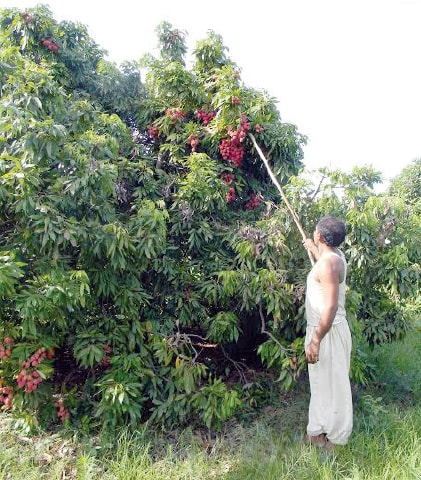 |
| A farmer picks fruit from a tree. — Dawn |
The farmer explained that lychee orchards need to be watered at least twice a month and preferably each week. Another farmer, Raja Khizar said that along with paucity of water and low rainfall, bats are another threat to the crop.
“Bats attack the lychee orchards in flocks,” he said.
Zahir Khan, another farmer, lamented that over fruit production in the area is seeing a decline.
He attributed this decline to rapid commercialisation of arable land and a reduction in the water table over the last few years.
Published in Dawn, July 2nd, 2015
On a mobile phone? Get the Dawn Mobile App: Apple Store | Google Play