0
0

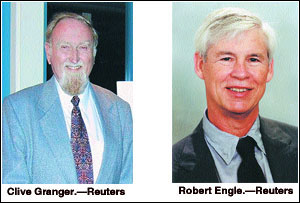 STOCKHOLM, Oct 8: US economist Robert Engle and Britain’s Clive Granger have won the 2003 Nobel economics prize for inventing models used to evaluate investment risk and study the relations between simultaneous economic phenomena.
“This year’s Laureates devised new statistical methods for dealing with two key properties of many economic time series: time-varying volatility and non-stationarity,” the Royal Swedish Academy of Sciences said on Wednesday.
The two men share the 10 million Swedish crown ($1.3 million) prize, which has been awarded since 1969.
Engle, born in 1942 in Syracuse in the state of New York, teaches at New York University and got the prize for improving methods of evaluating portfolio risk and asset pricing.
“Investors and financial institutions need forward-looking evaluation — forecasts — of volatility during the next day, week or year. Robert Engle formulated a model which allows such evaluations,” the Academy said.
Granger, born in 1934 in Wales, is an emeritus professor at the University of California. The academy said his work was used in studying links between wealth and consumption, exchange rates and price levels, and short and long-term interest rates.
Professor John Sutton of the London School of Economics said Granger had been a pioneer in his field.
“He did the key path-breaking work on how we can unravel the direction of causation when we ask questions like ‘Does an increase in money supply affect the level of inflation?’ or ‘Does the rise in the level of inflation lead to higher money supply?’” Sutton said.
The economics award was not among the original prizes for chemistry, physics, literature, medicine and peace founded by the inventor of dynamite, Alfred Nobel, in his will in 1895.
It was instituted by Sweden’s central bank as the “Bank of Sweden Prize in Economic Sciences in Memory of Alfred Nobel” in 1968 and first awarded in 1969.—Reuters