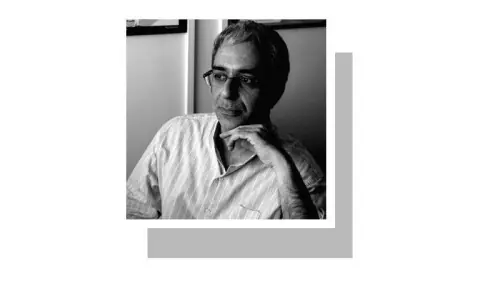
Today marks the 22nd death anniversary of Habib Jalib, the revolutionary poet extraordinaire.
Born in 1928, Habib Jalib migrated to Pakistan from India following partition in 1947 and started working for the Daily Imroz in Karachi. Being a progressive poet he wrote against the military coups of General Ayub Khan and Ziaul Haq and protested in the streets against the Hudood Ordinance alongside women.
Jalib was jailed several times but was resilient when it came to his poetry. Once, in jail, he was told that he would not be provided with pen or paper — to which he responded “I recite my poem to your guard, he will recite it in the town square, and so it will reach Lahore.”
It wouldn't be wrong to call him a people’s poet because unlike other Urdu poets, Jalib adhered to a colloquial style and was able to draw large audiences who related to his words that resonated with spirit and fervour.
Also read: Jalib, poetry & military courts
His poems Dastoor and Musheer are still as still as popular as they were when he recited them for the first time; Musheer spiked in popularity when the band Laal sang a rendition some years ago.
Dr. Taimur Rehman from Laal said of Jalib:
"Arguably the most wonderful thing about Habib Jalib was that he was an iconoclast at several fundamental levels. First, he was totally opposed to the currently prevailing socioeconomic system of capitalism, neocolonialism, and feudalism. He spent his life as an advocate of the progressive movement, the left, of Pakistan. In fact, it would not be wrong to say, that he was its most public advocate insofar as the masses of workers and peasants were concerned."
He also added that the reason Habib Jalib was widely read was because he took the complex ideas of socialism and distilled them into indigenous politics, poetry, and humour.
"In fact, a student of politics or literature could arguably retell the entire people’s history of Pakistan merely by reading Jalib’s poems sequentially and understanding not only the context in which they were written but also the struggles that they represented," Rehman said.
"People often ask me how Jalib can continue to be relevant to the people of Pakistan more than two decades after his passing away," he continued. "My answer is simple, he will remain relevant so long as the oppressive forces he stood up to remain in power. As Jalib himself wrote:"
 |
Musician and singer Ali Aftab Saeed also held the opinion that there would be none like Jalib because of his character.
"Habib Jalib was not a revolutionary who was confined to his poetry, rather he was a revolutionary in his life as well. He refused to take a single penny from the government even when he fell really sick, rather he told former Prime Minister Benazir Bhutto who insisted on taking him abroad, that "ye jo baaqi ward pe paray hain woh nazar nahi arahe? (Can't you see the rest of patients in the ward?)," said Saeed.
"In our history, one can't many artists who has survived without patronage of the state—Jalib was the only person who did that. He stands as an inspiration for me because during Jalib's time, there were many great poets yet his name remains alive because of the purity of his character. Similarly there are many great artistes other than me who are doing a better job but I feel that characters can make legacies just like Habib Jalib," he added.