7
7
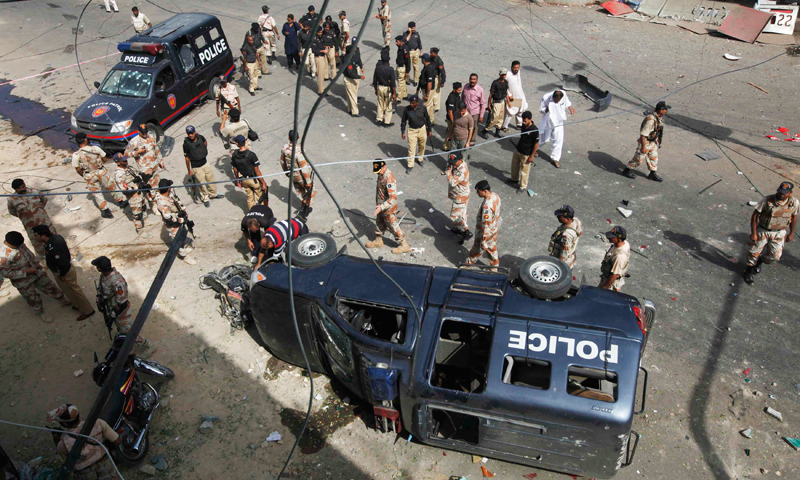

OF all the battlegrounds on which the National Action Plan against terrorism has to play out, none is as complex and fraught with risk as the city of Karachi.
Here the framework created by NAP for combating militancy is likely to prove inadequate for confronting the delicate balance of terror upon which the city’s functional peace rests. The reason is as simple as the problem is complex.
For a durable solution to Karachi’s problem of organised violence, the city’s institutions, including but not limited to the police, need to be depoliticised. But to do this, some measure of politics needs to be part of the operation.
Also read: Army will go to any extent for Karachi peace: COAS
This careful and subtle balance, between eradicating the influence of political parties while relying on these same parties to provide the consensus behind the enterprise, is the Gordian knot of Karachi, and it is worthwhile to recall that every government since the early 1990s has tried to tackle this problem — and failed. Care and subtlety are rare virtues in Pakistan’s political landscape.
The roots of organised violence in Karachi go into a vast struggle over control of the city’s resources — water, land, jobs, transport etc — and the anaemic state of governance in this teeming metropolis of 20m residents owes itself to the fact that informal mechanisms to gain control of these resources serves everybody’s purpose better than a formal and rules-based system does.
Eliminating one organised gang has usually done little more than create a vacuum that other actors quickly fill. Lyari provides some evidence of this today, where the leadership of the Amn Committee, created in a sinister move to counter the militarised elements of the MQM, has been eliminated from the locality but a new, younger and possibly more dangerous crop of organised gangs has stepped in instead.
Eliminating violent elements can only be the first step to restoring peace in Karachi. Creating the institutions to maintain peace in the aftermath, and more crucially, freeing up the city’s resources from the power struggle, must follow.
The presence of the banned TTP in parts of the city complicates the job further still. It is for this reason that the framework of NAP can prove inadequate in Karachi.
Any operation will need to be carefully calibrated, with a clear end point in sight beyond which the job must pass into the hands of city administrators, who have to drain the swamp of struggle over urban space that breeds organised violence.
The trick lies in recognising how politics is part of the problem, and part of the solution at the same time. This is the high-wire act necessary for stabilising Karachi. The authorities must learn from the excesses committed in the two security operations conducted in the 1990s, and realise that in Karachi, peace lies in the nebulous middle ground between coercion and consensus.
Published in Dawn, February 18th, 2015
On a mobile phone? Get the Dawn Mobile App: Apple Store | Google Play