0
0
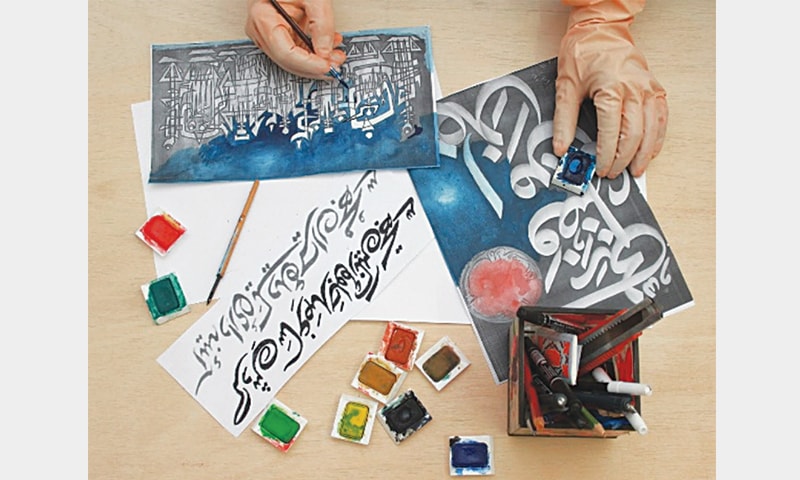

In the early 1990s, art maestro M. F. Hussain arrived in Karachi on a visit to Pakistan. His hosts and friends requested him to paint something for the Karachi Press Club. Others expected him to draw on canvas but, genius that he was, Hussain painted a wall instead. Why had he chosen to do so, asked his hosts. “Walls cannot be sold,” replied Hussain. “You can’t make a replica of a wall and sell it to ‘art lovers’.”
Hussain may have left Karachi soon after but his words reflect an interesting paradox and a grim reality: an artist, whose work is worth thousands of dollars even after his demise, simply did not want his work to be sold.
It wasn’t just Hussain who adhered to this philosophy: Sadequain also valued his art in more forms than financial.
In the open art market, Sadequain’s works began fetching great prices during his lifetime. Following his demise, demand for his artworks grew exponentially.
It is easy to plagiarise Sadequain ... simply because of how prolific he was
Today, some 28 years since his demise, Sadequain is perhaps the most plagiarised artist of the country.
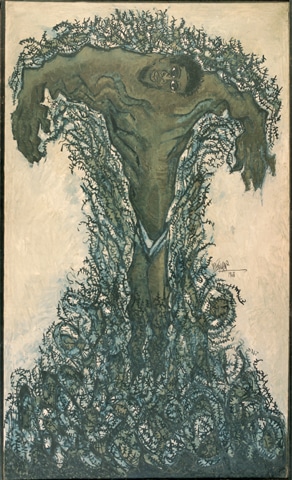 |
| Crucifixion: Martin Luther King, 1968 |
“Sadequain’s portfolio is very versatile,” explains a veteran artist, requesting anonymity. “There is an abundance of work, in every style and form — from his earlier nudes, figurative work, and later on, his calligraphy. He was very quick too when it came to drawing; some of his work inspirations were impromptu. As a result, there is a vast body of work that others try to copy.”
Plagiarism of art is neither new nor peculiar to Pakistan. But while heritage and built architecture — the remains of Mohenjodaro, Harappa and Gandhara— are preserved and safe, smaller art works are easier to recreate.
“I have seen seasoned artists make first class copies of Sadequain’s Gandhara sculptures, and sell them at exorbitant rates,” narrates a senior artist from Karachi on condition of anonymity. “Needless to say, all we Pakistanis think about is making money.”
Another senior art critic from Lahore believes framers have played a vital role in throwing art into jeopardy. “You hire unemployed painters, you give them a photo of the painting you want to replicate, and he paints it. You sell and people buy it. It starts at a very small scale which turns into a flourishing business.”
But that’s not all and not the last of what is being plagiarised.
“It’s a business. The culprits are not the plagiarists but the people who buy their work,” argues Abdul Qayyum, owner of an art gallery in Karachi. “An acquaintance bought paintings worth Rs25 million altogether, from a man claiming to have directly dealt with the painters. The works included some masterpieces by Sadequain, Gulgee and Jameel Naqsh. Later, 85 per cent of the work was proved as counterfeit by a senior art critic. The people involved in the case were eventually caught but no action was taken against them.”
Much like other sectors, art enthusiasts have nowhere to turn to if they claim compensation or want to sue for fraud.
“Who do we report it to? Well-known gallery owners, families of late painters and businessmen are involved. There’s a whole mafia behind the scene, who is going to stop it?” alleges a senior painter. “Sadly, this business has affected established painters more so than anyone else.”
While business thrives through such plagiarism, the government and other authorities concerned tend to turn a blind eye to theft of intellectual property. The consensus among the art community is that it is artists themselves who have to work to save themselves and their work from being killed.
“His work was worth half a million rupees while he was alive and healthy. You can imagine where the demand of his work would have reached soon after his demise. They have brought Sadequain’s work to a point where people no longer buy it,” argues the Lahore critic. “There is no system of authentication in this country for art. What they don’t understand is that this treasure called art is another way people identify themselves. Amidst the ongoing crises, art is what is keeping the country alive.”
Published in Dawn, Sunday Magazine, February 8th, 2015
On a mobile phone? Get the Dawn Mobile App: Apple Store | Google Play