33
33
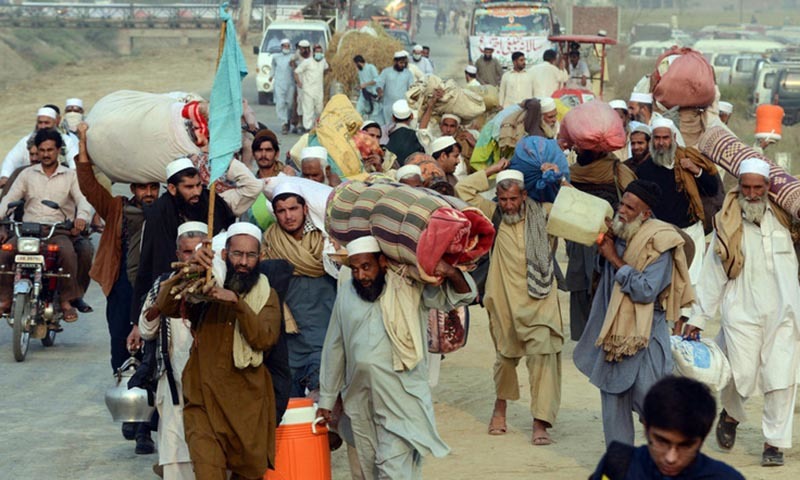

MOHAMMAD Ghufran took less than a few seconds to sum up the reasons that have led to the decline of the political and economic influence of the Muslims in the world. “We’ve digressed from the ‘true path’ of Islam and lost our way,” he explained to Dawn on Sunday, the last day of the first phase of the Tableeghi Jamaat’s annual gathering at its centre in Raiwind. The second phase begins on Wednesday.
The 32-year-old public schoolteacher from Gujranwala, who spends his weekends ‘reforming’ his fellow Muslims, isn’t the only one who holds that the Muslims can regain their old glory and dominate the world if they choose to return to the true path of Islam. Millions of other followers of the Tableeghi Jamaat, the largest Islamic revivalist movement in the world today, share his opinion, and are trying to change the Muslim societies and communities around the globe through dawa, or preaching.
Also read: JJ's path: from pop pioneer to tableeghi jamaat
The Jamaat, an offshoot of the Deobandi movement, was founded by Maulana Mohammad Ilyas in Saharanpur, now in India, to spread the message of Islam and purge the Muslims of the influences of other religions, especially those from Hindu culture. In the early years, its influence grew very slowly. Its biggest impetus came from the partition of the subcontinent after which it spread around the world. But “its roots essentially remain in South Asia and its leadership also comes from the subcontinent,” says Arsalan Khan, a cultural anthropologist who did his PhD on the movement and teaches at the Institute of Business Administration in Karachi. Today annual ijtemah, or gathering of the followers of the Jamaat, in Bangladesh and Pakistan are the second and third largest gatherings of Muslims, respectively, other than Haj.
The Jamaat has a very loosely organised structure with the neighbourhood mosque serving as its basic unit. The movement has a shura, or leadership that operates on the global level, but “there is no chain of command and each unit — national, sub-national, city or neighbourhood — is totally autonomous in taking its own decisions for dawa,” says Khan.
Tableeghi Jamaat’s disavowal of politics leaves many sceptical, who say the movement has brought about a deeper cultural shift in the country’s society and politics by helping to legitimise right-wing ideology.
The movement has been targeted by militant groups, most recently in an attack on its centre in Peshawar. According to Khan, this is because the movement disavows jihad, and any other violent path towards Islamic revival. Nevertheless, it has attracted the attention of scholars and terror experts in recent years because some individuals with links to the movement have allegedly been involved in terror incidents in some European countries.
Even though it has never been accused of supporting terrorism, some fear that it helps create a safe environment for militants to blend into. “You cannot discount fears that it acts as a breeding ground for radical and extremist groups and organisations,” says Farooq Tariq, the general secretary of the left-leaning Awami Workers’ Party (AWP). “There have been reports that the Raiwind ijtemah is used by militant organisations to recruit their cadre as well as for drug- and gun-running to gather funds for their activities.”
A professor of Islamic Studies at a public university in Lahore, speaking on the condition of anonymity, agrees that the movement is outwardly peaceful in its message, but adds that militants can easily penetrate its following for cover and travel abroad. “So it should not be surprising to see some individuals linked to it at the centre of terror investigations in Europe or elsewhere,” he adds.
Even its disavowal of politics leaves many sceptical, who say the movement has brought about a deeper cultural shift in the country’s society and politics by helping to legitimise right-wing ideology. “It has made a very large contribution to our society’s swing towards extremist ideology and religious fundamentalism,” the AWP leader stresses. He says the right-wing political parties like Pakistan Muslim League-Nawaz and the Pakistan Tehreek-i-Insaf support the Tableeghi Jamaat because these parties are the direct beneficiaries of society’s ideological swing towards the right.
Khan agrees to some extent. “The Tableeghi Jamaat is not political in the narrow sense of the word. But, yes, it is political in the sense that it wants to change the whole foundation of society.”
Others, like the Lahore-based professor, worry about the sectarian baggage that the Jamaat’s growing influence brings. Officially the movement is silent on sectarian issues, but “unofficially, its membership is strictly sectarian in its outlook because they are told to follow the faith of a particular sect,” he says, adding that he was witness to an incident when a local Tableeghi party in Lahore Cantt, led by a former general, ‘advised’ a resident to remove the emblem of his faith from his rooftop.
Khan agrees that individual followers of the Tableeghi Jamaat can be sectarian in their outlook, but adds that throughout his fieldwork with the group, he has “never seen or heard any leader of the movement speak in Takfiri terms”.
Published in Dawn, November 12th, 2014