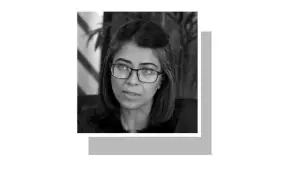
From making pickles with traditional recipes to knitting poems with an eccentric diction, she believes in romancing and celebrating every aspect of life.
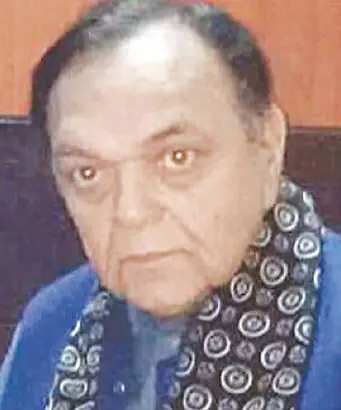
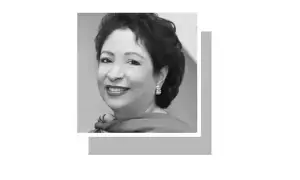
Renowned poet, radio broadcaster and political activist Nasreen Anjum Bhatti was born in Quetta and raised in an art-friendly environment.
“I grew up looking at drawings by my father; my cousins also used to draw a lot. I clearly remember Saeed Akhtar, who was our family friend and like an elder brother to me, doing portraits. I can say I lived a rich childhood,” she vividly recalls.
She was in junior school when her family moved to Sindh. After earning a scholarship, she joined the Lahore College for Women to earn a bachelors degree in Fine Arts. She started her professional career in 1971 as a producer at Radio Pakistan, Lahore, right after doing her master’s.
“Radio Pakistan was an institution that helped a great deal in my grooming as an artist. We were lucky to have the company of music and literary legends like Amanat Ali Khan, Wazeer Afzal, G.A. Chishti, Zaheer Kashmiri, Sufi Tabassum, Nasir Kazmi and Munir Niazi,” she recalls.
She has been composing poetry since a tender age. After moving to Lahore for studies, the interaction with literary icons like Dr Anees Nagi, Dr Aziz-ul Haque, Intizar Hussain, Abdullah Hussain and Kishwar Naheed helped her a lot in understanding the popular art and literary movements of 1970s.
“This generation of writers was very energetic and haunted by the pain and agony of partition. Even though we were the backbenchers at the houseful literary sessions at Pak Tea House, we were proud part of this fraternity,” she says.
She talks about the politically-charged environment of 70s and 80s with a great enthusiasm, “the age of Sartre and Albert Camus.”
“Being a government employee, I could not participate openly in political activities but I used to go to distribute flyers at night with fellow comrades.”
“The assassination of Bhutto created a shock wave and it was the beginning of the literature of resistance in Pakistan,” she adds.
“I was never inclined to write traditional romantic lines glorifying the love life of an individual. My romance deals with the collective pain and pleasure of folks and their class struggle. So I created an idiom of my own. It was striking and shocking for the conventional poets and critics,” she explains.
She is grateful to Najm Hosain Syed, who encouraged her to go for innovative experiments amid hostile criticism from literary pundits.
The pro-people and radical poets, especially Bulleh Shah, Shah Hussain and Latif Bhittai, have been her permanent sources of inspiration and energy.
Her first collection of Punjabi poetry, ‘Neel Karaiyan Neelkan’, published in 1979, made a lasting impression on modern Punjabi poetry and became her hallmark. It was followed by another collection, ‘Athay Pehr Tarah’, in 2010.
Her works were widely acclaimed and honoured with prestigious literary awards. She was awarded Tamgha-i-Imtiaz in 2011.
In her poetry, she creates surrealist images with a rich diction. Nasreen effortlessly knits poems with a sharp craft and facility to twist the ordinary words and phrases into stunningly beautiful lines. She challenges patriarchy, dictatorship and all other forms of oppression. Her works could be described as a bridge between folklore, classic and modern Punjabi poetry.
Published in Dawn, October 19th, 2014