1
1

PESHAWAR: The Peshawar High Court on Tuesday expressed displeasure at deaths of several people kept at the province’s internment centres and observed it won’t tolerate the handing over of the bodies to the respective families without autopsy.
A bench comprising Chief Justice Mazhar Alam Miankhel and Justice Malik Manzoor Hussain directed the head of Kohat internment centre to produce a detailed report on the death of four internees by Nov 6 and adjourned hearing into the case on it until then.
The bench directed Fata additional chief secretary Arbab Mohammad Arif and provincial home secretary Akhtar Ali Shah to ensure that none of the bodies of internees was handed over to their relatives without conducting their postmortem so as to ascertain their causes of death.
Also read: PHC asks for written replies in missing person cases
The chief justice observed that apparently, by not conducting autopsies of the bodies of the internees, the authorities were trying to conceal the cause of their deaths. He regretted that when the time was given to relatives of an internee for meeting him, they were instead given his body.
The bench warned when the relevant authorities had not been following the Action (in aid of civil power) Regulation 2011, the court would have to issue strict orders.
Observes won’t tolerate handing over of bodies to families without autopsy
Justice Malik Manzoor observed that it was the responsibility of the officials to inform the court about the cause of death of an internee as it was a legal requirement.
Arshad Khan Yousafzai, lawyer for petitioner Noor Mohammad, said the body of his client’s son, Minar Khan, who was interned at Kohat internment centre, was handed over to him a month ago.
He said his client did not want to pursue the case as his son had already been killed and that he could be the next target of security forces.
The bench, however, convinced the petitioner not to withdraw the case and ordered the head of the internment centre to produce a detailed report of the death of Minar Khan.
The petitioner, a resident of Bara, alleged that his son was taken into custody by the Qaumi Lashkar two and a half years ago and was handed over to security forces.
Another petitioner, Tahir Khan, said his brother, Liaqat Ali, was arrested on June 26, 2012, when he had gone to Peshawar to inquire after his mother admitted to a hospital. He claimed in last Ramazan, the family was given the member’s body by the Kohat internment centre.
Another petitioner said his brother, Jan Mohammad, was arrested by the police at Karkhano Bazaar and that a few days ago, he was handed his body by the Kohat internment centre.
Similarly, lawyer for petitioner Maryam said her son was interned at the Kohat internment centre and recently his body was handed over to the family without conducting autopsy.
When the bench asked about the reports produced by internment centres, additional advocate general Rab Nawaz Khan said so far in several cases, the government had not received reports.
The bench took exception to his statement and summoned the Fata ACS and home secretary.
When the two turned up, they were told about the gravity of the situation. The bench observed that despite repeated orders for production of reports of the relevant oversight boards and details about internees, the authorities had not been producing the same.
Home secretary Akhtar Ali Shah said reports of oversight boards had been sent to the chief minister for approval. He said in accordance with the orders of the court, the reports of oversight boards would be produced in sealed envelopes.
The home secretary said recently, he had directed the divisional commissioners to submit reports of oversight boards to the court. He added that action would be taken against the officials who would not comply with those directives.
The home secretary requested the bench to provide him some time as he would convene another meeting within a week so as to address the concerns of the court.
The bench gave him more time observing if its orders were not complied with, then it would order the production of all people kept at the internment centre.
Meanwhile, chairwoman of NGO Defence of Human Rights Amna Masood Janjua has claimed that during the last couple of months, 97 bodies of internees were handed over to their families by internment centres but the provincial government had turned a blind eye to the matter.
She told reporters on the premises of the high court that she had requested Pakistan Tehreek-i-Insaf chief Imran Khan and Chief Minister Pervez Khattak to give her time for a meeting on the matter but to no avail.
Amina said no noteworthy progress had been taking place in cases of missing persons and thus, increasing the misery and anxiety of the respective families.
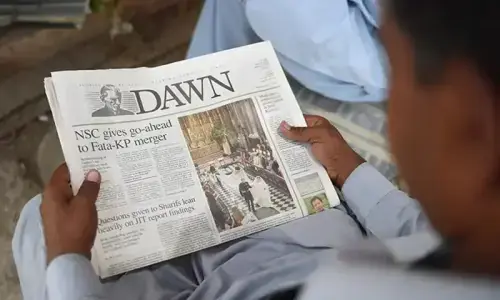
Published in Dawn, October 15th , 2014