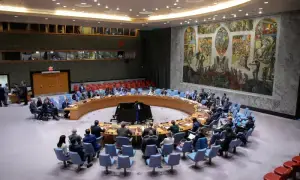
GENEVA: The UN's top human rights body called on Friday for nations to protect the rights of individuals regardless of sexual orientation, in a vote that exposed global fault lines over gay rights.
The 47-nation Human Rights Council resolution expressed “grave concern at acts of violence and discrimination, in all regions of the world, committed against individuals because of their sexual orientation and gender identity”.
“All human beings are born free and equal in dignity and rights,” the council said, adding that tradition was no excuse for the violence and discrimination suffered by people worldwide due to their gender and sexual identity.
But the vote cleaved the 47-state council neatly between mostly Western states, and a group including Asian and African nations, many Muslim.
The 25-strong bloc in favour of the resolution included Western and Latin American nations, as well as South Africa, the Philippines and Vietnam.
Fourteen nations opposed the resolution including Muslim countries Algeria, Indonesia, Morocco, Pakistan and Saudi Arabia, as well as Russia, and, from sub-Saharan Africa, Ivory Coast and Ethiopia.
Seven members including China and India abstained, while Benin's ambassador was absent.
Adversaries failed in multiple efforts to use procedural moves to strip the resolution of significance by removing all references to sexual orientation and gender identity.
They also tried to add language making it applicable only to countries who proactively declare support for sexual diversity and rights.
The resolution dismissed cultural specificity as a justification for states allowing anti-gay policies and violence.
“While the significance of national and regional particularities and various historical, cultural and religious backgrounds must be borne in mind, it is the duty of states, regardless of their political, economic and cultural systems, to promote and protect all human rights and fundamental freedoms,” it said.
The resolution also tasked the office of the UN High Commissioner for Human Rights with carrying out a new assessment of the state of violence and discrimination and how it can be battled.
“This resolution will offer hope for all those in the world who are victims of such violence or discrimination, and that is its goal,” said France's UN ambassador, Nicolas Niemtchinow.
South Africa offered its staunch support for the resolution, referring to its own history of enduring the apartheid regime.
“This history and the struggle against all forms of discrimination had therefore made us, as a people and a country, commuted to the principle that no person should be subjected to discrimination or violence based on race, class, sex, religion, gender and, as is the case with this resolution, on the basis of sexual orientation or gender identity,” said South Africa's ambassador, Abdul Samad Minty.