11
11


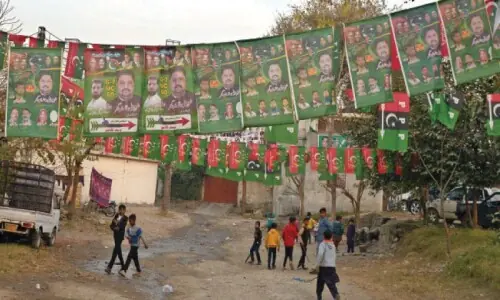
Calls for ‘naya Pakistan’ may have been mounting in Punjab last week, but the world’s attention is waning. Chatting with journalists who cover Pakistan for international media outlets, I wasn’t surprised to hear that they’re struggling to get column inches for their stories. The world currently offers too many other crises, from Iraq to Libya, Gaza to Donetsk. What seems like a vagary of the news cycle could yet have serious implications for stability in Pakistan.
The idea that Pakistan is ‘too big to fail’ has long been entrenched in our national psyche. We have long assumed that any amount of irresponsible behaviour on the part of our leaders would be excused by the international community because Pakistan is too critical to regional — perhaps even global — stability to let it self-destruct.
This notion is rooted in many national attributes: the country is a large and growing market; nuclear-armed; linked to the West through its diaspora; home to a grab-bag of militant groups whose activities produce ambivalence rather than condemnation; a key supply route in a region dotted with conflict; in cahoots with China, and more.
The perverse confidence that we’re too big to fail has often led to suicidal policymaking on the part of both civilian and military leaders. Consider, for example, the ‘double game’ with regard to militancy; the refusal to cut subsidies; continued obstinacy on India; and persistently poor governance.
The default mode of our leaders is to act now, think later
Our leaders continue to make bad decisions knowing that the world will think twice before letting Pakistan’s economy collapse or allowing militants to overrun its territory. The US in particular has fuelled this perception over the past decade, frequently giving in to Pakistan’s histrionics by swooping in with military aid or blessing new IMF packages to keep supply routes and back channels open.
But things are changing. The world is becoming better accustomed to failure. Washington concluded a while ago that it could not bring peace to Iraq, and walked away. Its return to that country last week to conduct air strikes against the jihadists of the militant group Islamic State was grudging, limited and pessimistic. The US has also resignedly watched developments in Syria, Ukraine, Israel-Palestine and elsewhere. The challenge in Syria is particularly extreme, with the country poised to be a haven for violent extremism in the heart of the Middle East.
Pakistan is thus no longer unique in its ability to teeter on the brink of collapse in ways that would be potentially destabilising to its neighbours. The paranoia that the thought of a jihadist Pakistan used to induce has lessened as an increasing number of European countries see their Muslim nationals flock to Syria, and fret that they may launch attacks upon their return.
Pakistan’s access to nuclear bombs will of course keep it on the global radar for many years to come, but it may only be a matter of time before this too is a more common phenomenon.
It is in this context that Pakistan’s refusal to tackle internal challenges could lead to instability. The default mode of Pakistan’s leaders is to act now, think later. They feel no need to cultivate a long-term vision for the country believing that they will always be bailed out of trouble: the politicians wait for the military to come to the rescue, the military waits for the US to step in with the backing of the international community.
Ironically, this very confidence in the fact that we’re too big to fail could trigger failure because the international community, plagued by crises, is losing the will to help those who won’t help themselves.
There are many counts on which Pakistan’s intransigence is likely to cause the world to throw up its hands in frustration and give up: the continued ambivalence towards militant groups, and the tendency to pit ‘good’ Taliban against ‘bad’ Taliban while engaging in proxy warfare; the irrational and self-serving behaviour of Pakistan’s politicians (as manifest in the recent shenanigans of the three Ps in Punjab); the absolute refusal to tackle systemic discrimination and persecution of religious minorities; and the failure to introduce meaningful economic reforms. While fighting to win small battles, our leaders have lost the plot.
There are many analysts who believe the realisation that we are no longer too big to fail (or that our failure won’t be as catastrophic or unique as previously believed) has driven the recent military operation in North Waziristan. Many have linked the military’s alleged pursuit of the Haqqani network to the fact that the US has made the release of a $300m tranche of the Coalition Support Fund conditional on an operation targeting the group.
If true, this would suggest our complacency has been shaken. Let’s hope the world’s diminishing interest in saving us from ourselves leads to introspection, self-reliance and responsible policymaking.
The writer is a freelance journalist.
Twitter: @humayusuf
Published in Dawn, August 18th, 2014