KARACHI: The Sindh government has received a letter from Islamabad asking for extensive polio campaigns in the province, particularly in Karachi, in anticipation of the arrival of thousands of internally displaced persons (IDPs) from North Waziristan Agency after the launch of an army operation there, it emerged on Friday.
Officials in the provincial health department said that they had received a letter last week from Islamabad asking for greater efforts to combat the crippling disease, the increasing incidence of which has led to travel sanctions on the country by the World Health Organisation (WHO).
The sources said the authorities in Islamabad wanted to know about the activities of the relevant authorities in Sindh vis-à-vis eradication of polio particularly during Ramazan.
Know more: IDPs show up in city as govt sounds polio, security alert
“The month is very important as it has come soon after the WHO sanctions and requires to be spent with a lot of effort,” said the letter, which the officials called a government memo.
“It is time to go for all an out-war against polio as it has already harmed the country a great deal,” a source quoted the document as having contained.
The officials, however, claimed that they had spent the whole month with all the resources available to root out polio, which included several campaigns, not publicised in the media for security reasons, in the city’s ‘most sensitive’ parts, which formed Karachi’s western and eastern fringes.
However, they conceded that many such campaigns could not be run when security was not available.
“Large congregations and shopping sprees everywhere required most of the police protection, because of which we could not get approved certain polio campaigns in Karachi during Ramazan,” said a senior police official.
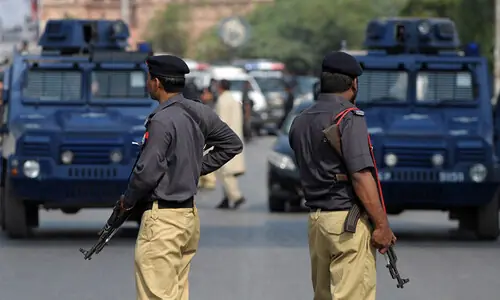
The recent practice required police protection and a ban on pillion-riding in the areas where a polio campaign is planned. The measure has been made mandatory after recent attacks on volunteers that killed and injured many of them.
No volunteer is permitted to go for vaccination of children aged up to five in the absence of police protection.
Sindh has recorded nine out of 99 polio cases in the country — eight of them from Karachi and one from Sanghar district.
The province recorded 10 cases last year with eight from Karachi and four in 2012 — the year when the city remained polio-free.
The officials said with the arrival of thousands of IDPs particularly in the city’s western fringes, the danger of polio had multiplied as NWA had reported more than 60 per cent of the polio cases recorded in the country.
“It is hugely dangerous. We have to see every child, but what concerns us more is that most of the arrivals from NWA have resided at their relatives who live in the localities that are already declared the most sensitive in our files,” said a senior official.
The officials identified Baldia and Gadap towns and Gulshan-i-Iqbal neighbourhood as areas where active virus had been detected.
They said Islamabad had also communicated with the provincial governments of Punjab and Khyber Pakhtunkhwa, expressing similar concerns over the detection of the poliovirus from the sewers of Rawalpindi, Faisalabad and Peshawar towns.
In its letter, the federal ministry sought the provinces’ help to ensure that the coverage in future immunisation drives reach the maximum number of children and those children missed out for a host of reasons, mostly reluctance on the part of their parents particularly in Pakhtun origin families, should be traced and inoculated in special campaigns.
Polio campaigns had been abruptly ended more than once in the city after attacks on volunteers in Qayyumabad this year and previously on a WHO doctor and several polio vaccinators.
As many as 754 polio cases have been detected during the past 18 years in Sindh, official figures show.
Apart from Pakistan, the only two other countries where polio cases were reported in 2012 were Nigeria (over 200 polio cases) and Afghanistan (over 60 polio cases). The results this year for both the countries are much improved than Pakistan.
Efforts to tackle polio in the country have been hampered over the years by local people’s ‘misconceptions’ and suspicions about vaccination, which has engendered violence.
Resistance also comes from parents, who believe in ‘conspiracy theories’ about the polio vaccine.
Published in Dawn, August 2nd, 2014