KARACHI: When does a symbol start to lose its efficacy? This is the question that often perturbs playwrights and other theatre persons. The play titled Kuttay directed by Meesam Naqvi on Sunday evening in Napa’s in-house theatre had some very convincing scenes as it moved through many technical realms (absurd, farcical and realistic, to name a few) to drive its point home. And yet, there came a time in the performance when one felt that the plot-pushing was a little overkill.
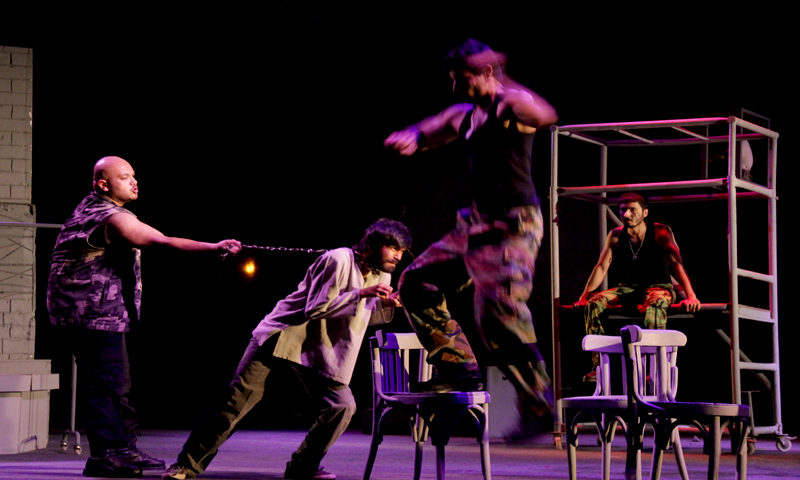
Kuttay tells a story that all Pakistanis are familiar with. There is a force that is out there to usurp people’s rights on the pretext of liberating them. Led by Hammad Sartaj, they get hold of a man (Shahjahan Narejo) and interrogate him. The man is a meek character who gives in to whatever the gun-toting men ask for. The references to the captured man’s aurat (woman) are used to indicate his everyday life and expose the latent diabolical side to his powerful captors.
From there on begins a series of role-playing. The military men assume many roles in the play, including the present-day politicians who harangue the public to press and further their agendas. Not just that, they also become characters, for example, those of doctors, who have different sets of rules for different patients (read: clients). In the mix, there’s a donkey that seems to be someone who gives orders but at heart is asinine a creature as they come.
The treatment of the meek man is harrowing. At one stage a leash is put on him to turn him into a dog, hence the title of the play. He is beaten and kicked around but he, like the loyal canine, returns to his master(s) without registering any kind of protest. Things don’t look up as the powers that be go from strength to strength (which has been the case for the past 60 odd years, as referenced in the script) and the subjugated become more and more submissive.
Meesam Naqvi’s effort on Sunday brimmed with energy. It was evident. What was also evident was the fact that he prepared the play with a lot of passion. The script (it was not mentioned who wrote it and from where it was adapted if it was adapted) had some solid lines. It had humour as well as sarcasm and at the same time dealt its addressees with a certain degree of disdain, trying to goad them into opening their eyes and wake up to reality.
Having said it all, the play went a little overboard while attempting to hold the mirror up to the audience. As symbols in a dramatic presentation have a life of their own, they need not be flogged to death. And if one needs to reinforce an idea, it can be done by breaking the visual and dialogic monotony.
Even at the end when Shahjahan, the actor, interacts with audience, it looked as if he didn’t have anything very substantial to say. Mind you, again, Kuttay is not an ordinary play. A little bit of tweaking can add to its power.