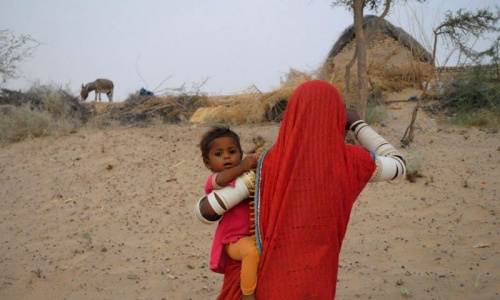
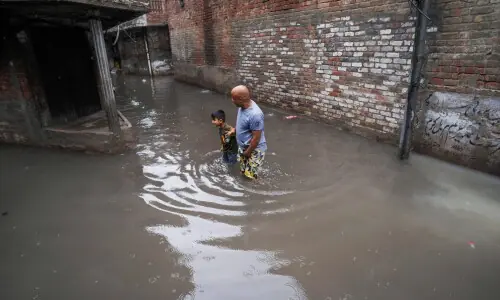
REPORTS in the media during the past few days about a virtual famine in Tharparkar, about a sharp increase in deaths, especially of children due to malnutrition or negligence, and about desperate outward migration of residents have caused justified widespread concern and prompted governmental, judicial, civil and military responses.
While conditions certainly deserve alleviation, the doom-like scenario misrepresents a substantial part of reality.
First: severe adversity affects parts of the population and the region, not the entire area and all residents. Tharparkar is spread over 22,000 square kilometres with a population of about 1.5 million residing in 2,300 villages and urban settlements. Divided into six talukas — Mithi, Islamkot, Chachro, Dihly, Diplo and Nagarparkar — the area often receives varying levels of rainfall or none at all.
Last year, Nagarparkar taluka received plentiful rain. Crops have been cultivated in over 336,000 acres and are adequate to sustain an average tehsil population of about 212,000.
Agricultural productivity in places like Kasbo can be so high that, currently, after meeting local needs, onions from Tharparkar are being trucked all the way to Gujranwala, Punjab. No case of starvation or even of severe malnutrition has been reported in the whole taluka, and even in some others.
There was scattered, uneven rainfall in the other five talukas. Several tens of thousands are definitely affected by farming water scarcity. But this is a recurrent, periodic feature of life.
People residing in small villages in the rural “baraari” parts cope by seasonal outward migration to the barrage-irrigated parts of Sindh to serve as farm labour.
At this very time, in the normal course, such migration begins: to harvest the imminently ripe wheat crop in the weeks ahead. Thus, ongoing migration is not necessarily linked to suddenly impactful drought.
Second: apart from farming, livestock-related income is a major source of livelihood. Of about six million animals comprising cattle, sheep, camels, goats, about half a million sheep are estimated to be victims of sheep pox or other ailments.
Blanket vaccination of all animals is the best protection against fatal epidemics.
But with only 11 veterinary doctors on duty out of a sanctioned number of only 17 posts and other paucity of resources in the 135 vet units across a large region, comprehensive vaccination was not conducted in 2013, causing loss of some, but not the majority of the livestock population which continues to support the human population.
Third: the livelihoods of a large number of residents come from shop retailing, small- and medium-scale trade, construction, transport, several services, and employment in the government and non-governmental sectors.
Thus, all are not dependent entirely on rain-based crops or livestock-related incomes, though drought does impact in some ways on other spheres.
Fourth: negligence, apathy, corruption, avoidable shortages and poor governance are far bigger ‘killers’ than drought and famine. In cases of a sharp increase in infant and child mortality in the Mithi Civil Hospital, all or some of the above appear to be the main causes. Prompt diagnosis in the recurring morbidity pattern such as of diarrhoea, malnutrition, under-nourishment (as distinct from outright starvation), pneumonia, etc; quick referral to specialists, and sustained treatment with both drug and non-drug therapies could swiftly contain and reduce mortalities.
The inadequacy dimension is typified by the fact that in the Nagarparkar taluka hospital, out of the 32 sanctioned posts for doctors, only four are presently staffed. Non-governmental health centres strive to redress such gross imbalances.
Of the total of 139 governmental health units in Tharparkar, 31 BHUs and 102 dispensaries administered by the stricter-accountability measures of the PPHI intervention will hopefully also correct deficiencies elsewhere, albeit on a limited scale.
Fifth: post-2000, the awkward, inconvenient truth is that, particularly during the regime of retired General Pervez Musharraf and former chief minister Arbab Ghulam Rahim, the physical infrastructure of Tharparkar reached an unprecedented level of progress.
Where, for example, in previous times, only about two kilometres of metalled road was built in a whole year, roads of the same length and more were built every month, and in even less time, for several years.
Grid electricity to main towns, water pipelines to large settlements, preparatory infrastructure for exploitation of coal reserves including work by the post-2008 PPP government, rapid proliferation of telecommunication and mobile phones have vastly enhanced mobility, access and information flow.
This transformative change remains ignored by the media which prefer stereotypical bad news.
Sixth: there is a need for immediate relief for large numbers in some parts. But the priorities should be the efficiency, integrity and quality of relief delivery, rather than quantum alone.
Corrupt practices in relief delivery often provide more benefits to the few rather than succour for the many. Several non-governmental organisations, with their limited resources, contribute to the relief work.
Without reducing the urgency of alleviating current suffering, the far more vital subjects requiring purposeful action by legislators, public office-holders and officials is non-partisan accountability and improved governance.
The media too need to curtail their sensationalist, under-researched outpourings while remaining vigilant. The candid self-criticism of Sindh’s chief minister is a helpful step forward.