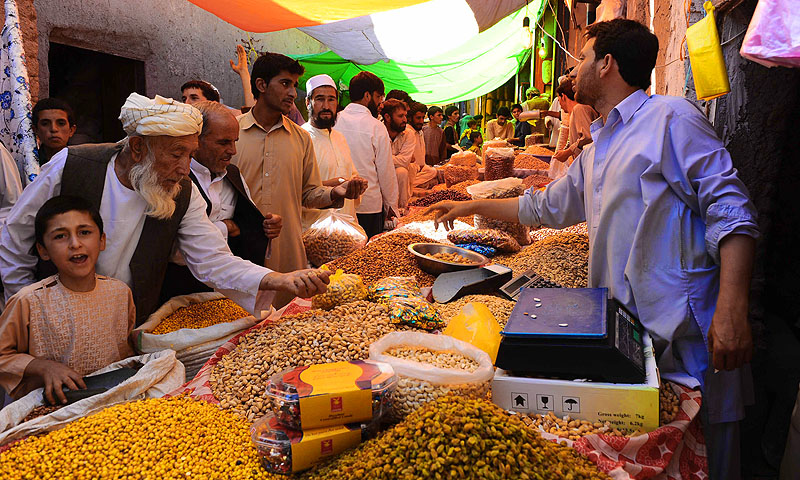
Prices of dry fruits are on the rise, as usual, as the winter is here, and more important, with scanty supplies. Stagnant local output, decline in production in Afghanistan and disrupted supplies from Iran are responsible for it.
For the past few years, increase in the cost of transportation has been a permanent price pusher too. And this year is no exception. Traders in Karachi, where winter has still not set in, say demand is not as high as in other parts of the country where cold weather is already in.
But they point out that commercial demand is high for almonds, pistachio, walnuts, peanuts and raisins that are used in making Christmas and New Year cakes. They say that except for dry dates, all dry fruits are short in supply to meet this demand leaving very little or almost nothing for exports.
“Pistachio’s output in Badghis (Afghanistan) has halved this year due to heightened militancy. Iranian pistachio and almonds are off sight as Pak-Iran land route trade remains suspended off and on. And a declining trend has long hit our own production of almonds, apricots and walnuts,” lamented a Jodia-Bazar based exporter. “Consumer demand is yet to pick up as Karachi’s weather is still not cold. But supply is so scant that it’s hard to meet even the current moderate demand. Exports have almost halted.”
Wholesale and retail prices of most of the dry fruits have so far recorded a 15-25 per cent increase, according to market reports.
At retail level at some upscale markets, almonds are being sold for Rs1200 - Rs1800 per kg, the American variety being the most expensive. Pistachios (with and without shell) are priced between Rs1400 and Rs1800 per kg and plain and roasted cashew nuts at Rs1200 and Rs1400 per kg. Prices of pine nuts (with and without shell) are being retailed at Rs2400 and Rs3200 per kg, peanuts at Rs320 and Rs400 per kg. Figs are being sold at Rs1400-Rs1600 per kg.
“Traders at semi wholesale markets in Karachi, no less than a dozen in number, are also partly to be blamed for the price hike,” says a retailer from North Nazimabad. Earlier, everything used to come direct from Jodia Bazar. But for the past few years, semi wholesalers at Water Pump market, for example, have come up on the scene. “Most retailers prefer purchases from nearby semi wholesale markets to cut transportation cost and avoid traffic gridlocks. But when semi wholesalers overcharge them, retail prices go up.”, he said.
Many shopkeepers at semi wholesale markets in Nazimabad, North Nazimabad and other areas concede that it is partly true. But they point out that many jobless people are now lifting large amounts of dry fruits to sell them on roadsides and on the streets. Most of them don’t even have money to buy push-carts and rent the same at Rs100 per day. “So, in a way retail demand is not that dull, perhaps people are buying less from retail shops and more from thelewalas,” according to a semi-wholesaler at Al-Asif Square, Abdul Hakim.
However, all people associated with dry fruits’ trade agree on one thing: supplies from neighbouring countries are low and local production is on the decline. Production of apricot, for example, fell from 240,000 tonnes in 2007-8 to about 190,000 tonnes in 2011-12, the latest year for which data is available.
Production of almonds declined from 26600 tonnes to 21400 tonnes and that of walnuts from 12700 tonnes to 10600 tonnes. Local output of pistachio and figs has also decreased from 775 tonnes each to 655 tonnes and 525 tonnes respectively, stats compiled by Ministry of National Food Security and Research show.
Gradual decline in production of all these dry fruits, except for pistachio, is partly attributable to the shrinking of area under cultivation, the ministry’s statistics reveal. The area under plantation of pistachio has remained almost unchanged but the production has somehow fallen, chiefly because farmers cannot gather nuts in time due to militancy in the areas where pistachio is grown.
Generally, thousands of nut-producing trees had been chopped down, during recent past, for firewood by both local residents and militants in remote parts of KPK and the Northern areas.
In this backdrop, not only consumers suffer due to ever-rising prices but the country’s export earnings are also hit drastically. Exporters of dry fruits recall that until a few years ago, Pakistan was exporting dry dates, walnuts, pine nuts, peanuts and even almonds but now only dry dates are being exported. Foreign sales of the other four items have become negligible.
Separate stats for exports of different dry fruits could not be obtained. But officials of Trade Development Authority of Pakistan confirm that fresh and dry dates now account for 90 per cent plus of the total export earnings (over $100m in FY13) under HS codes that cover dry fruits. —Mohiuddin Aazim