0
0

Remembering Mirza Zafr-ul-Hasan
 In 1968, Ghalib’ lovers around the world were planning to commemorate his centennial the following year in a big way. In India, and even in the former Soviet Union, preparations were afoot for the event but in Pakistan the lovers of Urdu and Ghalib were, to a large extent, asleep. Mirza Zafr-ul-Hasan, one of the greatest lovers Ghalib ever had, was aghast at the thought that the centennial of one of the greatest poets of Urdu would pass unmarked in a country that claimed to have Urdu as its national language. Worried, he talked to Faiz Ahmed Faiz, also a great admirer of Ghalib’s. Together they decided to commemorate the Ghalib centennial on a grand scale. To achieve the aim, the establishment of Idara-i-Yadgar-i-Ghalib at Karachi was announced on November 20, 1968, with Faiz as its founder president and Mirza Sahib the founder secretary.
The Idara’s programmes for Ghalib centennial proved a resounding success and its echoes were heard around the world. Scholars form all over the world participated in the programmes chalked out by the Idara, held during the entire year of 1969, drawing great crowds.
It was Mirza Sahib’s determination that generated a generous support from intellectuals such as Faiz, and the Idara set a trend that was followed by all. But like any other genius, and like the genie of the fables, Mirza Sahib could not sit idle and would ask for more work. Soon he realised that the objectives of the institution, established in the name of Ghalib to carry out research on the great poet and to promote literary activities, could not be achieved without a well-stocked library. He, therefore, decided to set up Ghalib Library, an idea supported by scores of luminaries.
Getting a plot at a suitable location and constructing a building for the library looked impossible, but Mirza Sahib had the spirit that countenanced no hurdles, and he thought no difficulty was insurmountable. He got the plot allotted in Nazimabad and the Habib Bank agreed to get the construction done. Finally, the library opened on Sept 1, 1971 and soon Mirza Sahib made it a place known for its books, literary gatherings and cultural aura.
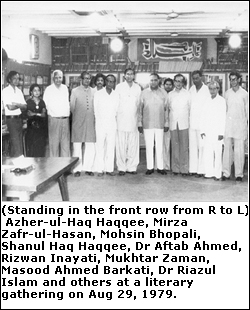 Though the literary gatherings are no longer held there, the Ghalib library is among the best ones Karachi has for scholars of Urdu and oriental studies. It boasts over 35,000 books and over 50,000 journals. In fact Karachi’s Bedil library, with a huge stock of rare Urdu magazines and newspapers, is the only one that rivals it in the city, a commercial and financial hub of the country otherwise known as a concrete jungle, with little room or time for intellectual activities.
The Ghalib library, Idara-i-Yadgar-i-Ghalib and Ghalib were not the only ones Mirza Sahib loved madly. Faiz Ahmed Faiz, Makhdoom Mohiuddin and Hyderabad Deccan, too, were among the ones that received Mirza Sahib’s unquestioned love. He spent his childhood in Deccan and his youth with Makhdoom Mohiuddin. He struck an acquaintance with Faiz after migrating to Pakistan and, already having an intellectual fraternity on account of the progressive streak both had, immediately fell for Faiz’s personality. All the three -- Makhdoom, Deccan and Faiz --- haunted him till his very last. The reason being that Mirza Sahib himself was a loving, sincere and caring person.
Mirza Zafr-ul-Hasan was a writer in his own right. He was a satirist, dramatist, short-story writer, critic and broadcaster. Born in Sangareddi, a small town in Deccan, on June 3, 1916, Mirza Sahib graduated from Usmania University, where he had been president of the students’ union.
He joined Radio Deccan in 1936 and remained there even after the Indian forces occupied Hyderabad. Later, he decided to migrate and came to Pakistan in January 1949. First he joined Radio Pakistan as a programme organiser and became an assistant director; later he was posted at the Pakistan Election Commission from where he retired as the deputy election commissioner.
Apart from his great feats, Idara-i-Yadgar-i-Ghalib and the Ghalib library, his remarkable contribution to Urdu literature has been his memoirs of Deccan. Written in his usual witty and satirical style, the memoirs, ‘Zikr-i-yar chale’, ‘Phir nazar mein phool mehke’ and ‘Deccan udaas hai yaro’, successfully capture the cultural atmosphere of the fallen princely state in the first half of the 20th century. Though apparently these books are the memoirs of an individual, they depict an era that was and is never to be seen again. It is amazing how a writer of fiction moulded himself to emerge as a critic and also wrote memoirs that can be put alongside the best in the language.
Mirza Zafr-ul-Hasan began his literary career as a short-story writer and a collection of his short stories ‘Mohabbat ki chhaaon’ was published as early as in 1939. He wrote plays as well, some of which were staged. His satirical essays appeared in many magazines but are yet to be collected.
‘Umr-i-gazashta ki kitab’ is an account of the life and works of Faiz and Makhdoom.
‘Wo qurbaten si wo faasle se’ is a travelogue of Hyderabd Deccan and records his impressions of his native place that he visited after some 30 years. His books on Faiz and his works include ‘Saleeben mere dareche mein’, ‘Mata-e-loh-o-qalam’, ‘Mah-o-saal-i-aashnai’, ‘Qarz-i-dostan’, ‘Khoon-i-dil ki kasheed’, ‘Yad-i-yar-i-mehrban’ and ‘Hamari qaumi saqafat’.
From his books and forewords, one can gather that his books that still remain unpublished are at least seven and among them is ‘Faiz soo-i-dar chale’, one that records important facts and opinions about the Rawalpindi Conspiracy case, a notorious case that charged Faiz with ‘treason’ and a ‘failed coup bid’.
Mirza Zafr-ul-Hasan launched and edited ‘Ghalib’, a bi-annual literary magazine, from the Ghalib library. After his death, Mushfiq Khwaja carried the torch and edited a few issues as well as looking after the library and the Idara. With his death, Dr Moinuddin Aqeel took the charge and carries the burden of the cross for all of us.
Mirza Zafr-ulHasan, the great dreamer who gave us a great library, died in Karachi on Sept 4, 1984.