0
0

The nation needs dedicated teachers
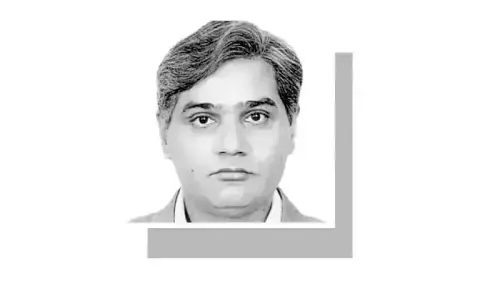
Pirzada Qasim
By Naseer Ahmad
 Well-known American poet and short story writer Edgar Allan Poe could write only when Pluto, his beloved cat, perched on his right shoulder. There are intellectuals whose muse lets them down unless they use such things as a paan, a cigarette, or a cup of tea. Since he loved to imbibe, Ghalib must have used his favourite beverage to make his poetic genius go. Ghalib also lived in a time when there were no fountain pens and notebooks to jot down his couplets. So he tied knots to his waistband whenever bits of his enduring poetry flashed across his mind.
Pirzada Qasim neither has a pet, nor is he in the habit of using stimulants, nor does he wear a ‘knotable’ waistband. He does not even use his pen and paper to write down his couplets as and when they take shape in his mind. When an idea pops ups, say during a talk, a walk, a flight, he allows it to rest there and moves on with his usual business of the day. “Neither anybody at my home, nor in office would have ever seen me poring over a piece of paper with a pen in an attempt to write a piece of poetry,” says Pirzada, the eminent poet, intellectual and science teacher. When he finally sits down to transfer his thoughts onto paper, probably at night, he tries to recall the couplets, which sometimes elude his memory forever.
He has two collections of poetry to his credit — Shaulay pay zuban and Tund hawa kay jashn main. A third one, Mujhay duaon main yaad rakhiyay, published by a group of his former students to honour him at a ceremony contains a selection from his two books as well as some fresh ghazals and poems. This book also contains eminent writers and poets’ laudatory comments they made about him at various occasions. The luminaries who have paid tribute to him include Ali Sardar Jafri, Akhtarul Eiman, Ahmed Nadeem Qasmi, Majrooh Sultanpuri, Raam Laal, Jamil Jalibi and Abul Khair Kashafi. He plans to bring out a fourth collection. He says he has not written much. But whatever he has written has been acclaimed by prominent critics.
When I tried to contact him, I was told the vice-chancellor of Karachi University was in Tehran. When newspaper reports suggested Dr (Prof) Pirzada Qasim Raza Siddiqui was back in town, before I could catch him, he had gone to Islamabad. And the day he was expected to return, he was in his office, where he might have come direct from the airport. His public relations office told me that the VC could be available for an interview on Friday, at 11am. “But make sure that 11 should mean 11 and not 11.15,” said the protocol officer of Karachi University.
When I was escorted to the hall adjoining the VC office, a few people were already seated there waiting for an audience with him. He had just seen off Dr Manzoor Ahmed, the well-known teacher and scholar. Faculty, staff and students constantly seek his attention. He has to peruse and sign official files, attend seminars, meetings with high-ranking officials, tour abroad and he is member of several academic institutions. He has to keep himself updated on the situation on the campus, remain in contact with foreign universities, and a lot more. Since he is in constant demand as a speaker at literary, cultural and academic functions, he has to prepare speeches for the events also. His resume shows he has always been in important positions besides being a teacher – head of department, acting vice-chancellor, pro-VC, VC of Urdu University, etc -- that demanded time and energy. Being a science student, he never had the luxury of rest.
Keeping in mind his occupation with such multiple matters, my obvious question was how he could spare time to read Urdu literature and compose his outstanding poetry. He says that from the beginning he has set his mind on how to make the best use of available time. “I calculate what task needs how much attention,” he says. For instance, when there is a pause in receiving people or signing papers, he picks up one of the books stacked high next to his seat and begins reading it. And before going to bed he reads for about two hours daily.
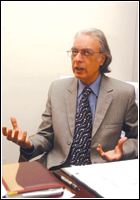 The vice-chancellor attributes his successes to the initial attention and training he received at his school. He studied at a ramshackle Jacobline government school, one of the few state-run schools now disparagingly called peela schools, on account of their yellow whitewash.
He says teachers in those days were committed to education. They tried their best to train and educate their students. “Now people who do not find any other job become teachers, which affects students adversely. The nation needs committed teachers.”
On his school bench, he was flanked on one side by the son of a big industrialist and on the other by a boy whose father ran a barber shop on Katrak Road. Proving that parents of that period were also very considerate, he cites the example of children of Sardar Abdur Rab Nishtar, who was then the governor of West Pakistan. “The governor house driver had been told to drop the children at the Empress Market, well away from the school so that other students did not have a sense of deprivation.”
He says children’s relationship with books should be established from the beginning. They should be inculcated with the habit of visiting school libraries on a regular basis. “They should be encouraged to borrow books from the library and return them the next day. Even if they do not read them, the habit will establish a link between them and books.”
He further suggests that besides taking children to recreational spots, they should be taken to big libraries and book fairs. They should be encouraged to buy books. “When I took my children (a girl and two boys) to book fairs, I allowed them to make generous purchases.”
He recalls that once his wife gave her a handsome amount of money to get a VCR, saying that everyone had the machine and their children also wanted one. When he returned home, his curious children began opening one after another the boxes he had brought in. “But to their surprise, instead of a VCR, came out from the cartons a set of encyclopedia.”
Recalling his visit to a library set up by the late Hakim Said, he says: “I was impressed to see the vast and varied collection. Hakim sahib said ‘Pirzada, do you know who has helped make this collection of books so vast? The unworthy offspring of renowned scholars and writers. When they pass away, their children first dump the books in a garage. Then seeing that the rooms filled with books have unnecessarily occupied the space, they dispose them of to junk dealers. And I have my men after those junk dealers to buy those books at nominal prices’. I became so depressed to learn this that I remained sick for two days.”
He says he has read almost all poets right from Wali Dakkani to known poets of today. “During this journey you make stopovers at places such as Mir, Ghalib and Iqbal to read them rather deeply. Many present-day poets are also very well highlighting the current issues.”
He says Ghalib is the paragon of Urdu poetry. He says a great poet is one who may make a common subject a unique one. In this regard he mentions Iqbal’s poem on the Cordoba mosque and says it can compare with any poem in world literature.
He says he is not satisfied with the state of higher education in Pakistan. “The things have, however, begun moving in the right direction. During the last four to five years, the government has given generous grants to universities. Now they do not only have enough to make their recurring expenditure but have funds to expand their infrastructure also.”
Born into an educated family of Delhi in 1943, Pirzada Qasim arrived in Pakistan at the age of five. Here he studied at the Jacobline school, D.J. Science College and Karachi University, where he earned his MSc (physiology) degree. He obtained his PhD from a British university.
Fehmida Mirza — the Nancy Pelosi of Pakistan
IN the heat of the heady times that we are going through, Dr Fehmida Mirza’s election as the first-ever woman speaker of the National Assembly may have added another historic leaf.
She was immediately dubbed as Pakistan’s Nancy Pelosi. “We may be behind the US that elected Ms Pelosi as leader of the US House of Representatives in 2002, but we are decades ahead in having Benazir Bhutto as the first woman head of state,” said journalist Nusrat Javed, who claimed exclusive copyright for the attribution.
“We have to see if they (Americans) match us now by electing Hillary.”
Perhaps Fehmida’s dynamism and charm struck out better in contrast to her predecessor’s lacklustre demeanour. Chaudhary Ameer Hussain looked visibly sad in relinquishing the charge. But his positive words at the parting may have slightly compensated for the partiality that he had showed all these years in bulldozing bills, ordinances and even a controversial constitutional amendment.
Also important was the figure of 249 votes that Fehmida Mirza got in the process. This means that if the ruling alliance could muster 54 votes in the Senate they will have a possible strength to impeach the president in a joint session of the parliament.
But then there was an eerie abstinence from the mention of the ‘M’ word throughout the proceedings. Neither Pervaiz Elahi talked about Musharraf the mentor, nor did Javed Hashmi name him as the tormentor.
There were a lot of allusions to the GHQ, the establishment and what not by Khawaja Asif, Maulana Fazlur Rehman and others but, like that villain in Harry Potter’s books, the M word was forbidden. Are we seeing things where none might exist? Perhaps not.
Ms Fehmida’s credentials to become the speaker are more than reasonably valid. A three-time member herself, she also had her father and husband as members of the National Assembly. Her spouse, Dr Zulfiqar Mirza, is now tipped to become home minister in Sindh.
Couple Raj
Therein lies a small hitch that may reflect a bigger problem. Those in favour are being rewarded not just in ‘ones’ but ‘twos’.
“It’s a couple Raj,” aptly commented a colleague in the press gallery. While the prime couple around Benazir Bhutto --- Safdar Abbassi and Nahid Khan --- is out, an array of new ones have set in.
Farah Nawaz Isphahani, with little or no history of being a party activist, has been rewarded by a ticket to the House from women’s quota. Now her husband, Hussain Haqqani, is tipped to become Pakistan’s ambassador in Washington.
Farzana Raja, already an MNA on women’s quota, is one of the candidates for the information portfolio. Her spouse, Pir Mukaram Shah, is likely to be adjusted somewhere, while his brother Pir Mazharul Haq is already the leader of the Sindh Parliamentary party.
Khalid Ghurki is Nazim in a rural area of Lahore, while wife Sameena has been made an MNA. Ahmad Riaz Sheikh, a former FIA goon who made his name while working as deputy director of immigration and was later jailed on various charges, has been reportedly made, horror of horrors, media adviser.
We are not sure whether this constitutes his promotion or the demotion of fellow hacks. His wife, already an MPA in Punjab, is eying a slot in the Punjab cabinet. Shahbaz Sharif is definitely going to resent it, given his history of trouble with her husband.
This pattern in Asif Zardari’s decision-making gives an impression that the party is his personal fief. Many feel that loyalty has become a bigger criterion than merit and service to the party.
Those who fear that this may be the last chance for the party may not be entirely wrong.
The party did not fare as well in the last polls as some might think. It got 80 directly elected seats in the 2002 elections, which (Gen) Ehtesham the Conscientious (after retirement, that is) confirmed as rigged.
Had the polls been fairer, the PPP might have got 100 seats.
In last month’s elections the party got only 87 seats. This was despite the sympathy wave caused by the assassination of Benazir Bhutto.
Analysts agree that besides bad electioneering, it was the dilly-dallying on the issue of the judiciary that damaged the PPP. The party, one has to admit, got power on the crutches of the lawyers’ struggle. The revolution may be far from over.
Aitzaz Ahsan was not in the house during all those fancy speeches, but his demons were haunting all of them sitting inside. The focus of power, it seemed, had shifted from the parliament, the executive and the establishment to the forces out on the streets, loosely named as the lawyers’ movement, civil society or media activists. Whether it is good or bad, only time will tell. What is sure is that the lawyers ‘aint sitting home’.
It was obvious in a meeting with Mr Aitzaz that the lawyers were not leaving the matter to the political parties alone. While they will give the parliament 30 days to come up with a resolution on the reinstatement of judges, they will not waste this time in their chambers.
“We shall be back to the streets two days after Chaudhary Iftikhar is released by the new government,” Mr Aitzaz said in a meeting with Dawn the other day.
“Of course, this will remain non-violent and will not be against the parliament or the new government.”
The first stop, he said, will be Rawalpindi, then Lahore, Faisalabad, Multan and then to the final destination that matters -- Karachi. It sure will be a test of nerves for both the MQM and the PPP.
Surely also, the unclogged media and the civil society are ‘aint sitting home. If the PPP fails to go along with these forces, say our pundits, Master Bilawal may have to rely more on Mamoon (uncle) Aitzaz than Papa Zardari to regain whatever is left of the party.
Until last reports came in, the PML-Q was busy trying to find out which one of their members had voted for Dr Fehmida. They need to wait for just another fortnight when the names will come up in the form of a forward bloc.
Until the last count they were short of just two for making it to the 13 members required for the bloc.
| © DAWN Media Group , 2008 |