0
0

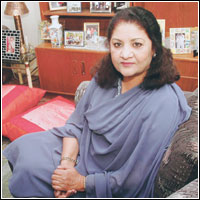
A new woman I am — Shahida Hasan
 KARACHI: Lying on a bed in the courtyard of her home on a starry night, young Shahida Hasan looked at the constellations adorning the sky and wondered how big the universe was. She had learnt at school that some of the stars and planets were many, many times bigger than our lowly earth. But comparing her small house with the earth, she prayed that she see the world extensively enough. Her prayer was answered. Now, name any country worth seeing and she has seen it.
When I visited her Gulistan-i-Jauhar apartment on Tuesday afternoon, she had just arrived from the Gulshan-i-Iqbal government degree college where she is the head of the English department. She was upset because of clashes that took place there earlier in the day. The disturbance was not something new for her, but every time it happens, it distresses her.
Agitated, she says the students of today have lost respect for teachers. They have become growingly insolent, intolerant and violent. “It is not a matter of political awareness. We as students also had a lot of such awareness. We also had disputes. But we accommodated one another’s points of view,” she says, adding that “When I saw the classroom empty, tears welled up in my eyes. I was there to teach but no student was in the classroom to be taught.”
She, however, soon rallies to defend the students’ behaviour. “When feelings in a society are suppressed indefinitely, such behaviour is its natural consequence.” She apportions the blame of unpleasant situations in colleges and universities to teachers also. “A majority of teachers are no longer interested in teaching in government institutions, thanks to the commercialization of education. Neither students nor teachers attach due importance to attending classes because of the scourge of tuitions.”
She also laments the lack of co-curricular activities on campuses. “In some institutions, teachers as individuals do encourage their students in healthy activities. In most city colleges, however, there is no such activity at all. In our times we had a lot to do besides studying. Students need means to channel their energies. When they have no outlet, their sentiments go haywire.”
It is not only the local conditions that disturb her. She is perturbed over the crises gripping the whole Muslim world, including Afghanistan, Iraq and Palestine. Her latter day poetry is replete with sentimental comments on the current issues.
With two poetry collections already published and a third one almost ready for publication, Shahida’s verses are highly popular among lovers of Urdu poetry. Several renowned critics, including Dr Jamil Jalibi and Shamsurrehman Farooqui, have praised her poetic genius and style.
Although she is very selective about mushairas, attendance increases if her name is among the invited poets. “I think poetry is a serious matter. What you read at the mushairas is only aimed at thrilling the audience. If you recite something meaningful, the audience rarely appreciates it.
 The decade of ‘70s >
The poetess says the decade of the 1970s was highly productive. It saw many budding poets earn prominence. They included Ayub Khawar, Tajdar Adil, Parveen Shakir and Saleem Kausar. She, however, appreciates some young writers saying they are contributing considerably to modern Urdu poetry.
She says her first verses began appearing in newspapers when she was in university. But even when she had not started composing poetry, she knew she could do it. “I have a very compassionate heart. I believe everybody has some characteristics in their genes; with the passage of time they are attracted to it. I was never attracted to things that were meaningless, ugly, dirty and rubbish.”
Parveen Shakir was a cousin, senior by two to three years. They both played in the same courtyard. They both took part in events together and won trophies at various colleges. They both did their Master’s in English at the Karachi University, two years apart, of course. They both, in their separate times, taught at the Abdullah Girls College. “We attended literary functions together. If she presented a ghazal at a poetry recital, I presented a poem and both were appreciated by the receptive audience and our seniors.”
When Parveen died in a road accident in Islamabad, she was shocked beyond measure. Her grief poured out in the form of a moving poem in memory of her beloved cousin and was printed by Ahmed Nadeem Qasmi in his literary magazine Funoon.
Family life
She is married to an airline officer, Syed Ali Hasnain Jafri. How obedient he is may be realized from the fact that he agreed to the choice of his elder sister, who happened to be teaching in the college where Shahida was also a lecturer. “I saw her only after marriage,” says Mr Jafri, basking in the glow of marital bliss.
The family receives periodical passes for foreign tours. Besides, she visits places to attend mushairas and other events. When she asked her husband if he had brought her ticket, he pulled out an envelop from his back pocket and placed it on the table. So in a few days, she is about to fly to Bahrain where she is invited to attend a mushaira.
Two of their sons have completed their education and settled down abroad and the youngest is an IBA student. The couple have no plan to swap Karachi for any other city in the world. “Whenever I am abroad, I feel as if I am living in another house.” That all mothers love their children is a universal phenomenon. But she is unlike most mothers. She can advertise her love for her children. Dedicating her second poetry collection Yahan kutch phool rakhay hain to her three sons, she says:
Apnay dada par he giya hay mera beta bhee
Pehlay such kehta hai phir iss par dutt jata hay
She has also written a biography of renowned poetess Ada Jafri – Shakhsiat aur fun – published by the Academy of Letters Pakistan.
She has won several national and international accolades. These include the Faani Badayuni Urdu Award in New Delhi and the Nishan-i-Aizaaz for poetry by the Women Writers Forum, Columbus City, USA. In 1999 she was invited by the Montclair State University to present her Urdu poetry with poets from Japan, England, Nepal and Bangladesh. She was also given the Honorary Citizenship and Goodwill Ambassador Awards by the mayor of Houston, Texas.
She has visited Denmark, Norway, the US, Canada, China, the Middle East, Saudi Arabia, Singapore, Iran, India and Nepal. Her longest stay was in the US, where she spent two-and-a-half years at a stretch. However, wherever she goes, she feels the pull of “Karachi, sweet Karachi,” with all its associated problems and fears.
Shahida Hasan insists she is not a feminist and believes in mutual respect between men and women. “As my father was a man, my husband and sons are men, how can I consider someone hostile on the basis of gender alone?” she says.
But she does write for women’s causes abundantly. One of her poems in translation goes like this: A fiction character I am no more/neither a queen of beauty/nor a pretty goddess on the throne/neither Naheed nor Shireen/nor Laila nor Ishtar/a new woman I am.
Honour of meeting Sir Don and umpiring standards in Australia
From Qamar Ahmed in London
The Australians may or may not visit Pakistan next month, depending on the political climate and reports by the intended visit of their security men. At present, though, things do not look very encouraging despite assurances given to Cricket Australia by the Pakistan Cricket Board. It will be sad if it does not happen because cricket loving people in Pakistan do not mean any harm to any sportsmen.
It has never happened, and in recent years teams like West Indies, South Africa, Sri Lanka, Bangladesh have all visited the country without much fuss. And so have India, the arch-rivals, who have more to fear than the Australians.
What of course is needed by Cricket Australia is what we call a’ positive approach’, very much like the recent apology of the Australian government to their indigenous citizens, the Aborigines, whose children were forcibly taken from their families and from their mothers’ laps under old assimilation policies and for inhuman treatment given to them over the years.
The prime minister Mr Kevin Rudd said ‘sorry’ three times before telling the parliament and thousands of Aborigines listening outside that’ We apologise for the laws and policies of successive parliaments and governments to have inflicted profound grief, suffering and loss on these fellow Australians.
Old policies, he said, were a stain on Australian soil which would never be repeated.
I am sure when comes the time, Mr Rudd will keep an open eye and so would Cricket Australia for their cricket tour of Pakistan.
Australia is a sports-mad country and worth a tour by anyone who loves sports or the game of cricket. Watching cricket there is an experience and so is the warmth and hospitality of those who follow this wonderful game.
With childlike exuberance, I looked forward to my first Australian visit when Pakistan toured under Imran Khan in 1984. It turned out to be the last series of the greats of Australian cricket - Dennis Lillee, Greg Chappell, Rodney Marsh — and, if I remember well, of our own great ‘keeper, Wasim Bari.
I also dreamt of a chance meeting with batting legend Sir Don Bradman, of whom it was said that he avoided meeting people, specially journalists. I felt a bit discouraged by the rumours and said to myself, ‘well if I am not able to meet a man with a Test batting average of 99.9’ and who is without doubt the greatest cricketer ever to walk this earth, my visit will be utter failure.’
Sitting next to an elderly and respectable looking journalist during the Adelaide Test, I enquired if Bradman would come to the match. “Oh, yes,” replied the gentleman. “He has his own box and he would be here sometime during the day.”
I told the veteran scribe that I would love to meet Bradman to which he said, “it will be tough.” He then asked me if it was my first visit to Australia. “Yes and that’s the reason why I am so keen to meet him,” I replied. “Well I can try for you,” he said. After tea he told me that I was in with a bit of luck since he had spoken to an official of South Australian Cricket and he was likely to fix a meeting with the great Sir Don.
Later, during the drinks interval, a gentleman turned up and asked me to accompany him to the Bradman Box - for three minutes only.
The first sight of him, I must admit, was absolutely spell-binding as he stood up and shook my hand. Short but still managing an upright stance even at his old age, Bradman’s eyes lit up as he talked to me with clarity and with full knowledge of the game which was, indeed, his life. My three minutes turned out in the end to be ten as I left the box in a daze after meeting the legendary figure.
Back in the box, I thanked the elderly pressman and asked his name. He gave me a deep look and said, “Son, I am Bill O’Rielly.” I almost fainted. “Oh my God,” I said, “You are Tiger O’Rielly, the great leg-spinner who played under Bradman?” He nodded in the affirmative. “Yes my son, that’s me.”
Embarrassed as I was, I asked for forgiveness for not recognising him. On my subsequent visits to Australia, I met Bradman on three more occasions. That was the positive side of my tours to Australia with Pakistan, the West Indies and India.
The negative side was the standard of umpiring that I experienced on various tours Down Under. I was no stranger to umpires and umpiring in my own side of the world, which I always considered to be quite poor. But the performance of the Australian umpires and that from the West Indies made me rethink about the game’s standards and compelled me to look at them in a different perspective altogether.
Visiting teams stood little chance as benefit of doubt never went in favour of the visitors and touring sides complained regularly. Renowned umpires such as Johnson, McConnell, French Evans and King all looked a lot more impressed with the home team than the visitors, even when the champion West Indians were playing and thrashing the Aussies all the time. Tony Crafter, who later became the head of the Australian umpires, was a lot better than others.
A key question that is often asked among the international critics and players is that why Pakistan never won a Test series in Australia and the West Indies. Well, I can tell you that if umpiring was not lop-sided or biased in most of those matches, Pakistan would have won a couple of series in both the countries. And I am saying this with first hand experience since I was present in most of the ‘contentious’ games.
The most disturbing was the second Test of the 1999-2000 series at Hobart when Pakistan, having lost the first Test, had come so close to levelling the series before the final Test when Australian umpire Parker’s decisions turned the match in favour of the home side. Destroyed by Saqlain Mushtaq’s Doosra’ as he ripped through Steve Waugh’s men by capturing 6-46 in the first innings, the match looked in Pakistan’s grasp.
Australia were then set 369 to win and were struggling at 5 for 126 when Parker declined a catch at the wicket appeal off Wasim Akram against Justin Langer and later against Adam Gilchrist as they went on to score 127 and 149 respectively to take Australia home by four wickets.
Had Pakistan won that Test, the last Test Perth could easily be Pakistan’s considering the firepower of Wasim Akram and Waqar Younis coupled with Saqlain’s unplayable guile.
A number of players visiting Australia pointed fingers at Darrell Hair and Ross Emerson but to no avail.
When Emerson called Muttiah Muralitharan for throwing and the controversy raged with Hair also getting into the act, the editor of Wisden Alamanack Mathew Engel wrote in his Editor’s note of 1999 edition. ‘The main blame must attach to Emerson who ignored both the ICC and common sense by no-balling Murali from apparent premeditation rather than because once ball was delivered in a different way from any of the others.’
‘This was the behaviour of a man with his own agenda. The quality of the Australian cricketers may be unsurpassed at present but their umpires could use a little humility concerning their own limitations. Australia can not even reliably provide competent TV umpires — not an especially arduous duty for Test matches.’ Strong words from one of the best, most reputable sports scribes indeed.
I must say though that in the present lot Simon Taufell, like our own Aleem Dar, is a breath of fresh air.
Now that the dust has settled on Harbhajan affair and Steve Bucknor has been made a scapegoat, umpiring despite the elites will be seen in a different perspective.
That said, one mistake in judgment should not ruin a man’s whole reputation.
Only agony, no ecstasy
 But surprisingly, his show at Canvas, curated by Sameera Raja, has just one piece of sculpture. Of the 34 paintings that have been put up on display, most show faces but while the colours are often bright, the faces are dismal.
Agony and anguish are writ large on them. There are suffering men and women. Many artists show women who get the dirty end of the stick in our society, but what about men, who could they be? I ask the Quetta-based artist and he replies “They could be missing men. There are many who have disappeared without leaving any clue behind. They could also be the people who are left behind to mourn for those about whom they are not sure, whether they are dead or alive.”
Baloch believes in art for life’s sake and all that he shows is what he sees, but then life is not all sorrow and gloom. There are flowers, there are innocent children and there is the cool breeze of the morning. How come he doesn’t take note of all these things? But then it’s for the artist to decide what he wants to paint just as it’s the prerogative of the writer to choose his theme and his subject.
Back to his work, some of the paintings have the effect of a net which he has created by drawing lines, horizontally and vertically, with a metallic tool. These paintings are done on Lasani board, initially in acrylic and then superimposed with a coat or two of oil paint.
“What do these broken diagonal lines signify?” an art buff asks him referring to three paintings hung in a row. “They could be the path of bullets,” he says.
The man who headed the fine arts department at Balochistan University and is now holding the position of Director of the Balochistan Study Centre is a seasoned campaigner.
He has had not one, not two but 20 solo exhibitions, three of which were held in Paris, arguably the fine arts capital of the world. He also has a number of workshops and residencies to his credit.
The show at Canvas will continue till March 5.—Asif Noorani
| © DAWN Media Group , 2008 |