0
0

Is this our fate?
MATCH-FIXING, ball-tampering, doping and now murder. Of all the coaches and other cricket officials at the World Cup 2007, murder had to befall on our coach? Why do these kinds of damaging controversies inevitably fall on Pakistani cricket?
Are these controversies merely the manifestations of betting and gambling on the game? Or are they tantamount to a wider campaign to sully Pakistani cricketers and the country’s image, and to prevent us from triumphing in international cricket?
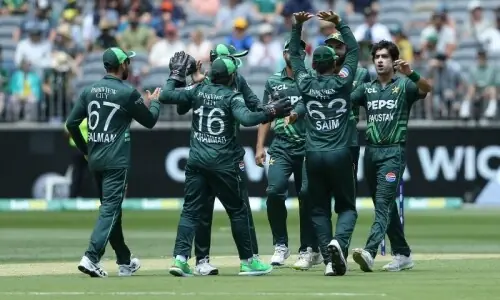
Pakistan’s experience at the World Cup has been a devastatingly demoralising one: defeat by West Indies in the first match; humiliation by Ireland in the second, which rendered our team the first to be knocked out of the tournament; shock over coach Bob Woolmer’s murder, and then more humiliation when our players were being finger-printed and DNA-ed like murder suspects. It is difficult to believe that no part of this drama has been deliberately engineered.
It is encouraging that the International Cricket Council (ICC) has declared that it would investigate whether match-fixing was a motive for the murder of Mr Woolmer. But it is hoped that investigations will be fair and above-board, and do not simply degenerate into a smear campaign against Pakistani cricket, in particular, and Pakistan, in general.
Whoever is responsible for Mr Woolmer’s grisly death has managed to deflect the focus of attention at the World Cup from the more important issue of match-fixing to the issue of who committed the terrible act on Woolmer and why.
Countless speculations have surfaced regarding why Woolmer was murdered, including possible match-fixing in Pakistan’s first match with the West Indies, but strangely little has been voiced about possible match-fixing in the more crucial match with inexperienced Ireland, in which Pakistan’s loss made it the first country to be knocked out of the tournament.
After all, Mr Woolmer was murdered immediately after the Pakistan-Ireland match, and before the match, he was reported to have complained about the grassy pitch of the venue being unfavourable to his team.
Deliberate under-performance by players may be the most common but not the only known way to fix a match. The landmark 2001 ICC Report on Corruption in International Cricket also mentions the practice of preparing pitches to assist a team and ensure a particular result for betting purposes. In such a case, any other official apart from the players can be responsible.
Despite efforts, locally and internationally, to crack down on match-fixing and gambling in cricket at the turn of the century, we are still unable to clear the air regarding one important previous match — the 1999 World Cup final between Pakistan and Australia — in which the Pakistani team lost the match to Australia by eight wickets.
A month after the then President of Pakistan and patron of the Pakistan Cricket Board had dramatically suspended the PCB constitution and its management in July 1999 on the allegation by the then Ehtesab Bureau that match-fixing was responsible for Pakistan’s loss in the final of the World Cup to Australia.
Strangely, the 1999 World Cup final match was never inquired into, not by the 1998-1999 Justice Malik Mohammad Qayyum Commission and the 2001-2002 Justice Karamat Nazir Bhandari Commission, both of which were appointed to probe into match- fixing by Pakistani players, nor by the ICC.
The 2001 Justice Qayyum report was a landmark judgment for cricket discipline, it having found a former captain guilty of match-fixing in several matches and implicated seven other players, but inquiry into the World Cup 1999 final was off-limits to the commission.
According to the Justice Qayyum report: “It is of great regret that the commission was prevented from inquiring into the World Cup through notification dated 18 August 1999 after having initially been given the green light through a notification on 16 August 1999. Questions about the team’s performance in the final and against Bangladesh still linger and looking into that matter would have only helped clear up the air.”
After the submission of the report, however, another one-man commission of Justice Bhandari was appointed to probe into Pakistan’s performance at the 1999 World Cup. But instead of looking into the final match in which match-fixing was originally alleged, the commission only inquired into two less important matches — the Group Stage match between Pakistan and Bangladesh in which the latter won by 62 runs, and the Super Six match between Pakistan and India in which India won by 47 runs.
Justice Bhandari report cleared the Pakistani team of match- fixing and betting, concluding that no evidence were found in the two matches. That the Bhandari commission failed to even mention the 1999 World Cup final in its report let alone investigate it, particularly since it was the government who had alleged match- fixing in that match, only raised more questions than clear the air.
The ICC also, in its 2001 Report on Corruption in International Cricket, only referred to possible match-fixing in the Pakistan-Bangladesh match and did not mention anything about the final match between Pakistan and Australia.
Since we lost the final in the 1999 World Cup and kicked up a fuss about match-fixing being responsible for our defeat, our team has not been able to move beyond the first round in the subsequent two World Cup tournaments in 2003 and 2007. Worse in 2007, we were the first team to be knocked out.
Ordinarily perhaps, we might have attributed this to fate. After all, as Justice Qayyum had reminded us in his report, the Pakistani team are not invincible; cricket is still a game of chance, the players are still human, and humans are fallible.
But when we know that betting and gambling on international cricket have been rife, and that, according to ICC report, one country at least has admitted that the sophisticated nature and monetary scale of betting there is linked to organised crime with clear signals of underworld mafia’s involvement, we cannot help but be suspicious of our fate in the World Cup 2007.
Whether or not the ICC inquiry into Woolmer’s murder and any match-fixing link is fair and above-board will perhaps be determined by whether all possible aspects of the case are covered in the investigation, including the Pakistan-Ireland match.
Meanwhile, we need to launch a high level inquiry of our own, and quickly too, to ascertain for ourselves the facts behind this tragic incident.
Beeline for Burnes Road
A colleague holidaying in the US writes that he has met two kinds of Karachiites. The grumbling kind only remembers Karachi for its shortcomings – power failure, water shortage, growing crime (as if other cities in the world, particularly the US are crime and corruption free).
You remind them about the services rendered by Abdus Sattar Edhi and his Foundation for the needy and they reply one swallow doesn’t make a summer. You remind them of the great work that SIUT, Layton Rahmatullah Benevolent Trust with its 14 eye hospitals all over Pakistan, The Citizens Foundation with its 300-plus schools for children from economically under-privileged families and the dozens of lesser known organisations are doing and the skeptics find faults with all of them.
The other kind of people, who are luckily more in number, look at the glass as half full. They pine for the city and its people. When scraping snow or washing their vehicles, removing dead leaves or having a burger (for want of time to prepare a proper meal) at lunch or dinner, they remember Karachi with nostalgia.
“What a luxury it was to live there. You could get help at affordable prices,” may well be their refrain. “There are grandparents to look after the kids. No baby sitter can shower the kids with so much love and care as nani and dadi or nana and dada do. The support system back home is worth its weight in gold,” is a comment one hears frequently. Back home one is not lonely when one falls ill.
Aqib Siddiqi, a physical therapist in Detroit, dreams of Karachi and the street cuisine it offers every night.
The day he lands in the city he spent his formative years in, he makes a beeline for Burnes Road – whatever the hour. He has no problem with traffic and insists his brother let him drive from the airport to home. For him, a trip to Karachi is alwaus a delight.
Road mishaps during rain
The recent rain saw more road mishaps than usual normal situation. The cause, many roads had long trenches and potholes. Though the downpour was unexpectedly heavy, warning had come several days in advance. At one place in F.B. Area, at least 10 big and small vehicles plunged in a one-kilometre-long trench along Block 14. A heavy crane was the first to fall. Several cars, vans and buses plunged one after the other at different sections of the road over the next hour. A motorcycle carrying three riders also plunged in.
The people present helped them out of the trench. The owners of the trapped vehicles had a tough task extracting them and had to seek help from labourers using ropes.
The vehicle-owners are not amused by the civic agencies performance. One such owner said whenever a political, religious or some other organisation holds a public gathering or congregation these civic agencies make elaborate arrangements for them. Unfortunately, when it comes to preventing mishaps and protecting citizens in emergencies, no civic agency plays an active role.
Hospital menu
Hospitals should provide care and peace to patients who come to it for treatment. A few weeks ago, I visited a large private hospital and was amused to see anyone could walk into the intensive care unit. I became an eye-witness to the fact while visiting an ailing relative; how was I permitted to go inside an intensive care unit? The hospital had no strict rules as every visitor was allowed to meet and talk to patients.
That is not all the poor quality of food served to serious patients is also questionable. The hospital management should explain why chickpeas (Channay key daal) is a regular meal for patients. This hospital also operates a medical college, so one wonders what our new generation of doctors is learning through these practices.
I even got VIP room of the paralysis ward. A big room with two rusted beds and chipped walls with big cracks. But wait the worst part was the deafening noise of traffic and the view behind the curtained window.
A peek behind the curtain revealed the window opened on the road, and one can hail a taxi directly from the room.
The staff were as bad. Nurses and the lower staff took a lifetime to attend patients calls, water bottles were provided every 24 hours and the hospital management favourite dish on the menu, (Chanay ki daal) served every second day. One wonders what doctors have to say about such meals for patients prescribed bed rest.
If this is how private hospitals with adequate resources function, one shudders to think how the government hospitals facing continuous funds shortage are faring.
— Karachian
| © DAWN Group of Newspapers, 2007 |