0
0

Hanging in the balance
THE fate of the Protection of Women Bill continues to hang in the balance. The bill was introduced by the government in the National Assembly more than two months ago to bring about amendments in the Hudood Ordinances. These were ostensibly designed to do away with the provisions which make women vulnerable to injustice of the worst kind. Any law which equates rape with adultery and allows the victim to be punished and provides an opening for the police to abuse the provision is a bad law and needs to be either repealed or amended. The bill has undergone drafting and redrafting a number of times and has been debated by a parliamentary select committee and another extra-parliamentary body of religious leaders in a bid to produce a consensus but to no avail. Last week, the women’s development minister had promised to have the bill adopted in the next session of the Assembly. Will the minister succeed this time remains a big question.
If the wrongs of the Hudood Ordinances — basically the product of the perverse thinking of a military dictator — are to be righted, the ideal measure would be to repeal them and restore the legal provisions for the punishment of rape under the PCC as they were before 1979. This, unfortunately, seems to be beyond the government’s capacity, given its political strategy of not provoking the religious parties. The MMA clerics have adopted such a rigid and unreasonable position on the bill that the government would find it difficult to win their support. It is plain that the debate on the Protection of Women Bill has a strong political dimension and its religious interpretation is being used by the MMA merely for its political ends and to promote its narrow-minded misogynism. It is intriguing why the government, whose head claims to be moderate and enlightened, does not go ahead with the revised draft that has the approval of the PPPP and the MQM as well. The backing of these parties would ensure the passage of the bill even if the MMA opposes it. It is, however, widely suspected in parliamentary circles that many members of the ruling party who are supporters of General Ziaul Haq are not in favour of the Hudood laws being softened in any way. This in itself does not explain the prevaricating approach of the government on the women’s bill when it is known to bring its members in line when voting for an issue it considers vital.
In spite of President Musharraf’s statements projecting himself as a champion of women’s rights, it seems his government does not consider this issue important enough to go ahead and pass this bill. For the time being he has managed to reassure his western backers that he is not such an anti-woman tyrant as the human rights activists have made him out to be. It seems he will let the matter rest there until the tyranny of the Hudood laws comes under the spotlight again. One only hopes that the ordinance of July 16 making the offences under the Hudood laws bailable will not be allowed to lapse on November 16, as it would in normal course. If the Protection of Women Bill fails to be adopted, the government would do well to revalidate the July ordinance.
No end to Baloch unrest
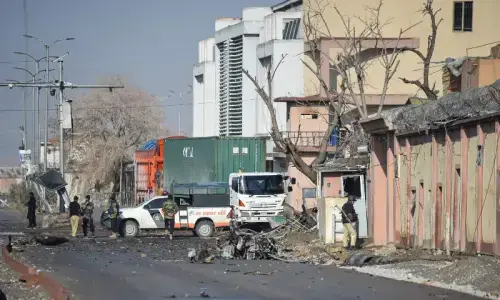
CONTINUING attacks on trains, gas pipelines and power transmission lines in Balochistan indicate that the situation in the province, far from returning to normal as claimed by the government, remains a source of worry. Clearly, Nawab Bugti’s death has not weakened the insurgency which is unlikely to abate so long as the Baloch people perceive themselves to be at the receiving end of the military’s highhandedness and the government’s unjust policies. There is realisation among policymakers that more needs to be done to redress the province’s economic and political grievances. The prime minister recently announced a Rs19.5 billion development package for Balochistan, earmarking Rs2.5 billion for the troubled districts of Kohlu and Dera Bugti. The federal job quota for the province has been raised to bring down the high rate of unemployment. Also, government functionaries have been indicating their willingness to hold talks to resolve all issues.
But, unfortunately, the damage to centre-province relations runs deep so that the government’s peace overtures seem to have cut no ice with the people. The latter continue to demand greater political autonomy and more equitable resource-sharing in addition to a solution to their social and economic problems. This means that the government cannot expect to tackle the insurgency first and then begin to fulfil its economic promises. The two tasks must be undertaken simultaneously. Politically, the government faces the task of ending the marginalisation of the Baloch people and absorbing them into the national mainstream. A first step towards this goal can be the return and resettlement of the uprooted who fled their homes during the army operation in Dera Bugti and Kohlu and who fear persecution on return. They want the government to guarantee their safety and take steps to rehabilitate them. The other issue is of the hundreds, possibly thousands, who have been picked up by intelligence agencies for interrogation and are being held incognito. This amounts to political persecution. Unless the missing ones are set free or produced before court to answer charges, the government’s claims of alleviating Baloch grievances will ring hollow.
It’s Tollinton Market again
LAHORE’S colonial-era Tollinton Market is back in the news, this time for being declared unfit to house a city museum by the relevant authorities. The rundown, original 1864 building was pulled down and rebuilt, opening its doors to the public only last January. In the preceding decades it had housed a meat, vegetable and grocery market. Better sense prevailed when the building fell into disrepair and had to be evacuated. The government wanted to build a parking plaza in its place but following public outcry it had to shelve the idea. Finally, after the restoration of the landmark building on The Mall, under public pressure, it was handed over to the Lahore Museum to establish a city museum there. Now, after the heavy monsoon downpour this past season, the museum authorities say the new Tollinton is unfit for housing artefacts for various reasons, the foremost being a leaking roof and seepage-spoiled walls. The Punjab government has already earmarked a sum of Rs150 million as seed money for a museum dedicated to the city’s past, but given the state of the building now, a much bigger amount may be required to first fix the structure and then set about establishing a museum there.
Tollinton Market is one of the old, city landmarks that have not been served well by the authorities concerned. For one, the Parks and Horticulture Authority (PHA) — that greedy outfit better known for cutting down trees than maintaining parks — had first grabbed the building with the aim of generating money by setting up artisans’ shops on the premises. No such nonsense should be entertained now that the museum authorities have declared the building unfit for housing artefacts; measures should be taken to swiftly remove the irritants. Also, at the very least, an inquiry should be initiated to examine the quality of construction undertaken at the behest of the PHA.
Higher growth is vulnerable
HIGH economic growth in Pakistan is more vulnerable than in China or India as it has few cushions or reserves to finance external shocks, says the World Bank.
Mr John Wall, World Bank country director in Pakistan for long was referring particularly to the trade deficit which aggravates external payments deficits and the sustained budget deficit which constrains the governments to opt for unpopular courses including printing of too much currency.
Talking during the presentation of a report “Can South Asia end poverty in a Generation?” Wall said though Pakistan had made major changes in the past fifteen years, investors trust has to be developed to enhance inflows of private direct investment and ultimately sustained growth.
Our external finances are truly vulnerable, that begins with the large gap between imports and exports primarily and now because of the high price of oil and larger commercial imports, external trade ended with a large deficit of $9.4 billion as Pakistan failed in its modest export target of $17 billion in the last fiscal year.
So for the current financial year, a modest exports target of $18.6 billion was set but after the first quarter ending September the increase in exports was only 2.9 per cent or $4.27 billion, resulting in a deficit of $3.15 billion.
Earlier, Prime Minister Shaukat Aziz and other officials had said that the top item in the heavy imports was machinery and the resulting industrial expansion would increase the exports, but the exports in the first quarter has increased by only 2.9 per cent. And the hardest hit industry is the textile where most of the imported machinery went in. But at a recent meeting of the All Pakistan Textile Mills Association it was said that if the state of the industry and exports continued like this a million spindles may close down by the end of the year.
That is an alarming prospect. The textile industry clearly needs a larger rescue package that has to be offered before more of our textile markets are lost to China, India and Bangladesh.
Earlier our foreign exchange reserve was 2-3 billion dollars and found less at times. Now the government feels proud it has a foreign exchange reserve of nearly 12 billion dollars. But the reserve is barely equivalent to six months imports and that is not much of a cushion. China has foreign exchange reserves of $987.9 billion with Hong Kong having $130.3 billion. Pakistan’s foreign exchange has come down to $11.3 billion, Pakistan’s adverse balance of trade is $12.6 billion and negative current account balance is $5 billion. This is not very comfortable for foreign investors with large and long term investments in mind.
When it comes to budgetary balance, it is not that the finance minister cannot raise larger revenues or that the areas from where such taxes can come are not within reach. But for political reasons the government does not want to tax large farm incomes or more appropriately the feudal lords who run the country do not want to tax themselves. Instead they seek to give themselves larger support prices for agricultural products, heavier subsidies on their inputs and spend higher amounts on water courses and dams.
Hence the government is not able to raise the additional 5-6 per cent revenues which it could normally raise, says Mr. Wall.
The government has also exempted from tax the large real estate transactions which are now incredibly profitable, and is not taxing large profits made through the stock exchange with its ever rising index of share prices as the large capital gains taxes are exempted from income tax.
So Shekhar Shah, chief economist from Delhi who wrote the World Bank report said that despite the sizable economic growth, South Asia was 30-40 years well behind East Asia. East Asia experienced high economic growth on account of high foreign direct investment inflows, while South Asian economists depended mainly on remittances.
It is the rising home remittances of Pakistan after 9/11 which have saved it from external financial disruption. They have risen from under one million dollars before 9/11 to over nine billion dollars last fiscal year and have further risen by 23 per cent in the first quarter of the new fiscal year over the same quarter last year. As the Hawala money transfers are restrained by the rest, more and more money is coming home to Asian countries particularly from Muslims overseas. At home the remittances have both a positive and a negative side when they are used for speculation and unfair economic practices.
In such circumstances, Pakistan has to be content with less than a four per cent increase in tax revenues annually. And it cannot cover the budgetary deficit and other basic needs with that modest increase.
The handicaps of Pakistan are many in the economic field. To begin with it has a large population of 160 million people, relative to its size which includes the mountains of Balochistan and the Frontier and the deserts of Sindh and the Punjab which are not ordinarily cultivable. And its water supply per capita has become too low compared to what it was two decades ago. And the water is misused by large farmers, while small farmers get too little of that.
The output of wheat is not too steady and it has to be imported from time to time to meet the needs of the rising population. Hoarders and profiteers create artificial shortages and exploit the situation.
The country depends on heavy import of POL to run its economy and it needs vegetable oil for cooking food and imports farm oil for $600 million a year. Other subsidy food item it imports includes milk, tea, pulses, meat, vegetables, etc. Now the import of milk powder has been stopped as its price has risen by $200 a tonne, $2400 for Indian milk and $2900 for milk from Europe.
President Musharraf insists that we are the 6th milk producing country in the world. But where is all that milk going when the poor and the low income groups cannot afford it? Fewer people will drink milk now as the prices of milk have shot up abruptly. The Basmati rice is said to be the best in the world, but sometimes one country or another stops its import. Mexico did that recently and Iran had done that now which will cost us $80 million now.
Our fish export is small compared to the vast possibilities but it gets banned by one country or another and too often by the European community for the lack of hygienic conditions at the Karachi Sindh Harbour. When it comes to our industry, except textiles, it depends on imports excessively. It depends on imports for the machinery, oil and the power produced using imported oil. The chemicals are imported, so are many of the raw materials and packaging materials which inflate the import bill a great deal.
While the textiles are our principle exports constituting 66 per cent, we have been trying to produce clean cotton, pest free and dust free cotton, all these years with only partial success and now with the production of cotton we may have to import one million bales of cotton plus one million bales of fine cotton to produce better textiles.
Our serious failure is not in producing the textile machinery our large industry needs in spite of having over 300 textile mills and. And we depend on imports which are costly or which are smuggled from India directly or through third countries like Singapore and Dubai.
We produce only a part of the steel we need, we import the rest and price it high to protect our steel mills and yet we have not been able to raise the production of the steel mills to three million tones from its one million tones. We import the iron ore and the coal needed by the steel mills. All that inflates the import bill. For all the investment we have made on our industries, our exportable surplus is small.
Mr Wall spoke of the inadequate infrastructure hampering the economic growth and the fiscal space of under 4 per cent revenue increase as too little to cover this deficiency.
When it comes to infrastructure, it is not only a problem of finding the money to invest in it, but also making a totally productive use of it and being able to get the best results out of that instead of neglecting that. If the infrastructure in the cities is not taken care of, in the rural areas it is bound to be neglected further. The question is how to prevent such rot setting in all round.
The prime minister now wants Pakistan to be the corridor for trade and energy for Central Asia and West China and for the entire region. He also wants Pakistan to be the hub globally for gems trade and jewellry making. All this would take tremendous investment even by foreign countries which would want proper political conditions to begin with.
Mr Shekhar Shah says that deprivation in South Asia is too much if the income of a family is raised to two dollars a day or even ten dollars it may take a long time for absolute poverty to be eliminated. For that purpose, education and public health systems have to be taken care of while the sanitary conditions have to be improved a great deal. The people have to be given safe drinking water and the environmental degradation has to be checked. We need a composite approach to poverty, not an elementary one.
In this context the results of the first education census in Pakistan as disclosed by the information minister Javed Ashraf Qazi are interesting or upsetting. Out of two lakh forty five thousand six eighty two public and private schools in the country surveyed, 12737 were ghost schools. Out of them a majority of 7542 are in Sindh. Who has been profiting by the proliferation of such schools, not the ghosts but the real politicians, local feudal lords and officials who collude with them helplessly or profitably for themselves?