0
0

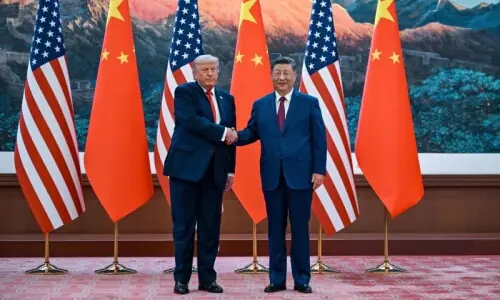
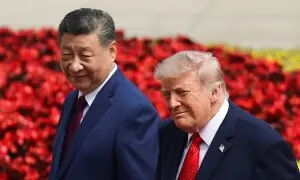
Is the communist pulse still beating?

IT was Daniel Cohn-Bendit, the French communist leader of the failed student uprising in 1968, who despairingly proclaimed: “God is dead, Marx is dead and I am not feeling too well myself.” Now the Council of Europe has raised doubts over the truth of the pithy epitaph. Otherwise the last rites of communism were probably presciently observed a good two decades before the fall of the mighty Soviet Union.
So, is communism still a threat to the larger world order? There must be reasonable and palpable provocations that even today the powerful conglomeration of traditionally capitalist countries of West Europe and the former communist countries of East Europe, is pondering a fresh condemnation of the “crimes of communist regimes” the world over. The Council of Europe is in fact being urged to consider these alleged crimes at par with the retribution meted out to the Nazis by the Allies.
Clearly, the spectre of communism that Marx and Engels spoke of does not seem to have lifted completely from Europe’s obsession with the ideology never mind the landmark Western successes in the dismantling of the Soviet Union bit by bit and the eventual co-option of its former communist satellites. Indian communist parties are feeling so miffed by Europe’s move to target communism anew that they are planning major protests to register their anger. Similar protests are being reportedly planned by communist parties elsewhere in different countries.
Interestingly the proposed condemnation and the shaping global witch-hunt of communists do not seem to have taken any serious note of the Indian comrades. And thereby hangs a tale. Perhaps Indian communists are so badly divided among themselves that they do not appear to even figure in the calculations of the new anti-communist assault.
This may be because there are the ‘good communists’ in India who play footsy with one or the other ruling party and there are the ‘bad communists’, also called Naxalites, who are actually fighting the ruling classes with guns, bombs and landmines but who also include the ‘collaborating communists’, another name for the ‘good communists’, among their class enemies.
Ironically it is the ‘good communists’ who are leading the charge against the Council of Europe. But what are they up to at home? The Communist Party of India (Marxist, CPI-M) which has ruled West Bengal for three decades together with smaller leftist allies was once so inimical to the Congress Party that it joined hands with the Hindu right to bring down Mrs Indira Gandhi’s rule. Conversely, the smaller group, the Communist Party of India, once a pro-Soviet ideologue, was so enamoured of the Mrs Gandhi, as probably tutored by Moscow, that they even supported her Emergency dictatorship of 1975-77.
Now the boot seems to be on the other foot. The CPI-M is supporting the Congress in key elections in Bihar and the CPI is opposing this alliance tooth and nail, with the result that the secular votes look set to be divided. That this would benefit the rightwing BJP seems not to bother either of the two communist parties. Given this state of affairs, it should be hardly surprising that they are not considered to be a problem for the global order to worry too much about.
Yet the CPI-M is riled. “It seems that the ruling classes of Europe are yet to rid themselves of the feverish malady of experiencing a spectre of communism”, it proclaimed last week. Goran Lindblad, a member of the Swedish Parliament, is also the Special Rapporteur to the Council of Europe on the “Need for international condemnation of crimes of communism.” His speech recently to a friendly audience contained ideas on what may be expected ahead. Pleading his case, Mr Lindblad observed with regret that so far, neither the Council of Europe nor any other international intergovernmental organisation had undertaken the task of “general evaluation of communist rules, serious discussion on the crimes committed in their name, and their public condemnation.”
Bringing in the idea of terrorism to go with the new evaluation of communism, Mr. Linblad complained that “there has been no serious, in-depth debate on the ideology which was, and is, at the root of widespread terror, massive human rights violations, death of many millions of individuals, and the plight of whole nations.
“Whereas another totalitarian regime of the XXth century, namely Nazism, has been investigated, internationally condemned and the perpetrators have been brought to trial, similar crimes committed in the name of communism have neither been investigated nor received any international condemnation.”
The absence of international condemnation may be partly explained by the existence of countries whose rule is still based on communist ideology, Mr Linblad observed. “The wish to maintain good relations with some of them may prevent certain politicians from dealing with this difficult subject.”
The facts to be placed before the Council of Europe, when it takes up the issue of communism in the first week of October, are stark. Communist rule lasted over 80 years in the country in which it first came into being, namely in Russia then renamed the Soviet Union. In other European countries it was about 45 years. Outside Europe, communist parties have been ruling for more than 50 years in China, North Korea and Vietnam, more than 40 years in Cuba, and 30 years in Laos. Communists reigned for some time in different African, Asian and South American countries under the then Soviet influence.
More than 20 countries on four continents may qualify as communist or under communist rule over some period of time,” according to the European view. Besides the Soviet Union and its six European satellites, the list includes Afghanistan, Albania, Angola, Benin, Kampuchea, China, Congo, Cuba, Ethiopia, North Korea, Laos, Mongolia, Mozambique, Vietnam, S. Yemen, and Yugoslavia.
For whatever reasons the Indian communists are not listed for censure. Does it indicate all is well with the Indian communist movement? Or are they not found deserving enough, at least in capitalist Europe, to be taken as a serious threat?
*****
Tailpiece: The foreign ministers of India, China and Russia, Messrs Natwar Singh, Li Zhaoxing and Sergei Lvavrov, who met in New York last week, appear to have made progress on the key issue of energy cooperation. The three agreed to convene a Round Table Conference of North and Central Asian Oil Supplies and Principal Buyers in New Delhi on 25th November and confirmed that their Ministers in charge of Oil and Natural Gas would participate. They feel such a forum would provide an opportunity to explore cooperation in a vital sector both on a trilateral basis as well as in the larger region of Central and North Asia. They are also expected to take stock of the evolving situation on the Iran-US standoff.
jawednaqvi@gmail.com
Wrong response
 A religious scholar once told a friend that two types of listeners spoil the effect of a sermon. “Those who understand everything being said in the sermon but choose to remain quiet and expressionless and those who do not understand a word and yet chant slogans mindlessly,” he said.
The words of the scholar came back the other day at a function organized by the Pakistan Council of Scientific and Industrial Research to launch a new type of wheat flour specially prepared for diabetes patients.
When a speaker said that a quarter of drugs sold at a pharmacy were bought by diabetes patients, the audience cheered and clapped.
When the chief guest, Federal Minister for Science and Technology Nauraiz Shakoor, arrived late for the function, the PCSIR chairman welcomed him and said: “Sir, you are most welcome here. We started the function without you because you were sleeping in your room upstairs.” The audience clapped enthusiastically as the federal minister grinned sheepishly.
Mr Shakoor said science and technology in Pakistan had been a success story. Unable to come up with concrete examples to shore up his assertion, he said: “Missiles and atomic bombs made by us are our success stories.” The audience clapped again.
No interest in planetarium
Many had spiritedly protested against the government decision to wind up the PIA planetarium located on University Road. But one was in for a rude shock during a visit to the facility the other day.
The plea taken by public-spirited citizens and non-governmental organizations against the government decision was that the closure of such an interesting educational facility would be a great loss of Karachians.
However, few citizens apparently go to the planetarium. On the day of the visit, planetarium staff said there would be no show on the designated time because fewer than 20 tickets had been sold. They asked visitors to wait until a couple of more astronomy enthusiasts came along. But in a population of 15 million people, not more than 20 people were interested in the highly informative show of the planetarium that evening.
As everyone waited, the planetarium had a power cut. Explaining that they had no generator or alternative power supply arrangements, the staff refused to start the show on the heaven-sent (or KESC-sent) pretext. When asked what they did when they had a power cut in the middle of a show, they said that tickets were returned to visitors who were asked to come again within a month.
Perhaps one reason why the planetarium has failed to click in Karachi is that the management running it has not launched new shows for the past 25 years. It has not properly marketed the planetarium either.
PIA imported equipment for five planetariums in the early 1980s and constructed two facilities – one in Karachi and the other in Lahore. The equipment of the rest of the three planetariums has reportedly been gathering dust in PIA warehouses for a quarter of a century. A building for a planetarium is ready in Peshawar, but perhaps PIA is not interested in installing equipment there. Seeing the disinterested response of the people of Karachi, PIA can hardly be blamed.
Promise unfulfilled
The family of a police constable designated a “Shaheed” by the government following the 1971 fall of Dhaka still awaits the promised compensation.
Constable Lal Khan Ghauri, who was based in Sanghar district, was deputed to the erstwhile East Pakistan in 1971 and died in action. The government promised to give the bereaved family Rs15,000 and a 17-acre plot in 1975.
Constable Ghauri left a widow, five sons and four daughters. His children recently told a colleague that their mother did her utmost to get the compensation but to no avail. She died in 1990.
Rain or shine
Vacationing in the foothills of the Himalayas, a colleague received a pre-dawn phone call from a friend informing him that heavy rains were lashing Karachi. Miffed at being disturbed at an ungodly hour, the colleague asked his friend what was so unusual about the rains in September. September was a monsoon month and often saw rains, he argued.
“But you wrote in a recent news story that there would be no monsoon rains this season. And you quoted none other than the director-general of the Pakistan Meteorological Department as saying that. You think he got it wrong?” the friend wondered.
Apparently, the Met Office director-general did get it wrong. But, then, there is nothing unusual about weather forecasts being off the mark. Few people, for instance, venture out with umbrellas the day the Met Office says the city will receive torrential rains.
There is perhaps nothing unusual about the Met Office being unaware of seismological happenings either. The other day a couple of residents of coastal areas called to say that their localities had been shaken by mild tremors. But the Met Office announced that it had recorded no earthquake that day. Period.
WSF in Karachi
The World Social Forum has come to Karachi. In January next year, it will hold a six-day annual conference at the Expo Centre where more than a 100,000 delegates are expected to turn up.
The theme of the upcoming WSF meeting is “Another world is possible”. At an introductory meeting, WSF activists gave their views about the type of annual conference WSF should have.
A map of the world formed the backdrop of the meeting. Curiously enough, the map was coloured yellow. (Old-time communists wondered why it wasn’t red.) In any case, WSF activists are determined to tell the world about the ruinous effect of neo-conservative policies being currently pursued by the United States.
— By Karachian
email: karachi_notebook@hotmail.com
Strengthening the ‘secular platform’
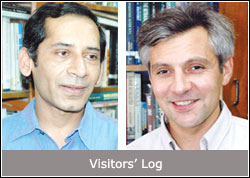 FRENCH and Indian peace activists believe that the World Social Forum (WSF) gathering in Karachi from Jan 24 to 29 in Karachi will not only be a great opportunity for dismantling the negative image of Pakistan created by the western media but will also strengthen the pro-democracy secular platform of civil society.
Two of those actively associated with the forthcoming event, Yeves Altazin, director of the Paris-based Freres des hommes (Brotherhood of Mankind), and Harish Kapoor, of the World Social Forum were in Karachi recently on their first visit to Pakistan and were “pleasantly surprised” to see for themselves that much of what was portrayed by media abroad about Pakistan was contrary to the situation on the ground.
Freres des hommes has long been cooperating with the Pakistan Institute for Labour Education and Research (PILER) and also the Fisherfolk Forum.
It is trying to help attract people from across the world to come to Karachi in large numbers. This time the world event will be simultaneously held in Asia, Africa and the Americas, creating an alternative paradigm and advocating that a new world is possible. The choice of Karachi as the venue for the polycentric WSF 2006 will provide Pakistan space to dismantle the image of the city as a bastion of extremists and terrorists. It will help to portray a more positive and forward-looking image.
“It’s a great occasion for me to discover that different people who are present in civil society here are not what we in France have usually in mind because the media has built only one image of Pakistan. The image that the western media has portrayed is that Pakistan is a religious, extremist society and there is no place to understand what is going on really,” said Altazin, who was pleasantly surprised to notice that there are plenty of people who were open to discussion, to share, who wanted to belong to a large movement of the people, and wanted to liberalize”.
The French peace activist said the WSF was an open meeting place for reflective thinking, democratic debate on ideas, formulation of proposals, free exchange of experiences and interlinking for effective action by groups and movements that were opposed to neo-liberalism and to domination of the world by capital and any form of imperialism, and were committed to building a world order centered on the individual.
“What we are trying to do is to push people and encourage them to come to Karachi and engage with different shades of civil society and NGOs,” said Yeves and Kapoor, both of whom emphasized the need for putting in more effort. “That is very important for the image of Pakistan.”
When their attention was invited to the existence of elements that contributed to extremism and terrorism in our societies and they were asked how issues concerning the common people could be addressed, they felt that there was some level of hope at every level of society. Very obviously a large number of extremist organizations had existed since long and it was the job of the various segments of civil society to strengthen the more secular platforms. “It is so crucial and important for the people who are genuinely working for the welfare of mankind and it is our job to strengthen the space for them.”
When it was pointed out that the element of religion in the politics of the regions was in fact deliberately injected by the West in its bid to contain communism during the Cold War period, they said: “This is where our role is important.” There is a role for civil society actors in Europe and America to check such disastrous policies of the western countries, which funded and supported these kinds of forces.”
They felt that religious extremism could also be due to lack of democracy. Therefore, “strengthening of democratic forces, both here and there, is very necessary because policy decisions are not freely decided even by the French or the American people.”
The need for creating a proactive platform against militarization was also emphasized together with the need for providing new space for communication. Civil society in both Pakistan and India could play a important role in strengthening and enlarging the constituency for diverting resources to the social sector instead of spending more on weapons. — Shamim-ur-Rahman
The woes of buying a car
THERE is no end to the exploitation of car-buying consumers here. For several years now, buyers of locally assembled cars have had to put up with a series of tactics by car manufacturers and dealers aimed at extracting more money from them than the stated price of the car.
These tactics include: full payment requirement at the time of booking even though the car is delivered months later, sometimes even as late as nine months to a year later; payment in full of any differential in the (likely) event of price increase by the manufacturer at the time of delivery, even for existing models without enhanced specifications; and payment of “premium” (or “on”) for instant or immediate delivery, which can amount to an extra Rs35,000 to Rs200,000 in addition to the stated price of the car depending on the make and model.
Recently, banks and leasing companies have also joined in this exploitation spree by increasing the interest rate or mark- up on car loans for their existing clients.
Thus, consumers who had earlier taken out car loans at a lower interest rate now find they have to pay up to an additional four per cent mark-up midway in the lease contract. Those who got car loans at the initial rate of 7 or 7.5 per cent now have to pay 11 per cent interest, while those who got loans at 10 or 11 per cent earlier now have to pay up to 15 per cent interest. Who knows when and how much more will the mark-up increase again in future.
So between the car manufacturers/dealers and the banks/leasing companies, consumers are ending up paying practically double the price of what they were actually supposed to have paid for their car, what with having to pay for premiums, differentials and increased interest rates!
Such tactics by car manufacturers/dealers and banks/leasing companies would have been considered unethical, unjust and unfair in many other countries. Just business ethics demand that only token advance be made upon booking of the car, and full payment be made only upon delivery of the car and not months in advance as it is the practice here.
Just business ethics also demand that if payment is already made in full in advance, no further payment due to rise in price should be made when the car is delivered. Similarly, fair business ethics dictate that any increase in the interest rate for loans should be applied only on new loan seekers and not on existing lessees/clients.
Amazingly, these unfair business practices are being carried out here in full swing without any shame on the part of those involved nor any control by the relevant authorities, viz., the ministry of industries and production, the Monopoly Control Authority, and the State Bank of Pakistan.
The government has off and on been saying that it would look into the high car prices, the long delivery period and the ever increasing premiums. (According to one economic study, car premiums totalled Rs10 billion in 2004, amounting to 20 per cent of the Rs50 billion domestic auto industry.)
In December last year for instance, the federal minister of industries and production promised to eliminate the car premium in two months. Accordingly in January this year, the State Bank of Pakistan prohibited banks and leasing institutions from financing car premiums, i.e., the amount which is over and above the stated factory price of the car. Lately, the government has also reduced the duties on the import of certain cars, in the apparent effort to give a little competition to locally assembled cars.
Yet, nothing much has changed. Car premiums are still there and the amount is ever increasing. Car prices are ever rising. Delivery periods of locally assembled cars are as long as ever. And now the mark-up has increased on existing car loans as well. The consumers’ woes do not end here.
Consumers have no choice but to accept the car eventually delivered to them even if it has defects because they have already made full payment for it months in advance. And locally manufactured cars usually have many defects.
A letter-to-the-editor in Dawn on September 1, 2005 detailed the defects which the writer found in his newly delivered car. The vehicle had a constant knocking sound coming from somewhere near the back seat. Whenever it was on CNG, the car would stall whenever it was stationary, e.g., at the traffic signal. Whenever the airconditioner was switched on, the load on the engine, as reflected in the “revving” sound, increased extraordinarily. The floor in front of the front passenger seat was constantly wet because water was leaking from the air- conditioner.
Other complaints which have appeared about the quality of locally assembled cars include loose and damaged rubber sealants on the doors, defective rubber mounts on the windshield, broken sunvisor and defective moulding below the dashboard.
Poor quality is a relatively minor problem compared to what nearly happened with one consumer. A letter-to-the-editor in Dawn on April 7, 2005 had pointed out a fraud which one bank at least had tried to do with unsuspecting clients seeking loans to buy their dream car. Upon close inspection of the lease agreement offered by the bank (not named) which was duly cleared by its legal department, the writer found that there was no provision of transfer of the car in the name of the lessee by the bank after the expiry of the lease term or payment of the lease amount as per the laid-down schedule. In fact, the writer said, the agreement contemplated that upon expiry of the lease agreement, the lessee would return the car to the bank which would refund the security deposit.
So, not only would the consumer have paid much more beyond the stated factory price for a car that was not in tip-top condition when delivered, he might eventually end up being “car- less” upon expiry of the lease term if he did not bother to read closely the terms and conditions of the car leasing agreement which he had signed!
Compounding the woes of the consumer is the lack of an effective complaint redressal system which he can approach to seek protection. There does not exist any legal and administrative framework where consumer complaints can be effectively redressed. The Monopoly Control Authority itself admits it lacks the legal powers and institutional capacity to tackle influential industrialists who are making huge profits by exploiting hapless consumers.
Unless the government moves considerably beyond mere lip service by adopting a real, more pro-consumer angle to its policies, particularly where the automobile market is concerned, car buyers cannot hope to get a fairer deal.
| © DAWN Group of Newspapers, 2005 |