0
0

61,000 dead
THIS is official. Neither an outlandish claim by some Kashmiri freedom group, nor a disclosure by a human rights agency, it is coming from the horse’s mouth. Speaking in Indian parliament during the debate on the Prevention of Terrorism Ordinance, L.K. Advani said 61,000 people, including security personnel, had been killed in the “proxy war” with Pakistan during the last 15 years. The Indian home minister did not give the exact number of civilians and Indian security personnel killed, but claimed that more Indian soldiers had been killed in this “proxy war” than during the (1965 and 1971) wars. Of course, no government gives exact figures for its military casualties. But that is hardly the point. In the larger picture, any neutral mind would, then, tend to ask what made no less than 61,000 people die in so small an area as the Srinagar valley.
Kashmiris have been up in arms for the last 15 years. They have revolted after decades of patience, because India showed no signs of granting them even a modicum of freedom or giving any indication that it intended to solve the problem by recourse to dialogue with Pakistan and with the representatives of the people of Kashmir. Instead, it has relied on brute force and an army of occupation that even by neutral estimates is in excess of half a million. Over the last one and a half decades, this army of occupation has been responsible for crass human rights violations. These have included torture, the wholesale burning of villages, the rape of hundreds of Kashmiri women, summary executions and “disappearances” numbering in thousands. It also goes without saying that casualties have also been caused by over-zealous mujahideen who sometimes targeted civilians opposed to them. All these human rights violations have been noted not only by other governments and world rights agencies but by India’s own HR groups.
To international HR groups’ criticism India’s only answer is to blame Pakistan and allege that the violence in Kashmir is the result of Islamabad’s alleged support to “terrorists” across the border. While this has been the standard Indian answer, the BJP government has gone one step ahead and repudiated the very concept of talks with Pakistan to solve the Kashmir issue. Last December the BJP-led government upped the ante by massing troops along Pakistan’s border, snapping rail, road and air links and making demands on Islamabad for the return of suspects involved in the terrorist attack on the Indian parliament building.
Pakistan’s stand has been fair: let us talk, it says, with a view to solving all Indo-Pakistan problems, including Kashmir. It is now for India itself to realize what kind of image it is creating for itself by slamming the door on negotiations. Is it the image of a responsible UN member that believes in good-neighbourly relations and principles of co-existence, or is it the image of a country that is aware of the preponderance of its armed might and is, thus, determined to perpetuate the kind of situation that has resulted in the death of 61,000 people over the last 15 years?
Cricket: India back-tracking?
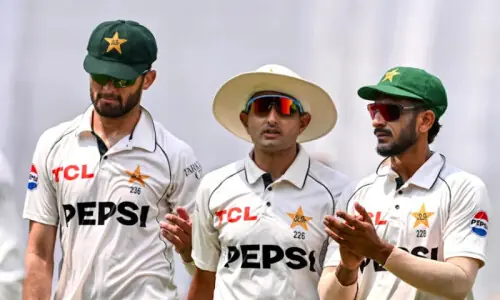
IT is understandable why the Pakistan Cricket Board has reacted cautiously to India’s reported readiness to discuss resumption of cricketing ties between the two countries during the forthcoming SAF Games meeting in Islamabad. As the chairman of the PCB observed, this was the first “positive signal from across the border” yet to be officially confirmed. New Delhi has to take a decision as the ball has been in its court since April-May 2000, when the two sides met in the Asian one-day tournament in Dhaka. But India pulled out of its first formal Test tour the same year with the result that the twelve-year ‘freeze’ continues. If the latest bilateral contact fails to break the deadlock the International Cricket Council’s ten-year plan under which India has to visit Pakistan next year might also be disturbed. These doubts and misgivings are rooted in the undulating and uncertain pattern of sporting contacts — rather ‘non-contacts’ — during the last decade. Now that the Indian Olympic Committee president, who has also been a federal minister, quotes Uma Bharti, a hard-liner, for initiating a dialogue to resume “normal sporting ties including cricket”, the chances of a pathbreaking departure from the frustrating past developments cannot be ruled out.
Pakistan’s approach in this context has been clear and positive. Not only the PCB Chief but the President of Pakistan repeatedly offered to play cricket with India anywhere. They have emphatically asserted that sports and politics should not be mixed up. But, unfortunately, the other side has officially stuck to a negative stance over the years. In between, however, some puzzling interludes defied the logic of their attitude. Only last month, the BCCI president said that India would not play New Zealand in November if it refused to tour Pakistan in April-May. His remark to follow up this threat is very significant. We quote “The Indian Board is an independent body and we will support the decisions and resolutions passed at the Asian Cricket Council meeting in Sharjah. We have no problems with our government if we refuse to play New Zealand since it is the BCCI which decides whom it hosts.” Now he says, “If the government takes a decision not to allow the board to play against another country, it should be treated as a force majeure ...” Strange contradiction indeed!.
Consumer rights
INTERNATIONAL Consumer Rights Day has once again gone by without any significant advancement in the consumers’ awareness about their rights. We are nowhere nearer to establishing, let alone protecting and enforcing, the basic rights of consumers as accepted internationally, viz., the right to safety, to be informed, and to be heard. There exist two specific consumer protection acts, namely, the Islamabad Consumer Protection Act, 1995, and the North-West Frontier Province Consumer Protection Act 1997, but these have never been fully implemented. Public services are excluded from their jurisdiction, and the consumer has no right to compensation or damages.
Several other laws and regulations also exist which are related to the issues of consumer protection, but, as with the above two acts, all are seriously deficient from the consumer perspective. Not only do these fail to provide an efficient and inexpensive judicial process for the disposal of consumer complaints, they have also failed to create a deterrent impact on manufacturers, businesses and providers of goods and services. The result is that annually millions of consumers suffer because they get for their money impure food and water, drugs that have harmful side-effects and defective products and appliances.
In many countries, governments play a major role in consumer protection, not only in terms of enacting and implementing consumer laws against unfair and deceptive practices but also in developing and enforcing quality and safety standards, product testing and consumer education. The Pakistan people and government must learn from the kind of protection consumers get in developed countries. The voice of the consumer is not being heard and his needs are not being considered when government decisions affecting them are made, especially in the formulation of prices. What consumers here need perhaps is a Ralph Nader, the lawyer who led the consumer-protection movement in the United States in the 1960s and whose activism resu